
Explore photon antibunching: a quantum optics phenomenon revealing light’s quantum nature, its impact on quantum tech, and future implications.
Introduction to Photon Antibunching
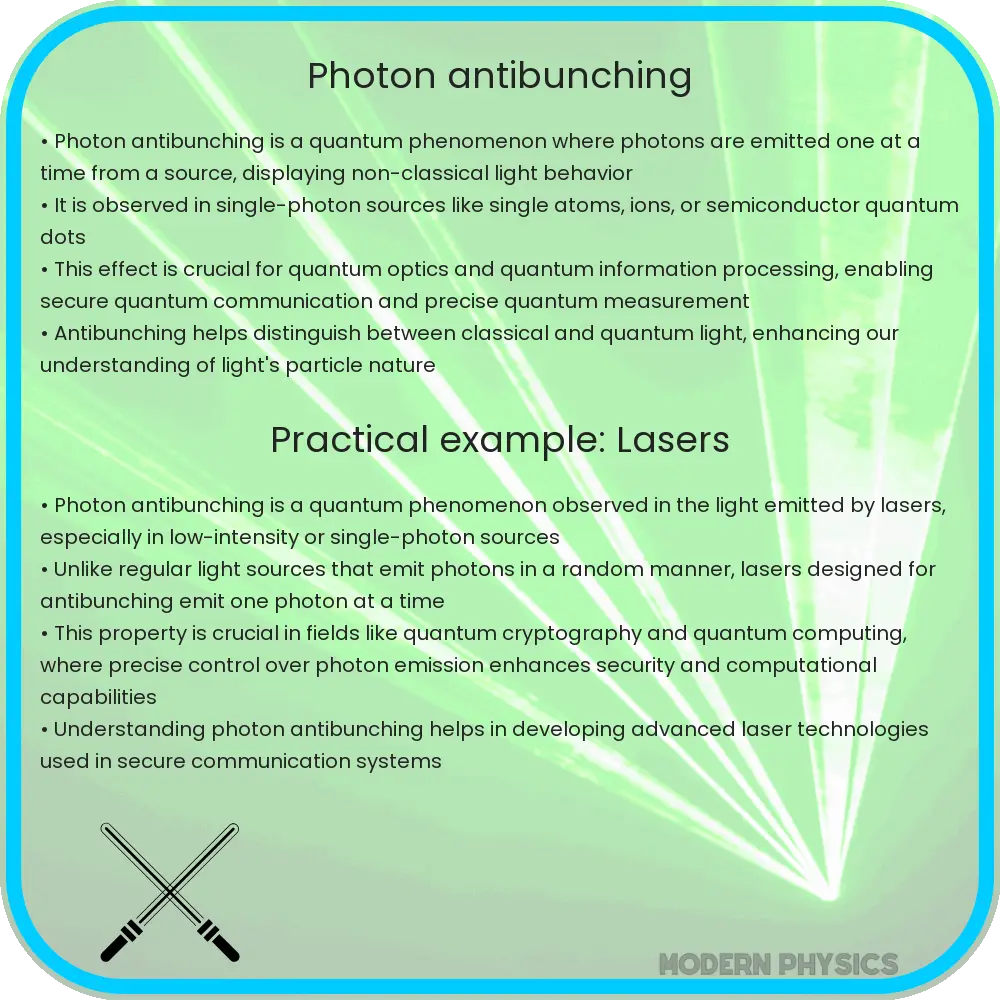
Photon antibunching is a fundamental phenomenon in quantum optics that showcases the quantum nature of light. Unlike classical light sources, which can emit photons in a continuous stream, quantum sources can exhibit behavior where photons are emitted one at a time. This concept is not only intriguing for its demonstration of the discrete nature of light but also for its implications in quantum communication and quantum computing.
Understanding Quantum Light
To appreciate photon antibunching, it’s crucial to understand the difference between classical and quantum light. Classical light, such as sunlight or that from a light bulb, can be described by Maxwell’s equations and behaves as a continuous wave. Quantum light, on the other hand, is described by quantum mechanics, emphasizing the particle-like properties of photons, the fundamental units of light.
The Principle of Antibunching
Photon antibunching refers to the phenomenon where photons are emitted in such a way that they do not arrive simultaneously but are “antibunched” – essentially arriving one after another. This behavior is observed in systems where the emission of one photon inhibits the immediate emission of another, a direct consequence of the quantum mechanical principle of Pauli’s exclusion principle for bosons under certain conditions.
Experimental Observation
The first observations of photon antibunching were made in experiments involving single atoms or molecules as light sources. By using a setup called a Hanbury Brown and Twiss (HBT) interferometer, researchers were able to detect the statistical distribution of arriving photons, clearly demonstrating the antibunching effect. This not only provided direct evidence of the quantum nature of light but also opened new avenues for research in quantum optics.
Applications and Implications
Photon antibunching has profound implications for fields such as quantum cryptography and quantum computing. In quantum cryptography, for example, the unique properties of antibunched photons can be used to ensure secure communication channels that are theoretically immune to eavesdropping. Similarly, in quantum computing, the controlled emission and detection of single photons can enable quantum information processing at unprecedented speeds and efficiencies.
Quantum Technology and Photon Antibunching
The practical applications of photon antibunching extend beyond theoretical interest and have begun to influence the development of cutting-edge technology. Quantum dots, for instance, are semiconductor devices that can emit single photons on demand, playing a crucial role in the realization of quantum networks. Additionally, the principles of antibunching are applied in the development of single-photon sources, which are essential for quantum communication and information processing tasks.
Challenges and Future Directions
Despite its promising applications, harnessing photon antibunching for practical quantum technology faces several challenges. High on this list is the need for efficient and reliable single-photon detectors, which are critical for observing antibunching phenomena. Moreover, creating and maintaining the conditions necessary for antibunching, such as low temperatures and precise control over the quantum systems, poses significant experimental and engineering challenges.
Photon Antibunching in Quantum Computing
In the realm of quantum computing, photon antibunching offers a pathway to realizing quantum bits (qubits) that are less prone to decoherence, a major stumbling block for scalable quantum computing. By encoding information in single photons and exploiting their antibunching properties, quantum computers can potentially operate with higher fidelity and at greater scales than currently possible.
Conclusion
Photon antibunching is a quintessential quantum phenomenon that underscores the particle-like behavior of light, challenging classical intuitions and enabling new technologies in the quantum realm. Its discovery and exploration have not only deepened our understanding of light but also paved the way for advancements in quantum communication, computing, and cryptography. As research continues to overcome the technical challenges associated with this phenomenon, the potential for photon antibunching to contribute to the development of revolutionary quantum technologies grows ever more promising. This intricate dance of photons, where quantum mechanics plays the lead, invites us to rethink the nature of light and its potential to drive the future of technological innovation.