
Perovskite catalysts are materials with a distinctive crystal structure used to catalyze chemical reactions in energy applications.
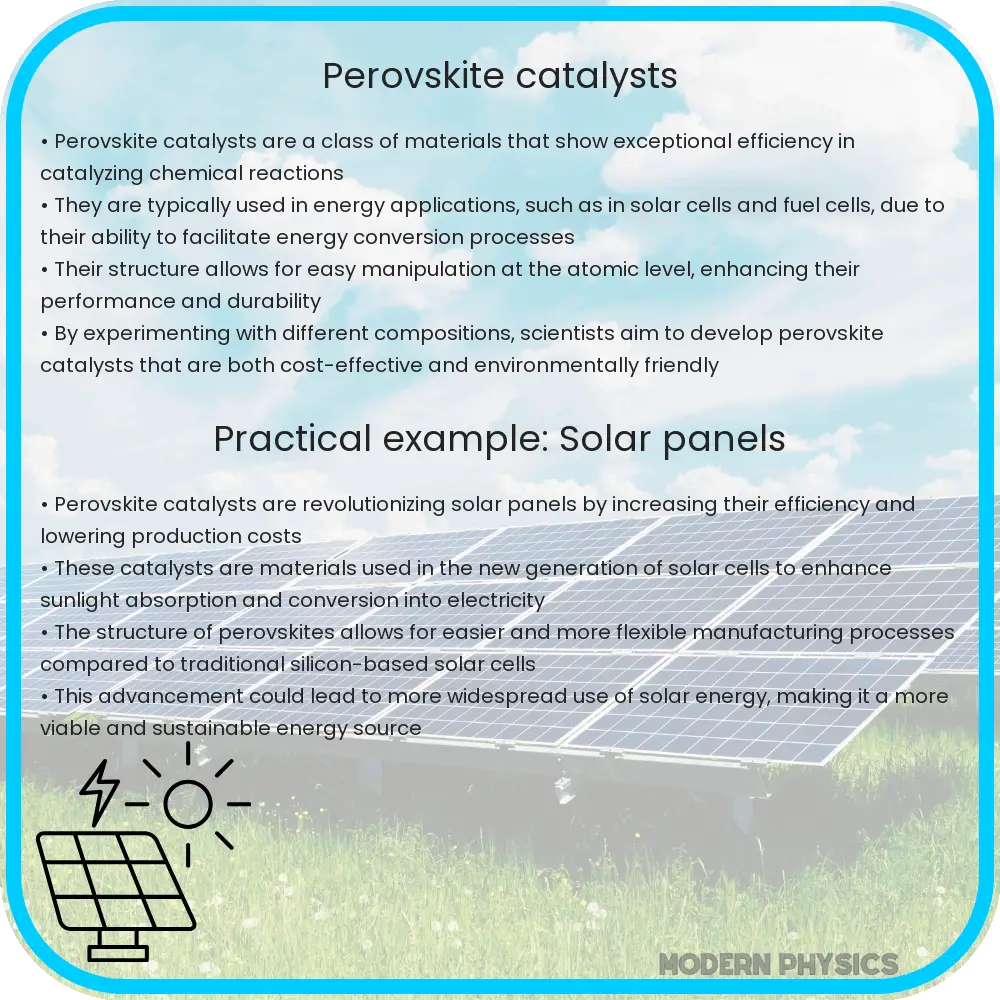
Understanding Perovskite Catalysts: Pioneering Efficiency and Stability in Energy Conversion
Perovskite catalysts, a group of materials with a distinctive crystal structure, are spearheading innovations in the field of energy conversion. Named after the mineral perovskite, which was discovered in the Ural Mountains of Russia and noted for its unique calcium titanium oxide composition (CaTiO3), these materials have been engineered to catalyze a variety of chemical reactions important in energy applications, from photovoltaics to sensors.
Efficiency of Perovskite Catalysts
One of the chief advantages of perovskite catalysts lies in their remarkable efficiency. These materials have demonstrated tremendous capability, particularly in the realm of solar energy conversion. Perovskites exhibit a high power conversion efficiency, which refers to the ability of the catalyst to convert sunlight into electrical energy. Recent developments have shown that certain perovskite compositions can achieve power conversion efficiencies exceeding 25%. This is rivaling, and in some cases surpassing, the performance of traditional silicon-based solar cells.
The efficiency of perovskites is partially due to their excellent light absorption characteristics and their ability to facilitate effective charge separation, reducing recombination losses. Engineers and scientists enhance the efficiency of these materials by tweaking their compositional and structural properties, such as modifying the organic and inorganic components or adjusting the material’s layer thickness.
Stability Challenges and Solutions for Perovskite Catalysts
Despite their high efficiency, perovskite catalysts historically suffered from stability issues, which have hindered their commercial viability. These materials are prone to degradation under environmental conditions—such as exposure to moisture, heat, and UV light—which reduces their operational lifespan and effectiveness.
To address these stability challenges, researchers have developed multiple strategies. These include the encapsulation of perovskite layers with stable, moisture-resistant materials, and the introduction of new chemical compositions that are inherently more stable. Innovations such as the implementation of 2D or quasi-2D perovskites, which layer perovskite materials alternately with organic cations, have shown significantly enhanced stability while maintaining high efficiency levels.
Chemical doping is another effective approach to enhance the stability of perovskites. By introducing small amounts of selected additives or dopants into the perovskite structure, scientists are able to modify and improve the stability of the material under various operational conditions. This has led to the development of perovskite catalysts that not only perform well but also last longer, marking a significant step forward in their practical application.
Innovative Applications of Perovskite Catalysts
The unique properties of perovskite catalysts have enabled their use in a range of innovative applications beyond solar power generation. For instance, their high catalytic activity and adjustable electronic properties make them suitable for use in fuel cells and electrolysis cells. These devices, critical for the advancement of clean energy technologies, benefit greatly from the efficiency and versatility of perovskite catalysts.
Moreover, the inherent flexibility and tunable nature of perovskites have led to their exploration in the field of sensors and other electronic devices. By engineering the electronic and ionic conduction properties of these materials, developers can create highly sensitive and selective sensors for environmental monitoring, healthcare, and industrial applications.
The ongoing research and development in perovskite catalysts are pushing the boundaries of what these fascinating materials can achieve. As these advancements continue, perovskite catalysts are set to play a crucial role in the transition towards sustainable and efficient energy systems worldwide.
Environmental Impact and Sustainability Considerations
While perovskite catalysts offer remarkable benefits for energy conversion technologies, it is crucial to consider their environmental impact and sustainability. The extraction and processing of raw materials used in perovskite production can be resource-intensive and potentially harmful to the environment. Therefore, developing greener synthesis methods and recycling protocols for perovskite materials is a priority for researchers.
Efforts are underway to minimize the ecological footprint of perovskite production by using less toxic components, reducing waste, and improving the energy efficiency of the manufacturing processes. These sustainability measures not only help in protecting the environment but also contribute to the economic viability of perovskite-based technologies by reducing costs and enhancing public acceptance.
Future Prospects and Challenges
The future of perovskite catalysts looks promising, with ongoing research aimed at further increasing their efficiency and stability. However, several challenges remain that must be addressed to fully leverage their potential. These include ensuring long-term durability, scaling up production to meet industrial demands, and overcoming regulatory and market hurdles.
As the technology matures, it will also be essential to integrate perovskite catalysts seamlessly with existing energy systems and to thoroughly evaluate their performance in real-world conditions. Collaborations across academia, industry, and government will be critical to overcome these challenges and to facilitate the widespread adoption of perovskite technologies.
Conclusion
Perovskite catalysts, with their impressive efficiency and diverse applications, are at the forefront of revolutionizing energy conversion technologies. Their ability to catalyze essential reactions with high efficiency offers a pathway towards more sustainable energy solutions. Despite facing stability and environmental sustainability challenges, innovations in material science and engineering continue to enhance the performance and viability of perovskite catalysts.
The continued evolution of perovskite technologies, guided by rigorous research and development, promises not only to improve the efficiency of energy conversion processes but also to make them more accessible and environmentally friendly. Looking ahead, perovskite catalysts are set to play a pivotal role in the global shift towards clean and sustainable energy systems, marking a significant milestone in the field of materials science and energy engineering.