
Explore the role, efficiency, activation, and stability of metal oxide catalysts in various industrial and environmental processes.
Understanding Metal Oxide Catalysts: Efficiency, Activation, and Stability
Metal oxide catalysts are critical components in a wide range of industrial and environmental processes. These materials help speed up chemical reactions without being consumed themselves, making them invaluable in manufacturing, pollution control, and energy conversion technologies. In this article, we explore the efficiency, activation, and stability of metal oxide catalysts, revealing why they are chosen for specific applications and how they can be optimized for performance.
Efficiency of Metal Oxide Catalysts
The efficiency of metal oxide catalysts is largely determined by their ability to facilitate chemical reactions at lower temperatures and with higher selectivity towards desired products. Efficiency is often quantified by turnover numbers (TON) and turnover frequencies (TOF), which measure the number of reactions catalyzed per active site per unit time. High TON and TOF values are desired attributes that suggest a catalyst can handle high throughput efficiently. Key factors influencing the efficiency include the surface area, crystallinity, and the presence of defects in the catalyst structure.
Activation of Metal Oxide Catalysts
Activation refers to the process of preparing a metal oxide catalyst to reach its optimal operational state. This often involves thermal treatments, exposure to certain chemicals, or reduction processes to modify the physical and chemical properties of the catalyst. For example, calcination, often used with catalysts like titanium dioxide or zirconia, involves heating the material to high temperatures in air or oxygen to increase surface area and porosity—traits that significantly enhance catalytic activity.
- Surface Modification: Techniques such as impregnation or doping with other metals can alter the electronic properties of the catalyst, improving reactivity and selectivity.
- Reductive Treatment: Some metal oxides require reduction, such as converting iron(III) oxide to iron(II) oxide, to create vacancies or reduce oxidation state, thus enhancing the catalytic performance.
Stability of Metal Oxide Catalysts
Stability is crucial for the practical application of catalysts, particularly in processes requiring high temperatures or continuous operation over extended periods. Metal oxide catalysts often suffer from sintering, poisoning, and phase transformation, which can degrade their performance over time.
- Sintering: High temperatures can cause particles of the catalyst to fuse together, reducing surface area and, consequently, activity.
- Poisoning: Accumulation of foreign species on the catalyst surface can block active sites, decreasing its effectiveness.
- Phase Stability: Under certain operational conditions, the crystal structure of the oxide can change, altering its catalytic properties.
Enhancing stability often involves the development of alloys or composites, incorporating structural promoters or using support materials that can withstand harsh conditions without degrading. For instance, adding small amounts of rare earth oxides can prevent phase transformations and sintering in high-temperature applications.
Real-World Applications
Metal oxide catalysts play a pivotal role in various sectors:
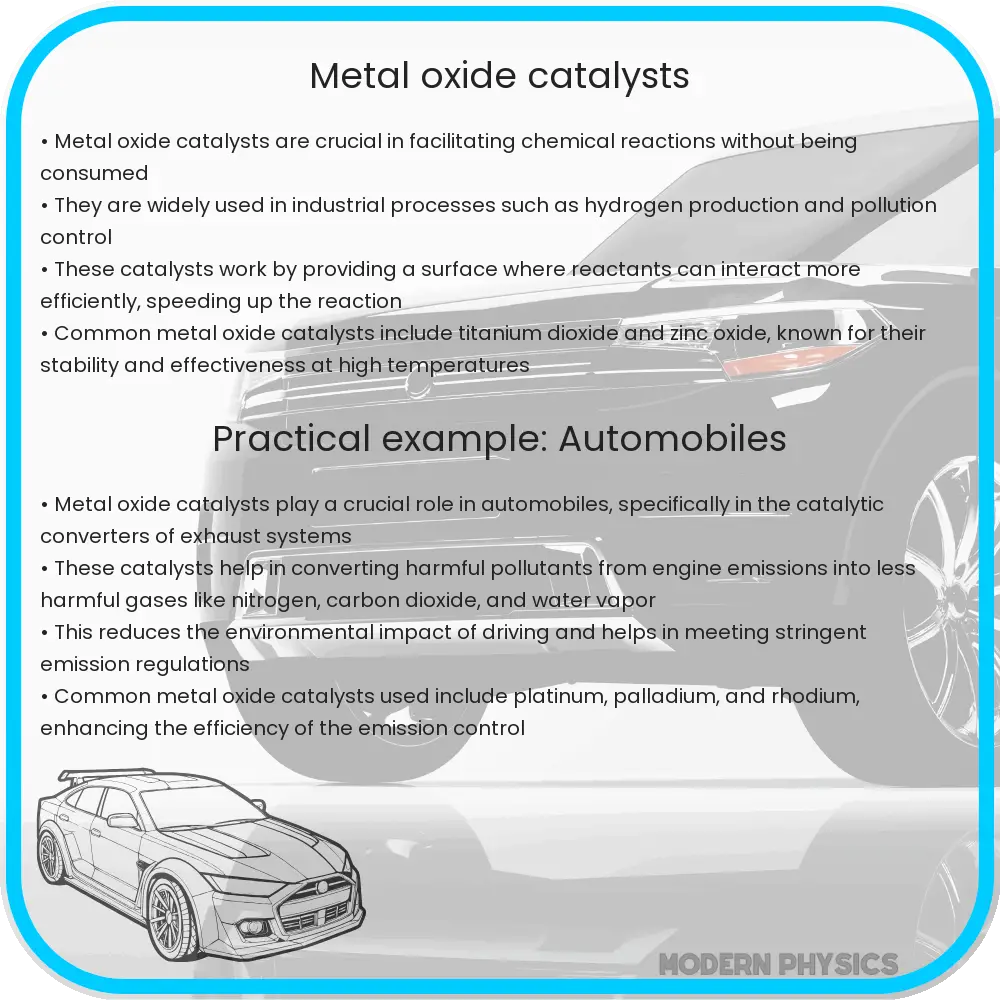
- Environmental Protection: Catalytic converters use metal oxides to remove harmful exhaust gases in vehicles, converting them into harmless gases through redox reactions.
- Chemical Synthesis: In industrial chemistry, metal oxides catalyze processes such as the oxidation of alcohols or the dehydrogenation of organic compounds, enabling more sustainable production methods.
- Energy Conversion: Materials like ceria (cerium oxide) are employed in solid oxide fuel cells for clean energy generation, facilitating the oxidation-reduction cycle required to produce electricity from hydrogen or other fuels.
Metal oxide catalysts are integral to pushing the boundaries of what’s chemically possible in both industry and environmental management. By understanding and improving their efficiency, activation processes, and stability, we can enhance performance and achieve more sustainable technological developments.
Challenges and Future Prospects
Despite their numerous advantages, the development and implementation of metal oxide catalysts face certain challenges. One significant issue is the cost associated with the procurement and processing of rare or precious metals often used in these catalysts. Additionally, the complexity of recycling catalysts, especially after degradation, poses environmental and economic challenges.
- Economic Feasibility: Innovations in synthesis methods that reduce costs without compromising efficiency are critical to wider adoption.
- Recycling Techniques: Developing effective recycling processes to recover valuable materials from spent catalysts is essential for sustainable practices.
In the future, research is expected to focus on creating more robust catalysts that can withstand various environmental stresses while maintaining high performance. Utilizing nanotechnology to engineer even smaller and more efficient catalyst structures is another promising avenue. These advancements could lead to even greater contributions in fields like renewable energy and waste reduction.
Conclusion
Metal oxide catalysts are indispensable tools in modern industry and environmental protection, driving crucial processes that enhance product quality, reduce harmful emissions, and contribute to sustainable practices. By improving their efficiency, activation, and stability, and addressing challenges like cost and recyclability, these catalysts will continue to play a vital role in advancing technology and protecting our planet. Understanding their mechanisms and applications not only benefits the scientific community but also opens up new possibilities for innovations in various sectors. As research progresses, the potential for metal oxide catalysts in making our world cleaner and more efficient is incredibly promising.