
Chief Ray: Understand its definition, importance in determining field of view, assessing image quality, system alignment, and its applications in optics.
Chief Ray: Basics, Importance & Applications in Optics
Optics is the branch of physics that deals with the study of light and its interactions with matter. One of the fundamental concepts in optics is the “chief ray. This article will delve into the basics of the chief ray, its importance in optical systems, and its various applications.
Basics of the Chief Ray
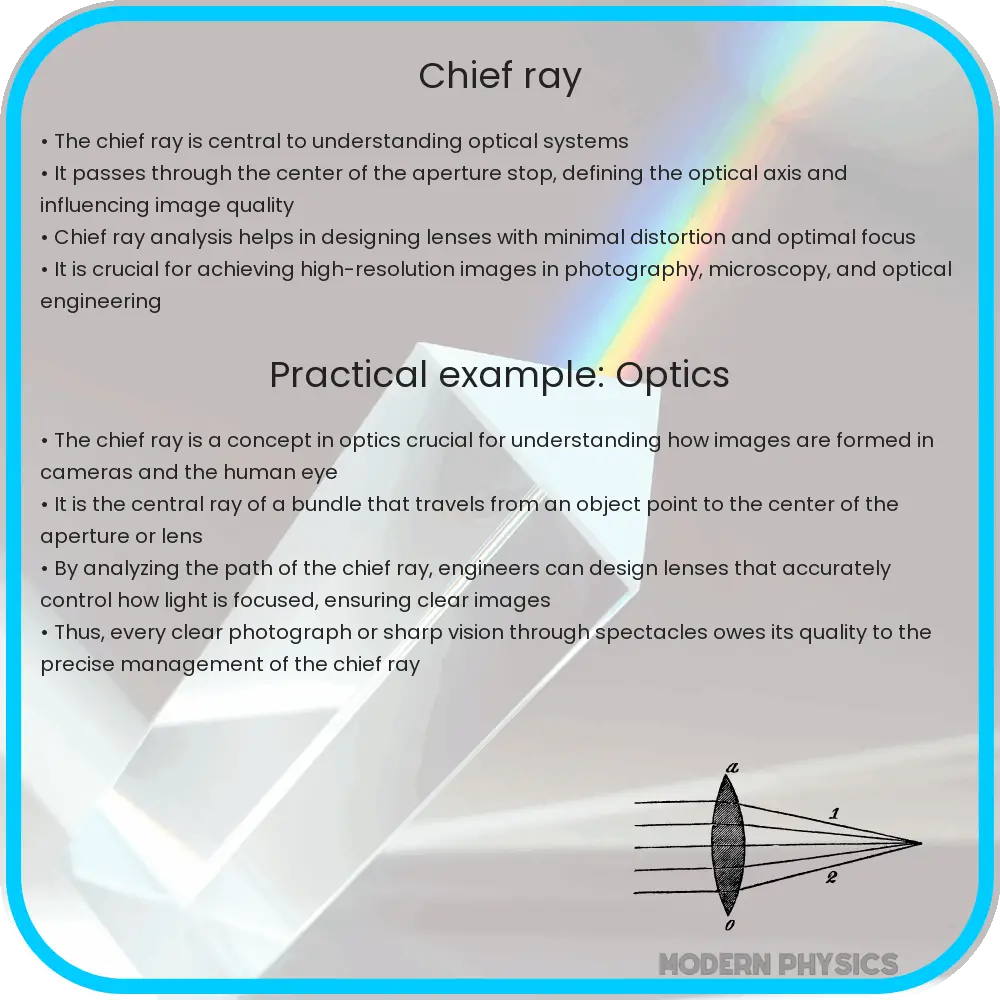
In optics, a chief ray is defined as the ray that passes through the center of the aperture stop of an optical system. The aperture stop is essentially the part of the system that determines the amount of light entering it. The chief ray is significant because it travels through the optical system in such a way that it provides critical information about the imaging properties of the system.
To understand this, let’s break it down further:
- Aperture Stop: This is the limiting aperture that controls the cone of light entering an optical system. It forms the boundary for rays contributing to the image formation.
- Chief Ray Path: The chief ray emanates from an off-axis object point and passes through the center of the aperture stop, subsequently passing through the optical system.
Importance of the Chief Ray
The chief ray plays a crucial role in optical system design and analysis. Here are some key reasons why it is so important:
- Determining Field of View: The path of the chief ray helps determine the field of view of the optical system. By analyzing where the chief ray intersects the image plane, optical engineers can define the extent of the scene that can be captured.
- Image Quality Analysis: Chief rays are instrumental in assessing potential aberrations in an optical system. Since the chief ray represents the central path of light from specific points on the object, any deviations help in identifying issues like distortion or vignetting.
- System Alignment: Properly aligning the chief ray ensures that the optical elements are positioned accurately, which is essential for the optimal performance of the system.
Applications of the Chief Ray in Optics
The concept of the chief ray is utilized in various applications to enhance and refine optical systems. Some of these applications include:
- Lens Design: In designing lenses, the chief ray is used to trace how light propagates through the lens system, ensuring the design meets specific criteria for focusing and imaging.
- Microscopy: In microscopes, understanding the chief ray is critical to achieve precise focusing and to minimize aberrations that would otherwise degrade the image quality.
- Telescopes: When designing telescopic systems, the chief ray analysis helps in optimizing the placement and curvature of mirrors and lenses to capture distant objects clearly.
Chief Ray Analysis Techniques
Optical engineers leverage various techniques to analyze the behavior and impact of the chief ray within an optical system. These techniques help in the accurate design and optimization of optical elements.
- Ray Tracing Methods: Using computational tools, engineers trace the path of the chief ray through the optical system. This process helps in visualizing how light travels from the object to the image plane, identifying any potential aberrations or misalignments.
- Spot Diagram Analysis: This technique involves plotting the intersections of chief rays with the image plane to form a spot diagram. By examining the spread and distribution of these spots, engineers can assess the image quality and detect aberrations.
- Wavefront Analysis: By analyzing the wavefront of light as it propagates through an optical system, engineers can understand how the chief ray interacts with other rays. This analysis is crucial for systems requiring high precision, such as those used in telescopes and microscopes.
Challenges in Chief Ray Analysis
Despite its importance, analyzing the chief ray can present some challenges. These challenges must be addressed to achieve optimal optical system performance:
- Complex Optical Systems: In intricate optical systems with multiple elements, accurately tracing the chief ray requires sophisticated computational models and software. Any inaccuracies in these models can lead to suboptimal system design.
- Aberrations and Distortions: Aberrations like spherical or chromatic aberrations can distort the path of the chief ray, complicating its analysis. Engineers must employ advanced correction techniques to mitigate these issues.
- Environmental Factors: Factors such as temperature fluctuations and mechanical vibrations can affect the alignment of optical components, thereby altering the chief ray path. Engineers must design systems that are robust against these environmental factors.
Conclusion
The chief ray is a pivotal concept in the field of optics, providing essential insights into the functioning and optimization of optical systems. From determining the field of view to analyzing image quality and system alignment, the chief ray is integral to the design and performance of various optical devices. By using ray tracing methods, spot diagram analysis, and wavefront analysis, engineers can accurately model and optimize optical systems. Nevertheless, challenges such as complex optical systems, aberrations, and environmental factors need to be meticulously addressed. Understanding and effectively utilizing the chief ray can lead to significant advancements in optical technologies, benefiting a wide range of applications from everyday lenses to sophisticated scientific instruments.