
Explore the essentials of Signal Integrity in electrodynamics, including challenges, analysis techniques, and solutions for optimal electronic system design.
Understanding Signal Integrity in Electrodynamics
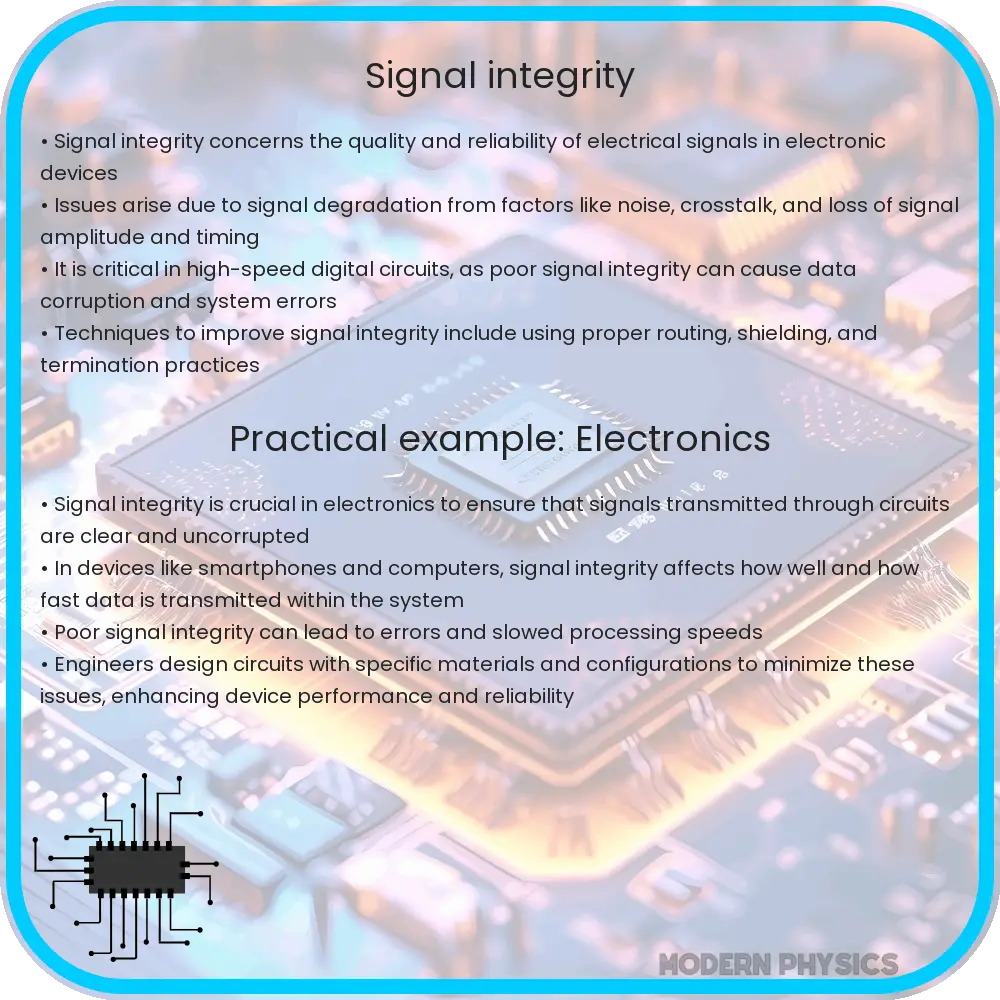
Signal integrity (SI) is a crucial aspect of electrodynamics, particularly in the design and analysis of electronic systems. It refers to the quality and reliability of electrical signals as they travel through various components of a circuit. This article aims to explore the fundamentals of signal integrity, its challenges, and effective solutions.
Key Concepts in Signal Integrity
At the heart of signal integrity are several key concepts:
- Reflection and Refraction: These phenomena occur due to impedance mismatches in the circuit, often leading to signal degradation.
- Crosstalk: This is the unwanted interference caused by one signal affecting another, which can result from closely packed traces or wires.
- Signal Attenuation: The reduction in signal strength over distance or due to resistive elements in the circuit.
- Noise: External or internal disturbances that can alter the signal’s original characteristics.
Analyzing Signal Integrity Issues
To analyze SI issues, it’s essential to understand the behavior of electromagnetic waves in circuits. This involves applying the principles of electrodynamics, such as Maxwell’s equations. Maxwell’s equations are expressed as:
- \(\nabla \cdot \mathbf{E} = \frac{\rho}{\varepsilon_0}\) (Gauss’s Law for Electricity)
- \(\nabla \cdot \mathbf{B} = 0\) (Gauss’s Law for Magnetism)
- \(\nabla \times \mathbf{E} = -\frac{\partial \mathbf{B}}{\partial t}\) (Faraday’s Law of Induction)
- \(\nabla \times \mathbf{B} = \mu_0\mathbf{J} + \mu_0\varepsilon_0\frac{\partial \mathbf{E}}{\partial t}\) (Ampere’s Law)
These equations describe how electric and magnetic fields interact with charges and currents, which is fundamental in understanding signal propagation and integrity.
Solutions for Signal Integrity Issues
Addressing signal integrity involves various strategies:
- Impedance Matching: Ensuring that the impedance of the source, transmission line, and load are matched to minimize reflections.
- Shielding and Grounding: Utilizing proper shielding techniques and grounding to reduce noise and interference.
- Trace Routing: Designing PCB layouts to minimize crosstalk and signal attenuation.
These solutions, when implemented correctly, can significantly improve the quality of signals in electronic systems.
Advanced Techniques in Signal Integrity Analysis
In addition to basic strategies, advanced techniques play a vital role in maintaining signal integrity, especially in high-speed and complex electronic systems. These include:
- Time Domain Reflectometry (TDR): A technique used to detect and locate impedance mismatches and other flaws in transmission lines.
- 3D Electromagnetic Field Simulation: This allows for the visualization and analysis of electromagnetic fields around PCB traces, aiding in the optimization of signal paths.
- Frequency Domain Analysis: Understanding the frequency response of a system helps in identifying potential issues with signal integrity at different frequencies.
Practical Application of Signal Integrity Principles
Implementing signal integrity principles effectively requires a combination of theoretical knowledge and practical application. This includes:
- PCB Layout Design: Careful planning of the PCB layout, considering trace spacing, layer stacking, and routing paths.
- Material Selection: Choosing the right materials for PCB and other components to ensure minimal signal loss and interference.
- Testing and Validation: Rigorous testing of the electronic system under various conditions to validate the design against signal integrity standards.
Conclusion
Signal integrity is a fundamental aspect of modern electronic design, where understanding and mitigating issues related to signal degradation is essential. From the basics of reflection, crosstalk, and noise to advanced techniques like TDR and 3D EM simulations, the field of signal integrity offers a comprehensive approach to ensure reliable and efficient electronic systems. As technology evolves, the importance of signal integrity analysis in electrodynamics will continue to grow, demanding more sophisticated solutions and deeper understanding. By integrating theoretical principles with practical design strategies, engineers can effectively overcome challenges and achieve optimal performance in electronic systems.