
Lighthouse lenses, optical marvels designed to guide mariners with strong, precise beams, employ Fresnel lens technology for enhanced maritime navigation.
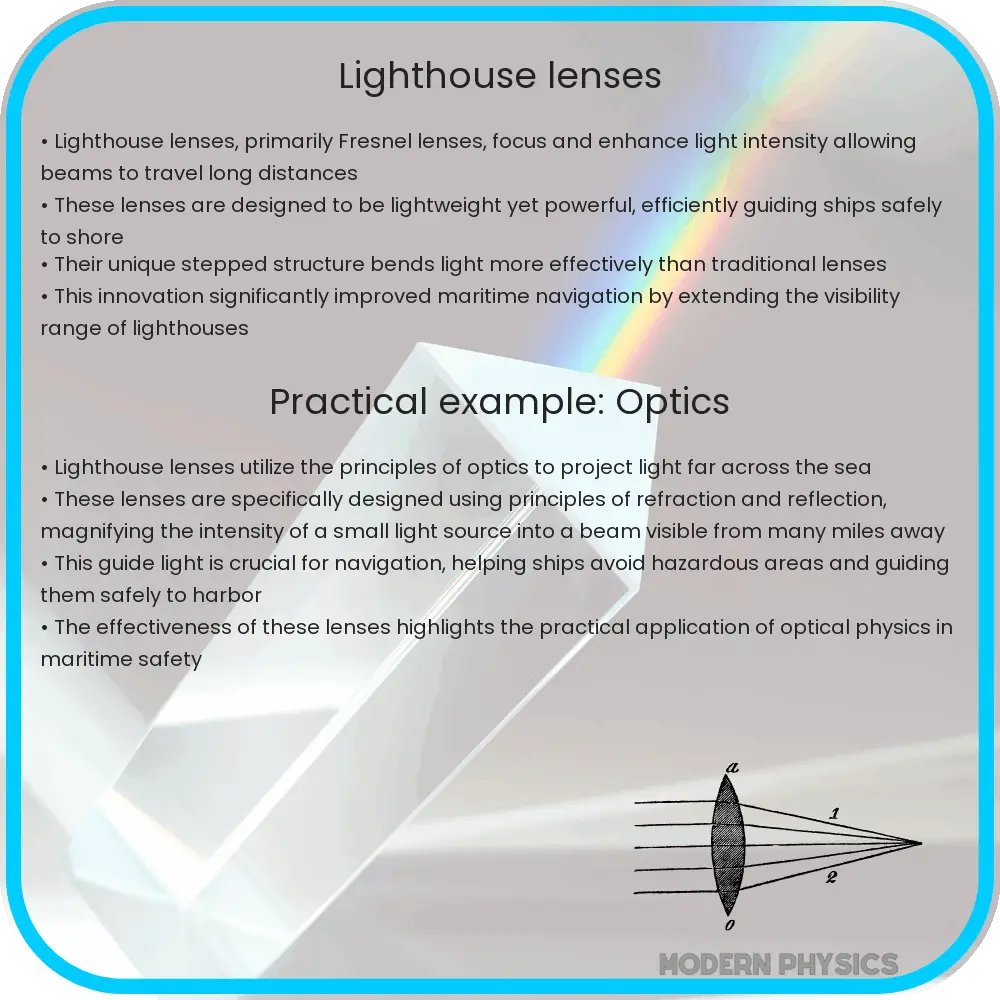
Understanding Lighthouse Lenses: A Beacon of Optical Engineering
Lighthouse lenses are marvels of optical engineering, designed to emit powerful beams of light that guide mariners safely to shore. These lenses, central to the function of every lighthouse, are predicated on principles of optics that enhance clarity, extend range, and ensure precision in light direction. This article explores how these lenses work, their historical development, and the physics behind their impressive capabilities.
The Development of Lighthouse Lenses
The technology behind lighthouse lenses underwent significant transformation with the invention of the Fresnel lens in the early 19th century by French physicist Augustin-Jean Fresnel. Prior to this, lighthouses used simple reflectors to guide ships, which were less efficient in terms of light direction and intensity. The introduction of the Fresnel lens revolutionized maritime navigation by dramatically increasing the luminous intensity that could be attained from a single light source.
The Fresnel Lens: A Breakthrough in Optical Engineering
The Fresnel lens is characterized by its unique design, which allows a large aperture and short focal length without the mass and volume of material that a conventional lens would require. This design is achieved by breaking down a large, bulky lens into a series of smaller, concentric annular sections known as “Fresnel zones. Each zone is angled slightly differently, directing light toward the horizon in a broad, powerful beam. This structure not only reduces the weight and volume of the lens but also minimizes the loss of light, which commonly occurs in thicker lenses.
- Clarity: The precise gradation of angles in the Fresnel zones allows the lens to focus light more effectively, reducing dispersion and enhancing the clarity of the emitted beam.
- Range: By collimating light into a concentrated beam, Fresnel lenses can extend the visible range of the lighthouse signal. The intensity and coherence of the light are maintained over greater distances than would be possible with traditional lenses.
- Precision: The design of the Fresnel lens allows for precise control of the light’s direction, which is critical for guiding ships accurately and safely.
The Physics of Lighthouse Lenses
The effectiveness of Fresnel lenses and other lighthouse optics can be understood through basic principles of geometrical optics, particularly the laws of refraction and reflection. When light passes through mediums of different densities (e.g., from air to glass), its speed and direction change—a phenomenon known as refraction. Fresnel lenses utilize this principle by crafting each segment to bend light precisely towards the same focal point.
On the mathematical side, the path of light can be predicted using Snell’s law, expressed as:
n1 sin(θ1) = n2 sin(θ2)
where n1 and n2 are the refractive indices of air and glass respectively, and θ1 and θ2 are the angles of incidence and refraction. By designing each Fresnel zone to obey this law at every point of contact with light, a strong, unified beam is projected outward toward the sea.
The structure of lighthouse lenses also utilizes the principle of total internal reflection, which occurs when light hits the interface between two media at an angle greater than the critical angle, ensuring no light escapes and is instead reflected within the lens.
Modern Adaptations and Technological Advancements
While the core principles of lighthouse lenses designed by Fresnel remain largely unchanged, modern technology has brought enhancements that improve efficiency and functionality. Innovations such as LED lighting and electronic controls have been integrated into lighthouse systems, allowing for more precise light management and lower maintenance requirements. These advancements also contribute to energy conservation, making lighthouses more environmentally friendly.
Advanced materials such as synthetic sapphire or fused silica are now used in some high-performance lighthouse lenses. These materials offer superior optical clarity and durability, resisting the harsh environmental conditions typically faced by maritime navigational aids. Additionally, modern coatings can further reduce the loss of light through absorption or scattering, enhancing the overall effectiveness of the lenses.
- Energy Efficiency: Modern lighthouses often use LED lights, which consume less power and have a longer lifespan than traditional bulbs.
- Automated Systems: Computerized controls can adjust light intensity and patterns according to visibility conditions, thereby improving safety during severe weather.
- Increased Durability: The use of advanced materials in lens construction reduces the need for frequent replacements and maintenance.
The Enduring Importance of Lighthouse Lenses
The development and continuous improvement of lighthouse lenses represent a fascinating intersection of history, physics, and engineering. From the groundbreaking work of Fresnel to the latest technological innovations, these lenses have played a crucial role in ensuring the safety of mariners around the world. The principles of optics applied in these designs not only illuminate paths but also highlight the importance of scientific understanding in solving practical problems.
Lighthouse lenses are a testament to the potential of human ingenuity to enhance safety and efficiency in critical applications. As we continue to develop and harness new technologies, the legacy of the Fresnel lens reminds us of the lasting impact that well-applied scientific principles can have on our world.
Conclusion
Lighthouse lenses, from the Fresnel lens to modern adaptations, epitomize the remarkable synergy between physics and engineering. These devices not only guide mariners safely to shore but also showcase the power of optical science in overcoming real-world challenges. As technology evolves, the fundamental design initiated by Fresnel continues to influence innovations, ensuring that the beacon of a lighthouse remains a strong, reliable guide through the ages. Whether through enhanced materials, efficient lighting, or automated systems, the evolution of lighthouse lenses continues to be a bright example of practical science lighting the way towards a safer, smarter world.