
Explore how beam homogenizers enhance light uniformity and efficiency in optical systems, improving applications in laser processing and medical treatments.
Understanding Beam Homogenizers: Elevating Light Uniformity and Efficiency in Optical Systems
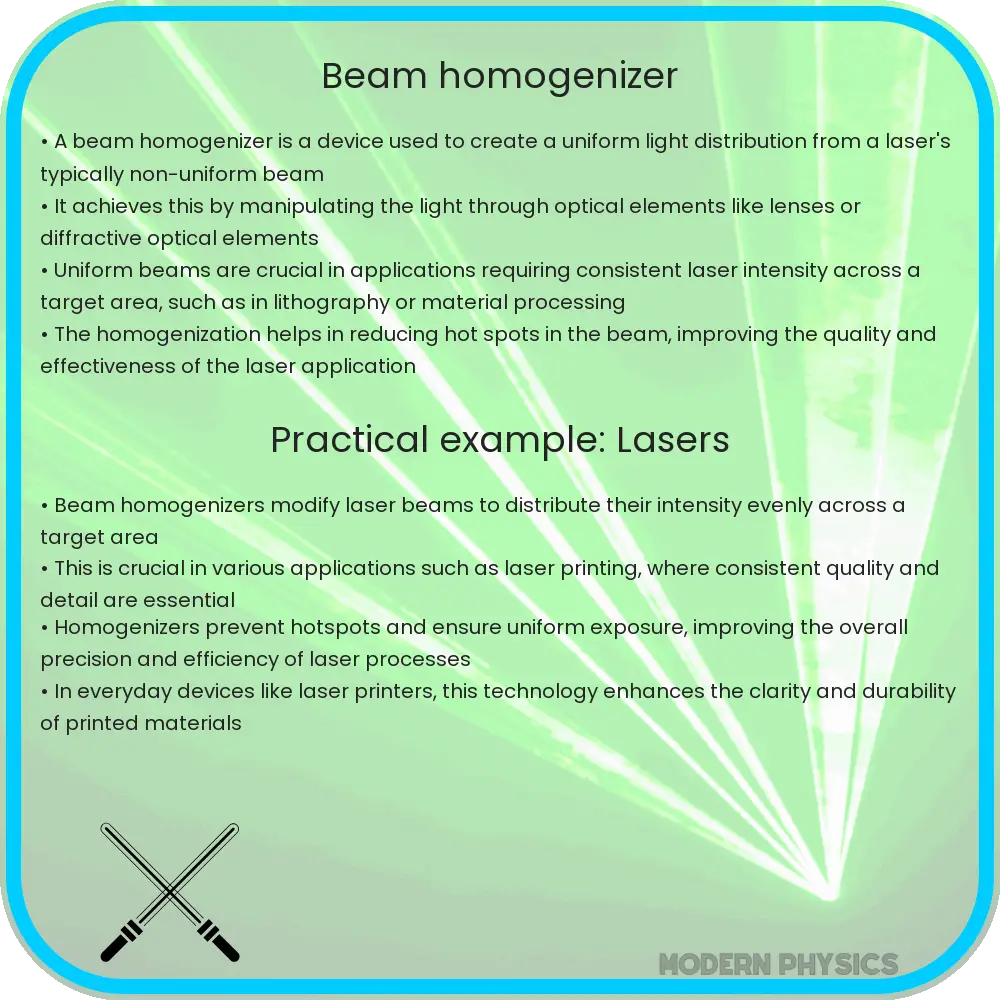
Beam homogenizers play a pivotal role in enhancing the performance of optical systems by improving light uniformity and efficiency. These sophisticated devices are engineered to transform non-uniform light beams into uniform distributions, a critical requirement in a myriad of applications spanning from laser processing to imaging and medical treatments. Understanding the principle and benefits of beam homogenizers is essential for leveraging their potential in advancing optical technologies.
The Principle Behind Beam Homogenization
At the core of beam homogenization lies the principle of diffusing or redistributing the light intensity across the beam’s cross-section. This is achieved through various methods such as microlens arrays, diffractive optical elements, or integrating rods. Microlens arrays, for instance, consist of numerous small lenses that divide the incoming beam into multiple smaller beams, which overlap at the target plane to form a uniform intensity profile. Diffractive optical elements manipulate the phase of the incoming light to achieve a similar effect, while integrating rods use internal reflection to mix the light within a cylindrical rod, leading to a homogenized output.
Enhancing Light Uniformity and Efficiency
Uniform light distribution is paramount in applications where consistent exposure or treatment is required. Non-uniform beams can lead to hot spots or underexposed areas, compromising the quality and reliability of the process. Beam homogenizers address this challenge by ensuring that the light intensity is evenly distributed across the target area, thereby enhancing the process’s overall efficiency and outcome. This uniformity is not only crucial for achieving high-quality results in manufacturing processes, such as laser annealing or cutting, but also in medical procedures where precise energy distribution is necessary for safety and effectiveness.
Applications and Advantages
- Laser Processing: In laser cutting, welding, and marking, beam homogenizers ensure consistent material processing, reducing waste and improving finish quality.
- Imaging: Uniform illumination provided by beam homogenizers enhances the quality of imaging systems, crucial for applications in microscopy and photography.
- Medical Treatments: In laser therapy and surgery, uniform light distribution ensures precise control over the energy delivered to the tissue, improving treatment outcomes.
The integration of beam homogenizers into optical systems marks a significant advancement in the pursuit of efficiency and precision. By delivering uniform light intensity across various applications, these devices unlock new possibilities in optical technology, paving the way for innovative solutions in both industrial and medical fields.
Optimizing Optical Systems with Beam Homogenizers
As the demand for precision and efficiency in optical applications continues to grow, the role of beam homogenizers becomes increasingly crucial. By addressing the challenges of non-uniform light distribution, these devices not only improve the quality of outcomes but also enhance the versatility and adaptability of optical systems. The ability to control light distribution with high precision opens up new avenues for research and development, enabling breakthroughs in fields that rely heavily on optical technologies.
Key Considerations for Beam Homogenizer Selection
Selecting the appropriate beam homogenizer for a specific application involves several critical considerations. The nature of the light source, the desired uniformity level, and the specific requirements of the application are paramount. Additionally, factors such as the homogenizer’s efficiency, loss of light intensity, and the impact on the overall system’s performance must be evaluated to ensure optimal integration and functionality.
Future Prospects and Technological Advancements
The continuous advancement in beam homogenization technology promises further enhancements in light uniformity and efficiency. Innovations in materials science and optical engineering are paving the way for more compact, efficient, and versatile homogenizers. These developments are expected to extend the applications of beam homogenizers beyond current boundaries, including new realms of scientific research, advanced manufacturing processes, and even consumer electronics.
Conclusion
Beam homogenizers represent a critical component in the evolution of optical systems, offering unparalleled improvements in light uniformity and efficiency. Their ability to transform non-uniform light beams into uniform distributions has profound implications across a wide range of applications, from enhancing manufacturing processes to advancing medical treatments. As technology progresses, the potential for beam homogenizers to revolutionize optical systems continues to expand, underscoring their significance in the ongoing quest for precision, efficiency, and innovation in the field of optics. With the ongoing advancements in optical engineering, beam homogenizers are set to play an even more pivotal role in shaping the future of technology, making them an indispensable tool in the arsenal of optical professionals and researchers alike.