
Explore the mystery of neutrino mass hierarchy, its impact on physics, and the groundbreaking experiments aiming to unlock the secrets of the universe.
Neutrino Mass Hierarchy: Unveiling the Quantum Enigma
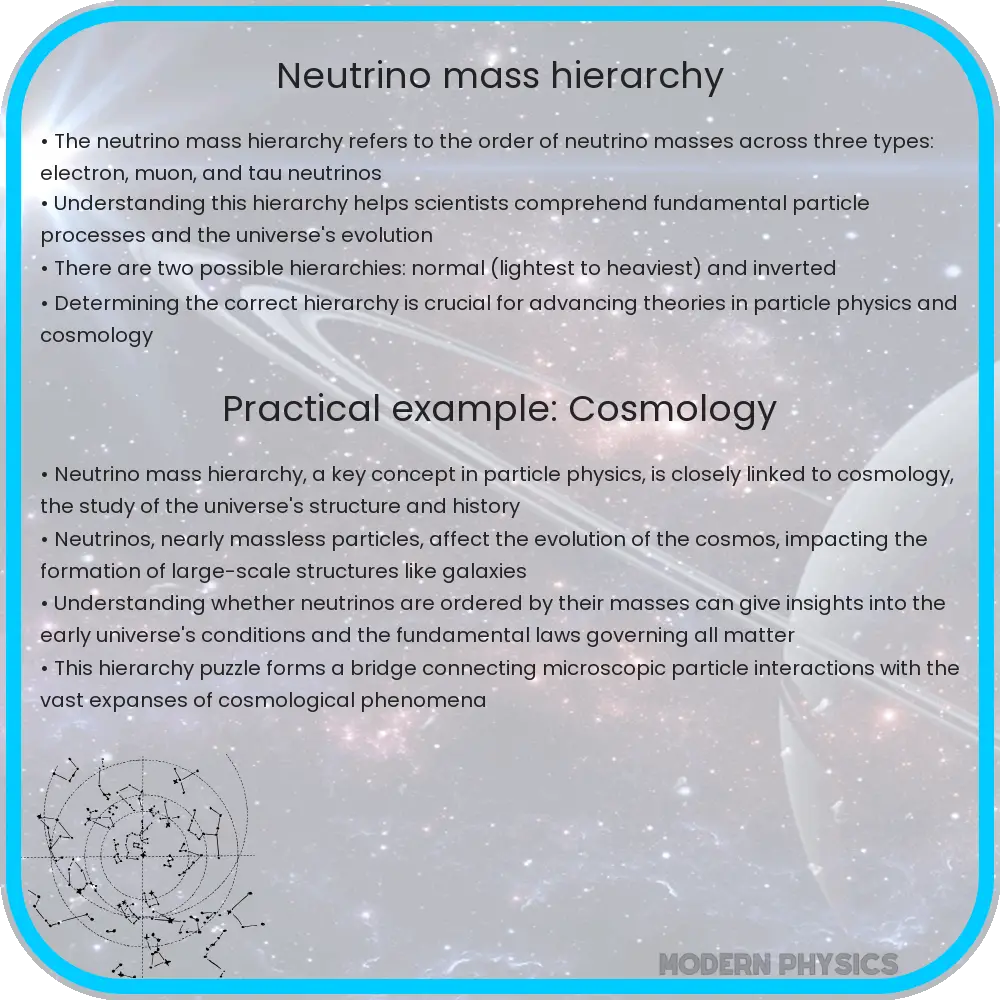
The neutrino mass hierarchy is a fundamental question in particle physics, exploring the arrangement of the neutrino masses. Neutrinos, nearly massless particles that barely interact with matter, are essential to our understanding of the universe. There are three types, or ‘flavors,’ of neutrinos: electron neutrinos (\(\nu_e\)), muon neutrinos (\(\nu_\mu\)), and tau neutrinos (\(\nu_\tau\)). The mystery surrounding their mass hierarchy pertains to which one of these types is the heaviest and which is the lightest.
Understanding the Neutrino Mass Scales
There are two possible arrangements for the neutrino masses: the normal hierarchy (NH) and the inverted hierarchy (IH). In NH, the \(\nu_1\) mass state is the lightest, followed by \(\nu_2\), with \(\nu_3\) being the heaviest. Conversely, in IH, \(\nu_3\) is the lightest, whereas \(\nu_1\) and \(\nu_2\) are heavier. The precise measurement of these mass states is challenging due to the neutrinos’ extremely light and non-interactive nature.
Experiments Shedding Light on the Mystery
Several experiments have been designed to probe the neutrino mass hierarchy, utilizing a range of methods from observing solar and atmospheric neutrinos to using reactors and accelerators as neutrino sources. Notable experiments include the Super-Kamiokande in Japan, the Sudbury Neutrino Observatory in Canada, and the IceCube Neutrino Observatory in Antarctica. These experiments aim to detect neutrino oscillations, a phenomenon where neutrinos switch between different flavors as they travel, which is sensitive to the differences in the squares of the mass states (\(\Delta m^2\)).
The Impact of Solving the Neutrino Mass Hierarchy
Unraveling the neutrino mass hierarchy has profound implications for physics and cosmology. It can significantly enhance our understanding of the Standard Model of particle physics and provide insights into the early universe’s conditions. Moreover, it could offer clues to new physics beyond the Standard Model, such as the nature of dark matter and the imbalance between matter and antimatter in the universe.
Challenges and Future Prospects
The primary challenge in resolving the neutrino mass hierarchy lies in the tiny mass differences between the neutrino types, necessitating highly sensitive and large-scale experiments. The ongoing and future experiments, such as the Deep Underground Neutrino Experiment (DUNE) in the United States and the Jiangmen Underground Neutrino Observatory (JUNO) in China, aim to improve our understanding by employing advanced technologies and methodologies. These experiments are expected to provide clearer insights into the neutrino mass hierarchy within the next decade.
Interdisciplinary Significance
The quest to understand the neutrino mass hierarchy transcends the boundaries of particle physics, impacting fields such as astrophysics and cosmology. For instance, a definitive determination of the mass hierarchy could refine our models of stellar explosions, such as supernovae, and the processes that occurred immediately after the Big Bang. Additionally, it could have implications for the study of neutrinoless double beta decay, a process that could confirm the Majorana nature of neutrinos, suggesting that they are their own antiparticles.
Conclusion
The mystery of the neutrino mass hierarchy is a pivotal question in modern physics, holding the key to new discoveries and enhancing our understanding of the universe. Despite the experimental challenges, the relentless pursuit by the scientific community indicates a hopeful future toward unraveling this enigma. Solving the neutrino mass hierarchy will not only mark a significant milestone in particle physics but also pave the way for new theories and discoveries, potentially leading to a deeper comprehension of the cosmos and the fundamental laws governing it. As we stand on the brink of these potential breakthroughs, the journey to decipher the secrets of neutrinos continues to be one of the most exciting endeavors in the realm of scientific research.