
Explore the mystery of neutrino oscillation, its impact on particle physics, and its cosmic significance, unraveling the secrets of the universe.
Unraveling the Mystery of Neutrino Oscillation
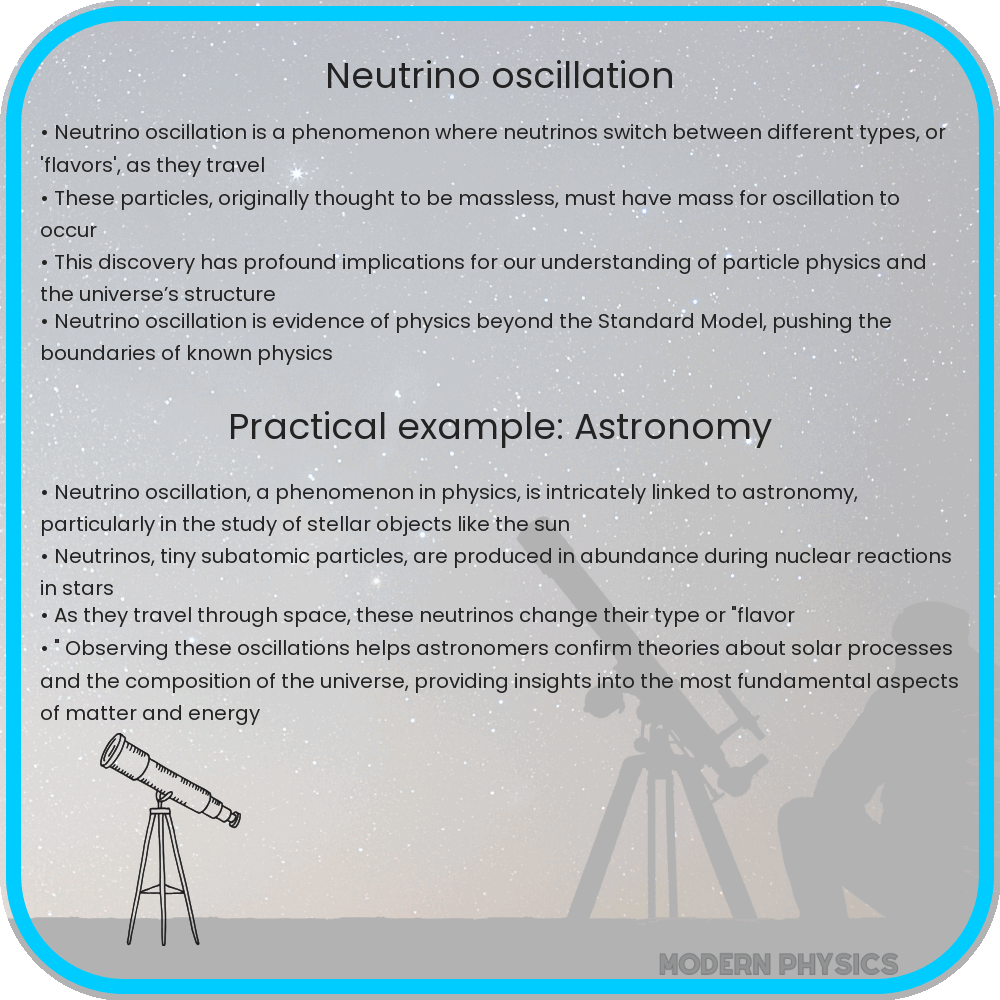
Neutrinos, often referred to as ‘ghost particles’, are one of the most enigmatic constituents of the quantum realm. Despite their weak interaction with matter, making them incredibly elusive, neutrinos hold the key to understanding some of the most fundamental questions in physics. One of the most fascinating aspects of neutrinos is their ability to oscillate, a phenomenon that reveals their mass and changes our understanding of the universe.
Quantum Identity and the Discovery of Oscillation
The concept of neutrino oscillation was first proposed by Bruno Pontecorvo in the late 1950s, postulating that neutrinos could change types (or ‘flavors’) as they travel through space. Neutrinos come in three flavors: electron neutrinos (\(\nu_e\)), muon neutrinos (\(\nu_{\mu}\)), and tau neutrinos (\(\nu_{\tau}\)). The ability of neutrinos to oscillate from one flavor to another as they move is a direct consequence of quantum mechanics and implies that neutrinos, contrary to previous beliefs, have mass.
The Mechanism Behind Neutrino Oscillation
Neutrino oscillation is a quantum phenomenon rooted in the difference between the mass states and flavor states of neutrinos. While neutrinos are produced and detected in one of their flavor states, their propagation through space occurs in terms of their mass states. These mass states are superpositions of the flavor states, leading to a phase difference as they travel, which in turn causes the oscillation between flavors. The probability of a neutrino changing its flavor depends on several factors, including the differences in squared masses of the neutrinos, the distance the neutrino travels, and the energy of the neutrino.
Implications of Neutrino Mass
The discovery of neutrino oscillation was groundbreaking as it provided the first tangible evidence of neutrino mass. This discovery has profound implications for the Standard Model of particle physics, which initially assumed neutrinos were massless. The existence of neutrino mass suggests new physics beyond the Standard Model and has significant implications for the understanding of the universe, including the nature of dark matter and the mechanisms of the Big Bang.
Experimental Evidence and Global Impact
The first experimental confirmation of neutrino oscillation came from the Super-Kamiokande detector in Japan in 1998, observing atmospheric neutrinos produced by cosmic rays. Subsequently, solar neutrino experiments, reactor neutrino experiments, and accelerator neutrino experiments have provided further proof, solidifying neutrino oscillation as a fundamental aspect of particle physics. These experiments not only validate the phenomenon but also help in measuring the mass differences and mixing angles between neutrino flavors, essential parameters in understanding neutrino physics.
Neutrino Oscillation in Cosmology and Astrophysics
The implications of neutrino oscillation extend beyond particle physics into cosmology and astrophysics. Neutrinos play a crucial role in the early universe and in stellar processes. The revelation that neutrinos have mass contributes to our understanding of the universe’s evolution, including the synthesis of elements in stars and the dynamics of supernova explosions. Furthermore, since neutrinos are a major component of the universe’s total mass, understanding their mass helps in elucidating dark matter and the universe’s overall mass-energy balance.
Future Directions in Neutrino Research
The study of neutrino oscillation is far from complete. Future experiments aim to address unresolved questions, such as the exact values of the neutrino mass hierarchy and the CP violation in the neutrino sector, which could explain the matter-antimatter asymmetry in the universe. Advanced detectors and experimental setups, such as the Deep Underground Neutrino Experiment (DUNE) in the United States and the Hyper-Kamiokande in Japan, are being designed to provide deeper insights into the nature and properties of neutrinos.
Conclusion
Neutrino oscillation stands as a profound discovery that challenges and expands our understanding of the quantum world. It not only demonstrates that neutrinos have mass but also highlights the intricate link between particle physics and the cosmos. As research progresses, the study of neutrinos will continue to be at the forefront of unraveling the mysteries of the universe, offering a unique window into the workings of the cosmos at its most fundamental level. The journey into the world of neutrinos is a testament to the endless pursuit of knowledge and the power of human curiosity.