
Explore the mysteries of pion decay in particle astrophysics: from basic processes to cosmic implications, uncover how this phenomenon shapes our universe.
Pion Decay: Unlocking the Mysteries of Particle Astrophysics
Pions, also known as pi mesons, are subatomic particles integral to understanding the forces that bind the universe’s fundamental particles. Discovered in the mid-20th century, pions are pivotal in the study of particle physics and astrophysics, acting as mediators for the strong nuclear force between nucleons in atomic nuclei. This article delves into the phenomenon of pion decay, a process vital for astrophysical insights and research into the fundamental principles of particle interactions.
The Basics of Pion Decay
Pions exist in three forms: + (positive), − (negative), and 0 (neutral). Each type undergoes different decay processes, governed by the weak force, one of the four fundamental forces in the universe. The most common decay pathways are:
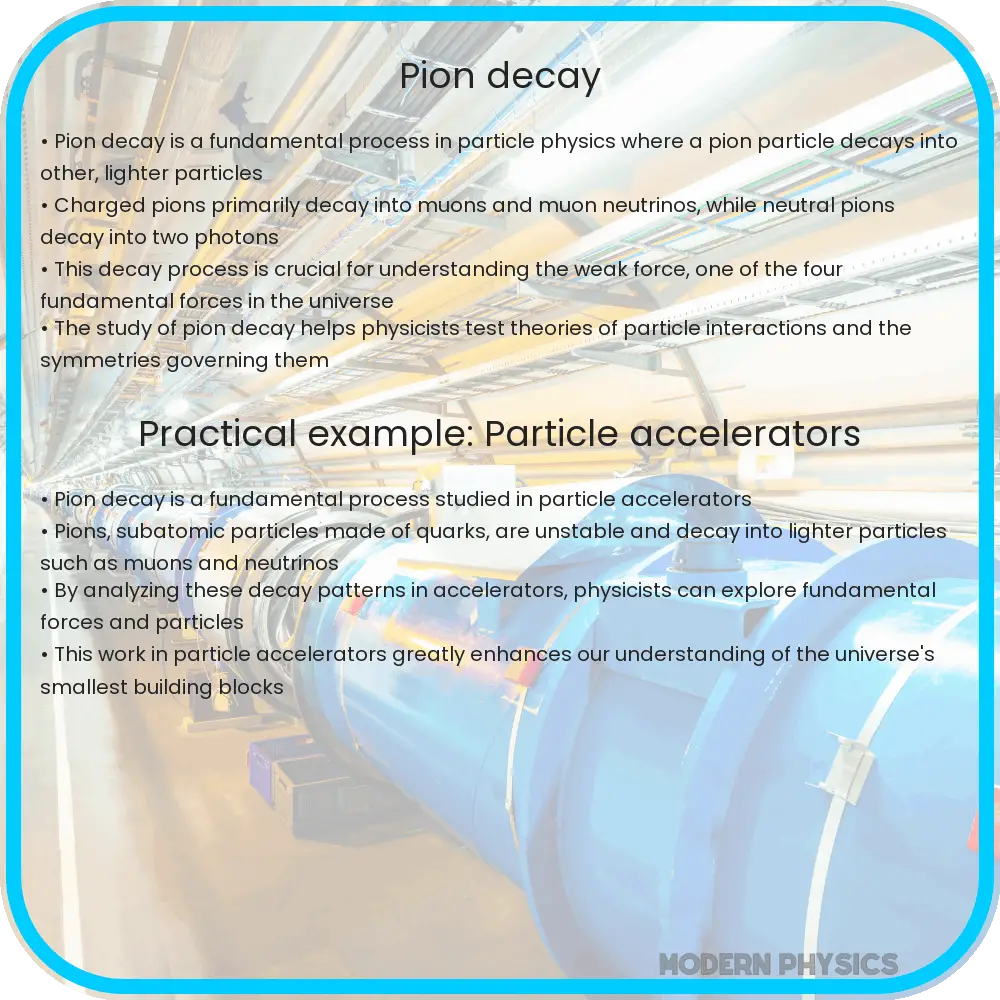
- Charged Pions (π+ and π−): These pions decay into a muon and a muon neutrino or antineutrino, respectively. The reactions can be represented as π+ → μ+ + νμ and π− → μ− + νμ. This decay mode has significant implications for cosmic ray studies and the understanding of muon production in the Earth’s atmosphere.
- Neutral Pions (π0): These pions mainly decay into two photons (γ), with the reaction written as π0 → 2γ. This process is critical for understanding electromagnetic processes in astrophysical environments and plays a key role in the interactions between cosmic radiation and interstellar matter.
The study of pion decay not only sheds light on the weak force but also provides insights into the conservation laws of energy, momentum, and angular momentum in subatomic processes. The decay rates and mechanisms of pions influence the understanding of particle lifetimes, symmetry breaking, and the interactions between quarks and leptons, which are fundamental components of matter.
Implications of Pion Decay in Particle Astrophysics
The decay of pions has profound implications in the field of particle astrophysics, impacting our understanding of the universe’s most energetic phenomena. For instance, the decay of charged pions in cosmic rays illuminates the nature of high-energy particles from space as they interact with the Earth’s atmosphere, leading to cascades of secondary particles observed as muon showers. Furthermore, the neutral pion decay into gamma rays is essential for gamma-ray astronomy, allowing scientists to probe high-energy processes occurring in supernova remnants, pulsar wind nebulae, and active galactic nuclei.
In addition to astrophysical applications, pion decay plays a crucial role in experimental particle physics. The precise measurement of pion decay parameters aids in testing the predictions of the Standard Model, the theoretical framework describing the electromagnetic, weak, and strong nuclear interactions. Deviations from expected decay rates or patterns could hint at new physics beyond the Standard Model, such as supersymmetry or dark matter interactions.
Future Directions and Research
Research in pion decay continues to be a vibrant field, with several experimental and theoretical studies aimed at uncovering more about this fundamental process. Advances in particle accelerators, detection technologies, and theoretical models are paving the way for deeper insights into the weak force and the role of pions in the universe. Additionally, interdisciplinary studies combining particle physics, astrophysics, and cosmology are expanding our understanding of how fundamental particles influence cosmic evolution and structures.
Conclusion
In summary, pion decay is a cornerstone of particle astrophysics, offering critical insights into the fundamental forces and particles that compose our universe. The study of how pions decay bridges the microscopic world of quantum mechanics with the macroscopic realm of cosmic phenomena, illustrating the interconnectedness of all scales in physics. As research advances, the understanding of pion decay will continue to illuminate dark corners of the universe, providing clues to the ultimate nature of matter and the forces that shape our cosmos.