
Explore the mysteries of Glashow resonance and its impact on neutrino interactions and cosmic rays, revealing new insights into the universe’s secrets.
Glashow Resonance: Bridging Neutrino Interactions and Cosmic Rays
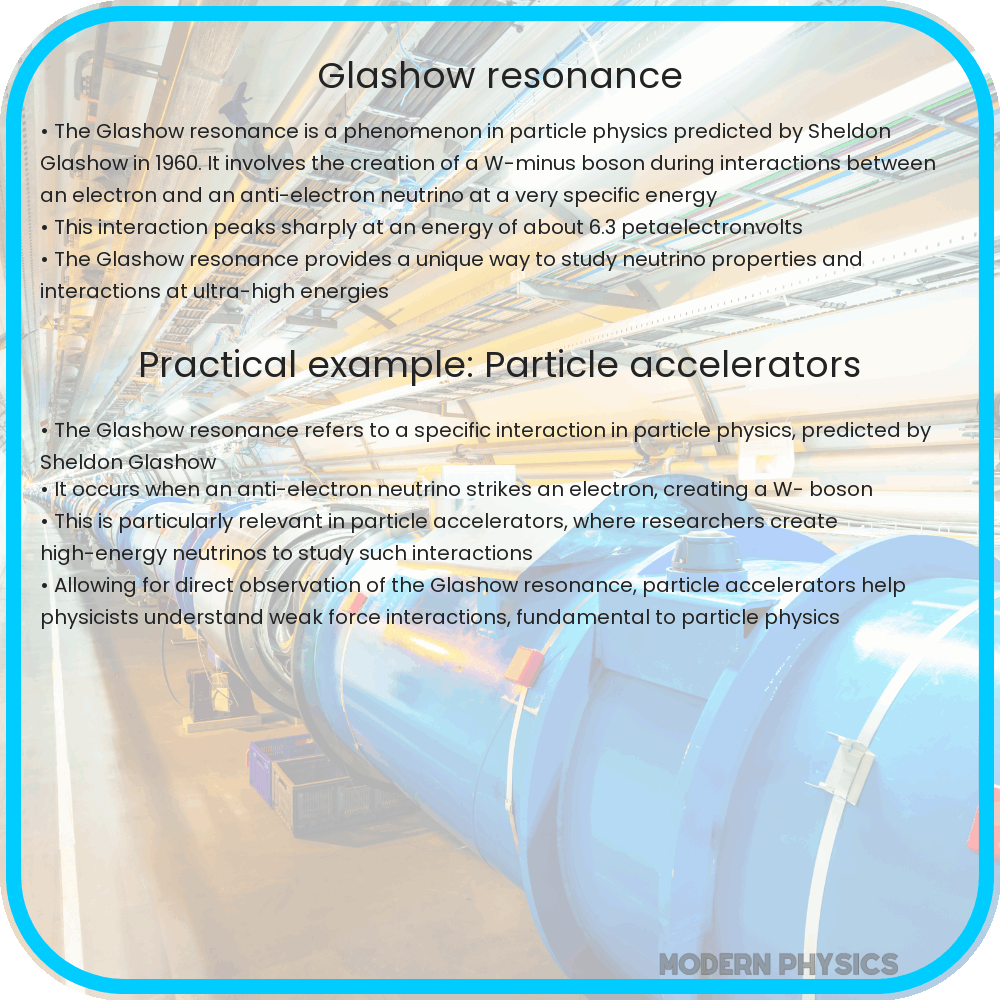
The Glashow resonance phenomenon represents a fascinating intersection between neutrino physics and cosmic ray studies. This rare process occurs when an anti-electron neutrino (νe) encounters an electron at rest, leading to the creation of a resonant state. This interaction was first theorized by the Nobel laureate Sheldon Lee Glashow in 1960, highlighting a unique way that particles could interact via the weak nuclear force.
Neutrinos are elusive particles that rarely interact with matter, making them incredibly challenging to detect. They are produced in abundance in cosmic events such as supernovae and the sun’s core reactions. Neutrinos travel vast distances, passing through planets, stars, and galaxies without any hindrance. However, under the right conditions, neutrinos can interact with matter, providing valuable insights into high-energy cosmic phenomena.
Understanding the Basics of Glashow Resonance
Glashow resonance occurs specifically when an anti-electron neutrino meets an electron at just the right energy level—approximately 6.3 PeV (Petaelectronvolts). At this energy, the neutrino and the electron can produce a W– boson, a mediator of the weak force, in a resonant state. This state is highly unstable, quickly decaying into various particles, including leptons and hadrons, depending on the decay mode.
The significance of Glashow resonance extends beyond its rarity and into its potential for cosmic ray research. High-energy neutrinos are believed to be produced by the same astrophysical sources as cosmic rays, such as active galactic nuclei and gamma-ray bursts. By studying neutrino interactions like the Glashow resonance, scientists can gain insights into these extreme cosmic environments and the processes fueling them.
Experimental Efforts and Challenges
Observing Glashow resonance is a monumental challenge due to the need for detecting ultra-high-energy neutrinos amidst a background of lower energy particles. Experiments like IceCube, a neutrino observatory buried in the Antarctic ice, aim to capture these rare interactions. The IceCube detector, with its thousands of optical sensors embedded deep within the ice, is specifically designed to monitor for the faint light signals produced when neutrinos interact with the ice molecules.
The detection of Glashow resonance events not only serves as a test for the Standard Model of particle physics but also provides a new tool for astrophysical investigations. By analyzing the characteristics of these interactions, scientists can infer the properties of the neutrino sources and the mechanisms of high-energy cosmic ray production.
Advancements and Implications of Glashow Resonance Observations
The successful observation of Glashow resonance events would mark a significant milestone in neutrino astronomy and the study of cosmic rays. It would confirm the presence of ultra-high-energy neutrinos, which are pivotal in understanding the universe’s most energetic phenomena. Moreover, these observations could help decipher the origins and acceleration mechanisms of cosmic rays, which remain one of astrophysics’ greatest mysteries.
Furthermore, the Glashow resonance provides a unique testing ground for the Standard Model of particle physics at energies not accessible in human-made accelerators. Any deviations from the expected resonance characteristics could indicate new physics beyond the Standard Model, such as additional neutrino types or interactions.
Future Prospects and Challenges
While the potential of Glashow resonance in advancing our understanding of the universe is immense, significant challenges remain. The rarity of these events, combined with the difficulty in distinguishing them from background signals, requires vast detectors and sophisticated analysis techniques. Future neutrino observatories, possibly situated in different mediums or utilizing advanced technologies, are essential for improving the detection rates and accuracy of Glashow resonance events.
Collaborations between various international scientific communities and the development of more sensitive detection methods are crucial for the future of neutrino astronomy. As technology advances, so too will our ability to observe and understand the elusive neutrino and its role in the cosmic ballet.
Conclusion
The study of Glashow resonance offers a unique window into the high-energy universe, bridging the gap between quantum mechanics and cosmic phenomena. This rare interaction not only tests the limits of the Standard Model but also provides insights into the sources and mechanisms of cosmic rays, contributing to our broader understanding of the universe’s most energetic events. Despite the challenges in observing these rare events, the ongoing efforts and future advancements in neutrino astronomy promise to unravel more of the universe’s secrets, leading to a deeper understanding of the cosmos and the fundamental laws that govern it.