
Explore nanophotonic light trapping’s role in enhancing solar cell efficiency, its methods, applications, and future potential in renewable energy.
Nanophotonic Light Trapping: Revolutionizing Solar Energy Efficiency
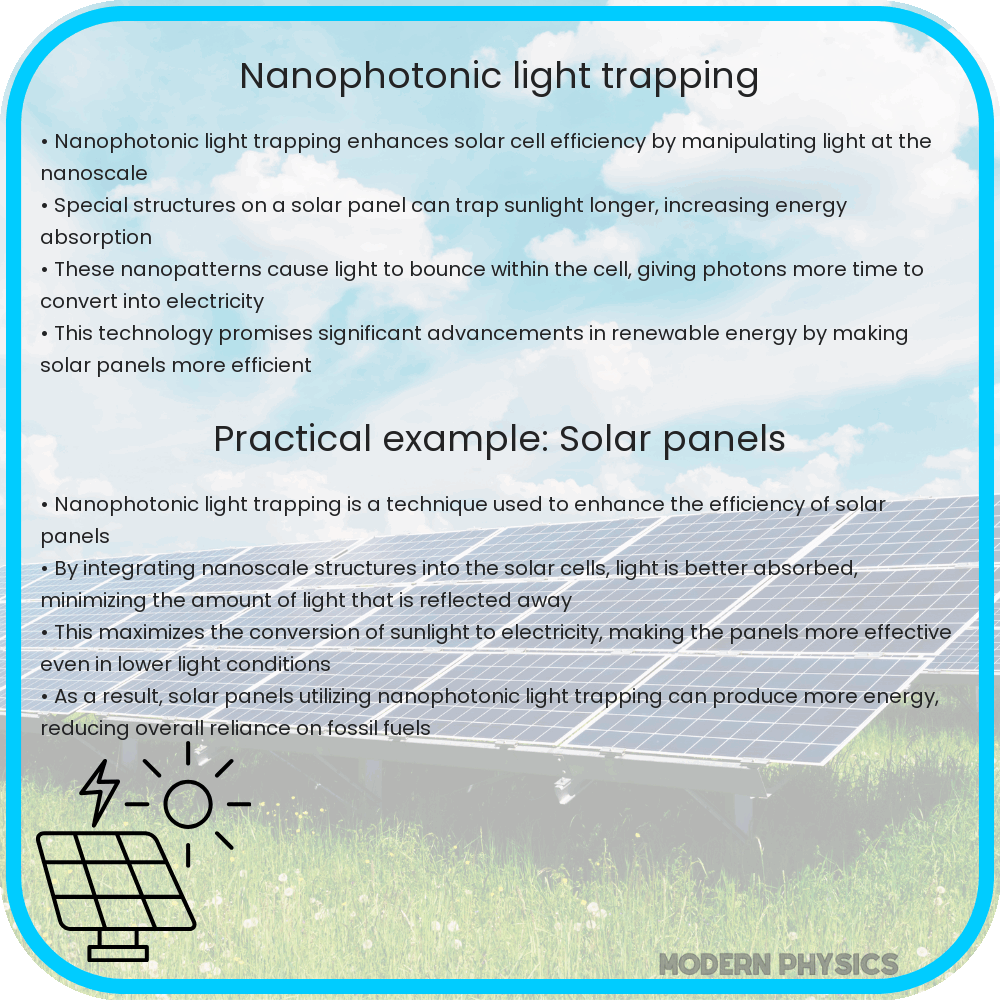
In the quest for sustainable energy, solar power stands as a beacon of hope. However, a critical challenge in solar technology is maximizing the efficiency of solar cells. Nanophotonic light trapping, an innovative approach at the crossroads of nanotechnology and photonics, has emerged as a game-changer in this arena. This technology ingeniously manipulates light at the nanoscale, significantly enhancing solar cell efficiency.
Understanding Nanophotonic Light Trapping
Nanophotonic light trapping involves the use of nanostructures to confine and manipulate light in solar cells. These nanostructures, often smaller than the wavelength of light, interact with solar radiation in unique ways, increasing the absorption of sunlight within the solar cell. This enhanced absorption is crucial, as it directly translates to higher electricity generation.
Methods of Nanophotonic Light Trapping
Several methods are employed to achieve efficient light trapping at the nanoscale. Key among these are:
- Nanostructured Surfaces: By etching or depositing nano-sized patterns on the surface of solar cells, these structures create a larger surface area, leading to more light absorption.
- Plasmonic Nanostructures: These involve metal nanoparticles that generate localized plasmon resonances, effectively capturing and scattering light into the solar cell.
- Photonic Crystals: These periodic optical nanostructures affect the motion of photons in a similar way that ionic lattices affect electrons in solids, enhancing light-matter interactions within the solar cell.
Efficiency Gains from Nanophotonic Light Trapping
The efficiency of solar cells is significantly boosted by nanophotonic light trapping. Traditional solar cells, without such advanced light management, typically suffer from rapid light escape and reduced absorption. Nanophotonics addresses these issues by extending the path of light within the cell, allowing more photons to be absorbed and converted into electricity. This not only improves the power conversion efficiency but also paves the way for thinner, less material-intensive solar cells.
Applications Beyond Solar Cells
While solar energy is the primary beneficiary of nanophotonic light trapping, its applications extend to other areas. This includes:
- Sensors: Enhancing the sensitivity of photonic sensors in medical and environmental applications.
- LEDs: Improving the light extraction efficiency of light-emitting diodes for brighter and more energy-efficient lighting.
- Optical Communications: Advancing fiber-optic technologies for faster and more efficient data transmission.
The versatility of nanophotonic light trapping makes it a pivotal technology in advancing not only renewable energy but also various other fields requiring efficient light management.
Challenges and Future Directions in Nanophotonic Light Trapping
Despite its promise, nanophotonic light trapping faces several challenges. Manufacturing complexities, cost considerations, and material durability under harsh environmental conditions are significant hurdles. Precise fabrication of nanostructures requires sophisticated techniques, often increasing production costs. Additionally, ensuring long-term stability and performance of these nano-enhanced solar cells is critical for their widespread adoption.
Innovative Research and Material Advances
Continued research is focusing on overcoming these challenges. Innovations in material science, such as the use of perovskite materials, are showing potential in creating more efficient and less expensive solar cells. Combining perovskites with nanophotonic structures could lead to a new generation of high-performance, cost-effective solar solutions.
Environmental Impact and Sustainability
Another crucial aspect of advancing nanophotonic light trapping technology is its environmental impact. Research is ongoing to ensure that the materials and processes used are sustainable and eco-friendly. The goal is to achieve a balance between technological advancement and environmental stewardship.
Integration with Existing Solar Technologies
Integrating nanophotonic light trapping with existing solar cell technologies is another area of focus. This integration aims to enhance the performance of current solar panels without the need for complete redesigns, making the transition to nanophotonics smoother and more cost-effective.
Conclusion: The Bright Future of Nanophotonic Light Trapping
Nanophotonic light trapping stands at the forefront of solar energy innovation, offering a pathway to significantly higher efficiencies and broader applications. While challenges remain, ongoing research and technological advances are steadily overcoming these barriers, promising a brighter and more sustainable future. This technology not only holds the key to revolutionizing solar energy but also has the potential to transform a myriad of fields that rely on efficient light management. As we move forward, the harmonization of efficiency, sustainability, and cost-effectiveness will be paramount in fully realizing the potential of nanophotonic light trapping in our journey towards a greener, more energy-efficient world.