
Explore the advanced world of Fiber Optic Temperature Sensors: their principles, benefits, applications, and future in precision temperature monitoring.
Understanding Fiber Optic Temperature Sensors
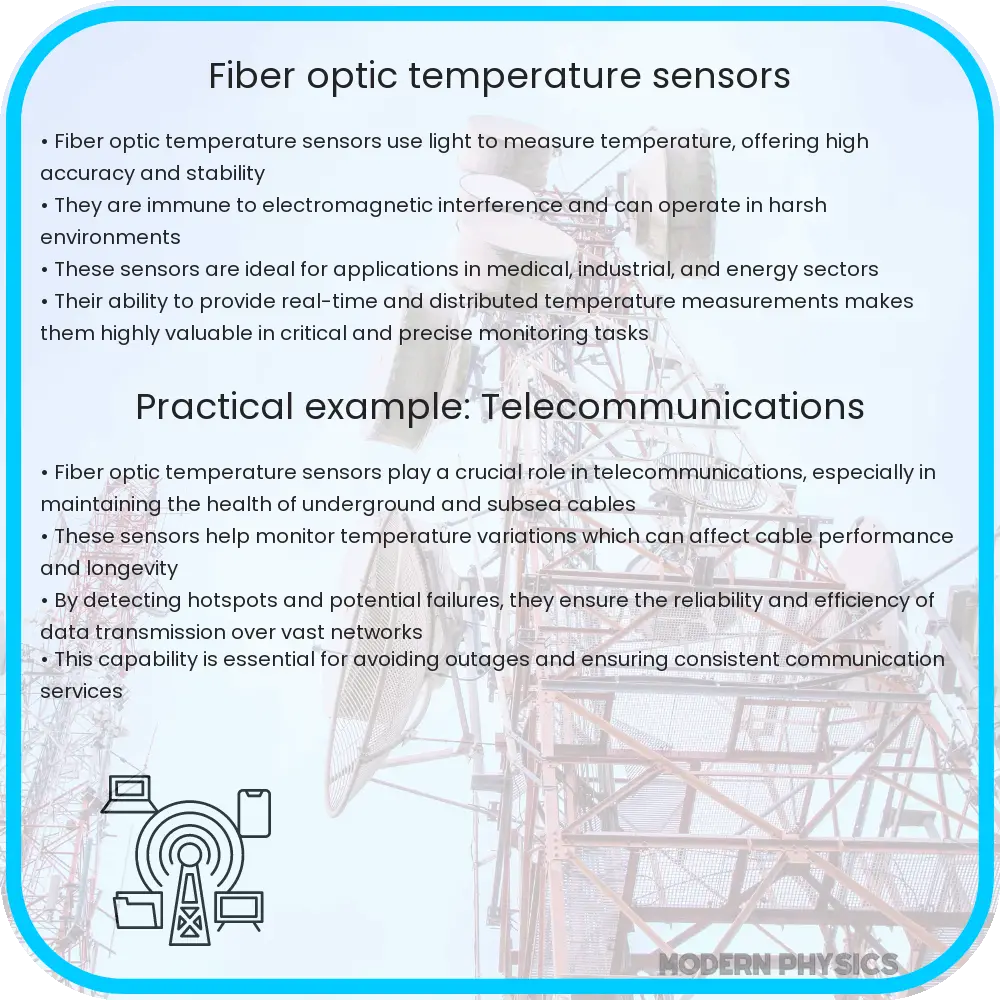
Fiber optic temperature sensors represent a significant advancement in precision temperature measurement technology. These sensors, based on the principles of optical physics, offer unparalleled accuracy, stability, and speed in various industrial, scientific, and environmental applications. This article delves into the mechanics of these sensors and examines their key benefits and applications.
Principles of Operation
The fundamental principle behind fiber optic temperature sensors is the use of light to measure temperature. These sensors typically employ a phenomenon known as the Raman Effect, where light scattered by molecules in a medium varies depending on the medium’s temperature. By analyzing this scattered light, the sensor can accurately determine the temperature of the environment.
Key Advantages
The advantages of fiber optic temperature sensors are numerous:
- Precision: They offer high accuracy, often within a fraction of a degree Celsius, making them ideal for precise temperature monitoring.
- Stability: Unlike traditional sensors, these do not drift over time, ensuring consistent readings.
- Speed: They provide rapid temperature readings, enabling real-time monitoring in dynamic environments.
- Electromagnetic Immunity: Being optical in nature, they are immune to electromagnetic interference, which is critical in environments with high electromagnetic fields.
- Remote Sensing Capability: Fiber optic sensors can measure temperatures over long distances, allowing for monitoring in hazardous or inaccessible areas.
Applications
Fiber optic temperature sensors find applications in diverse fields:
- Medical Field: For monitoring temperatures in MRI machines and other sensitive medical equipment.
- Energy Sector: In monitoring the temperature of power generation equipment, especially in nuclear reactors where radiation precludes electronic sensors.
- Environmental Monitoring: For tracking temperature changes in oceans and atmospheric studies.
- Industrial Processes: Where precise temperature control is essential for product quality.
These sensors are revolutionizing how industries and scientists measure and react to temperature changes. With their precision, stability, and speed, they are set to become indispensable tools in an increasingly data-driven world.
Technological Innovations in Fiber Optic Sensors
The technology behind fiber optic temperature sensors is continually evolving. Recent innovations include the development of distributed temperature sensing (DTS) systems. DTS systems utilize the entire length of the optical fiber as a continuous sensor, allowing for temperature mapping over large areas. This is particularly beneficial for monitoring long pipelines, large industrial complexes, and environmental monitoring over vast geographical areas.
Challenges and Future Prospects
Despite their numerous advantages, fiber optic temperature sensors face certain challenges. The initial cost and complexity of installation can be higher than traditional sensors. However, their long-term reliability and lower maintenance requirements can offset these initial expenses. Future developments are likely to focus on reducing costs and enhancing the usability of these systems, making them more accessible for a broader range of applications.
Integrating with IoT and Big Data
Another exciting frontier for fiber optic temperature sensors is their integration with the Internet of Things (IoT) and big data analytics. By connecting these sensors to IoT networks, data can be collected in real-time and analyzed using advanced algorithms, providing insights for predictive maintenance, process optimization, and environmental management.
Conclusion
Fiber optic temperature sensors represent a paradigm shift in temperature monitoring and control. Their precision, stability, and speed, combined with immunity to electromagnetic interference and remote sensing capabilities, make them highly valuable in a wide range of applications. While challenges in cost and complexity exist, ongoing technological advancements and integration with IoT and big data are set to broaden their applicability. As industries and scientific research increasingly rely on accurate and real-time data, fiber optic temperature sensors are poised to play a crucial role in this data-driven future.
Is this conversation helpful so far?