
Nanoimprint lithography (NIL) is a materials science technique for precise, efficient nanoscale patterning, used in microchip and nanostructure fabrication.
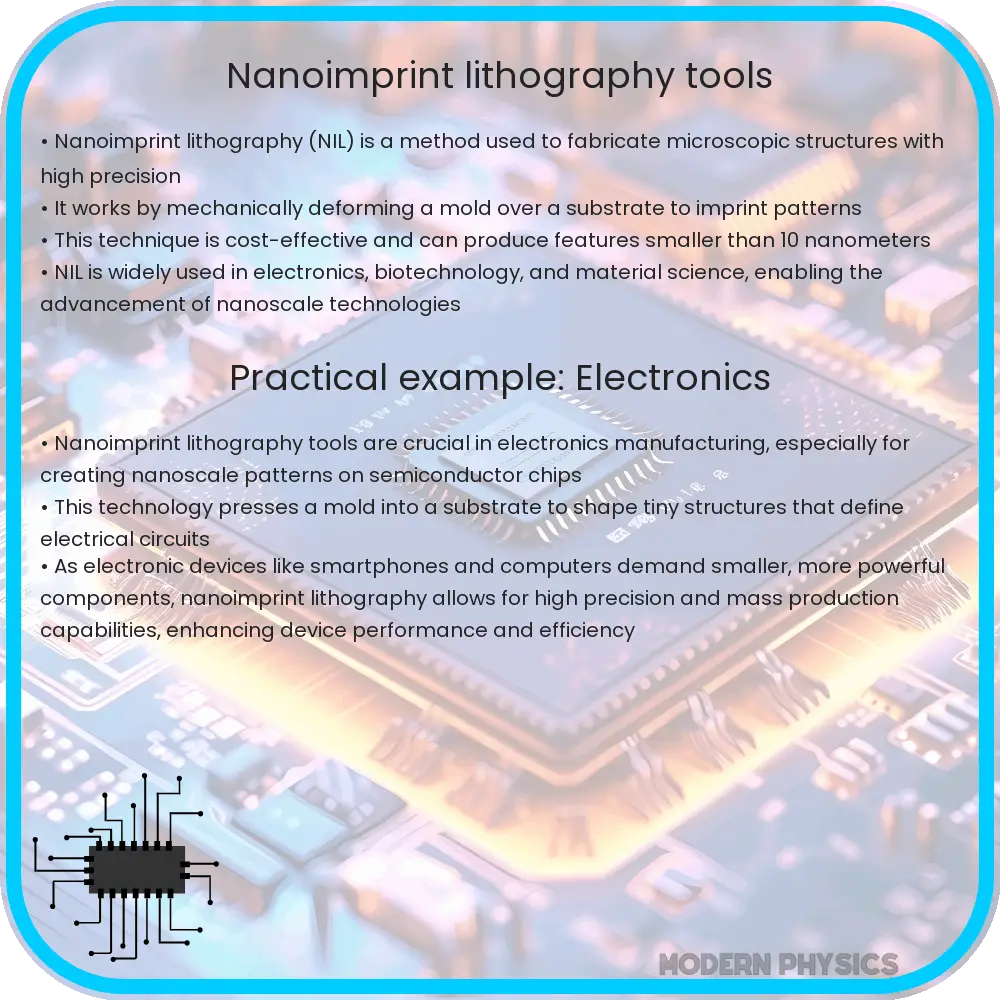
Nanoimprint Lithography Tools: Precision, Efficiency & Innovation in Materials Science
Nanoimprint lithography (NIL) is a groundbreaking technique in the field of materials science, pivotal for its precision and efficiency in patterning at the nanoscale. This method stands out in the fabrication of microchips, biochips, and other nanostructures, offering significant advantages over traditional lithography in terms of cost, simplicity, and throughput.
Understanding Nanoimprint Lithography
Nanoimprint lithography works fundamentally by mechanically deforming a substrate covered with a resist layer, using a mold with the desired pattern. There are two main types of NIL: thermal NIL and UV NIL. In thermal NIL, heat is applied to make the resist pliable, while in UV NIL, the resist is a UV-curable polymer that hardens when exposed to UV light post-impression.
- Thermal NIL leverages heat to soften the resist before the imprinting process begins. Temperatures typically range from 90°C to 200°C, depending on the resist material.
- UV NIL, on the other hand, uses UV light to cure the resist once it has been imprinted, functioning effectively at room temperatures and allowing the use of substrates that are sensitive to higher temperatures.
Components of Nanoimprint Lithography Tools
The essential components of nanoimprint lithography tools include the template or mold, the resist dispensing system, the imprint head or press, alignment system, and the substrate holder. Each of these parts must perform with high precision to ensure the accurate replication of nanoscale features across the entire substrate.
- Template or Mold: Typically made from silicon or quartz, the mold is engineered with the negative of the desired pattern. Advanced techniques such as electron beam lithography are often used to create these molds.
- Resist Dispensing System: This system carefully deposits the polymer resist across the substrate, ensuring a uniform layer that will accurately convey the pattern from the mold under pressure.
- Imprint Head or Press: This applies the necessary force to imprint the resist-covered substrate. The pressure and temperature (for thermal NIL) must be finely controlled to avoid defects.
- Alignment System: Crucial for layer-to-layer accuracy, this system aligns the mold and the substrate with exceptional precision to ensure that the imprinting is performed correctly over multiple layers.
- Substrate Holder: Holds the substrate in place and ensures it remains flat and stable during the imprinting process.
The operation of NIL tools is a delicate balance of these components, demanding meticulous calibration and control. This precision engineering enables the replication of patterns with feature sizes down to a few nanometers, a capability critical for advanced electronics and materials science applications.
Advantages of Nanoimprint Lithography
The appeal of nanoimprint lithography lies in its simplicity and efficiency. Unlike photolithography, NIL does not require complex optical systems or vacuum environments, making it less expensive and more accessible for laboratories and industries. Moreover, the direct imprinting method of NIL avoids issues with resolution limits imposed by light diffraction or beam scattering, common in other lithographic techniques. As a result, NIL can achieve higher resolution and pattern fidelity, which is vital for next-generation nanoelectronics and photonics applications.
In addition to its technical benefits, NIL is lauded for its ability to rapidly prototype and scale up production, offering a valuable tool for both research and industrial applications. One of the most significant advantages of NIL is its superb pattern uniformity and repeatability over large areas, a crucial factor for manufacturing processes.
Future Trends and Developments in Nanoimprint Lithography
As technology advances, the landscape of nanoimprint lithography continues to evolve. Researchers are consistently seeking methods to enhance throughput and reduce costs further. Innovations like roll-to-roll nanoimprint lithography and soft lithography are set to revolutionize the production processes by enabling continuous, high-speed manufacturing of nanoscale devices.
- Roll-to-Roll Nanoimprint Lithography: This technique involves transferring nanostructures onto flexible substrates using a rolling mechanism. It’s particularly suited for the mass production of nanoscale features across large areas and is expected to significantly impact sectors like solar energy and flexible electronics.
- Soft Lithography: Utilizes elastomeric stamps to replicate patterns, offering a cost-effective and simpler alternative for creating micro- and nano-scale features, particularly useful in the biomedical field for tissue engineering and microfluidics.
Further down the line, incorporating artificial intelligence and advanced process control systems in nanoimprint lithography can potentially optimize the precision and efficiency of pattern replication. These future technologies will not only enhance the capabilities of NIL but also extend its applications to new and emerging fields.
Conclusion
Nanoimprint lithography stands as a pivotal technology in modern materials science, offering unrivaled precision and efficiency in the fabrication of nanostructures. This method circumvents the limitations found in traditional lithographic techniques by utilizing mechanical imprinting, which allows for superior resolution and pattern fidelity. The simplicity and cost-effectiveness of NIL make it an increasingly attractive option for not only traditional electronics but also for innovative applications in photonics, biotechnology, and flexible electronics.
With continuous advancements in this field such as roll-to-roll processing and potential AI integration, NIL is set to broaden its impact, promising a future where nanoscale precision is accessible across various industries. As we move forward, the evolution of nanoimprint lithography will undoubtedly play a crucial role in shaping the next generation of technological developments, making an indelible mark on both science and industry.