
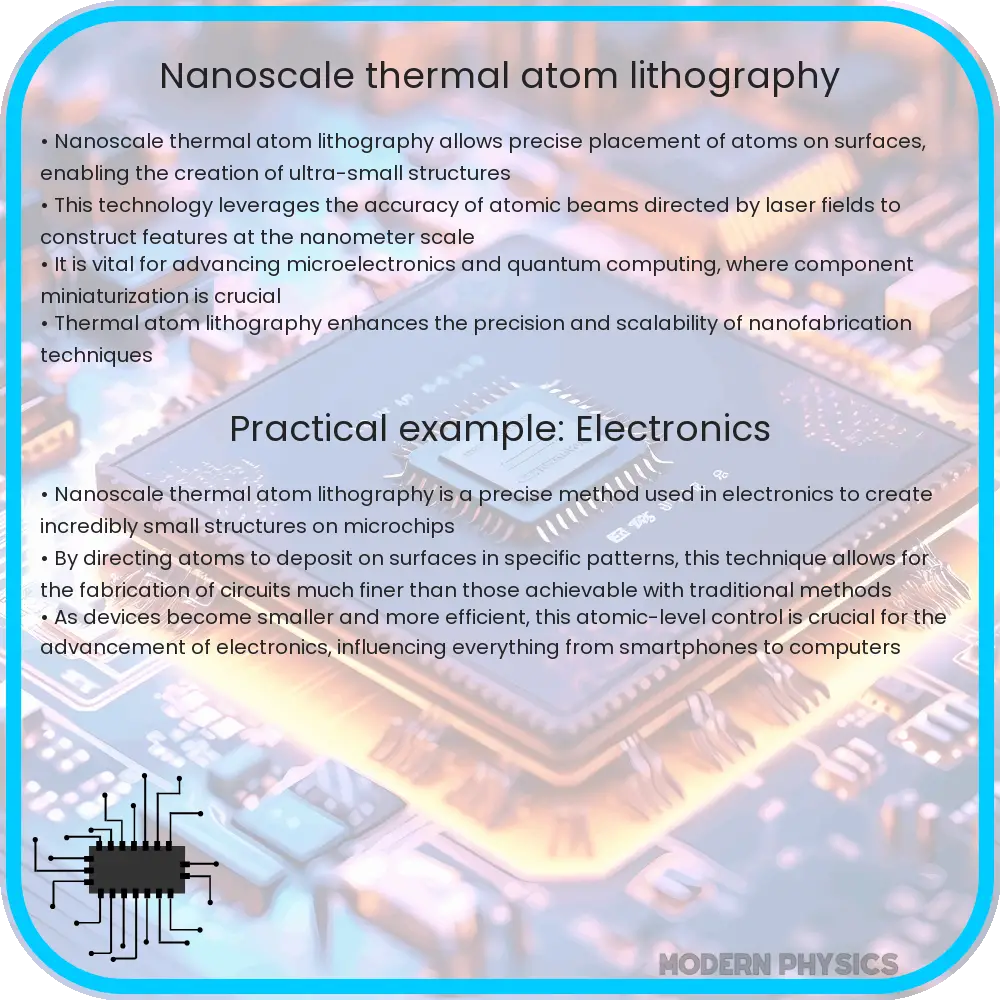
Nanoscale Thermal Atom Lithography (NTAL) is a precise fabrication technique for creating nanostructures using thermal energy to direct atom deposition onto substrates.
Introduction to Nanoscale Thermal Atom Lithography
Nanoscale Thermal Atom Lithography (NTAL) is an advanced technique that uses controlled thermal energy to manipulate atoms directly onto substrates, creating precise nanostructures. This method is pivotal for the fabrication of micro and nanoscale devices and has extensive applications in electronics, optics, and materials science.
How Does Nanoscale Thermal Atom Lithography Work?
The process of NTAL begins with the generation of a thermal atomic beam. Atoms or molecules are heated in an oven to a high temperature, causing them to evaporate and form a beam. This beam of excited atoms is then directed towards a substrate. A mask with nano-apertures or patterns is positioned between the atomic beam and the substrate. As the atoms pass through these tiny openings, they deposit onto the substrate in the desired pattern.
This technique is remarkable for its ability to achieve feature resolutions on the order of tens of nanometers. The precision is largely due to the control over the thermal energy of the atoms, which influences their trajectory and the final deposition pattern.
Key Advantages of NTAL
- High Resolution: NTAL can create structures with extremely fine details, essential for the development of next-generation nanodevices.
- Material Versatility: This method can be used with a wide range of materials, including metals, semiconductors, and insulators, making it highly versatile for different applications.
- Cost-Effective: NTAL offers a less expensive alternative to other lithographic techniques, such as electron beam lithography, as it requires simpler equipment and fewer processing steps.
- Scalability: The technique is suitable for both small-scale laboratory experiments and large-scale industrial production, providing a versatile approach across various research and development settings.
Applications of Nanoscale Thermal Atom Lithography
NTAL finds its application across several fields:
- Electronics: In the development of nanoscale transistors, sensors, and integrated circuits, NTAL plays a critical role in pushing the boundaries of how small these devices can be fabricated.
- Photonics: The creation of nano-optical devices such as waveguides, grating, and lenses benefits significantly from the high precision and resolution of NTAL.
- Material Science: NTAL is used in the structuring of new materials at the nanoscale, which can lead to the discovery of new material properties and applications.
As the demand for smaller and more efficient devices continues to grow, NTal’s importance in modern technological developments is set to increase. Its ability to fabricate complex nanoscale patterns efficiently and cost-effectively makes it an indispensable tool in the field of nanotechnology.
Challenges in Implementing NTAL
While NTAL offers numerous advantages, it also faces several challenges that researchers and engineers must address:
- Alignment Precision: The alignment of the mask with the substrate needs to be extremely precise. Any misalignment can cause defects in the final nanostructures, impacting the performance of the device.
- Thermal Control: Maintaining the precise thermal conditions crucial for the stability of the atomic beam can be challenging, especially in varying operational environments.
- Mask Fabrication: Creating and maintaining nano-apertures in the mask without damage or wear over time is complex and requires high-precision engineering.
- Substrate Compatibility: The substrate material must be carefully chosen to ensure compatibility with the selected atoms and to maintain structural integrity at high temperatures.
Future Directions in NTAL Technology
Research in NTAL continues to evolve, with ongoing advancements focused on overcoming current limitations and enhancing capabilities. Future developments may include:
- Improved Mask Technology: Innovations in mask design and material will likely improve durability and precision, enabling more complex nanoscale patterning.
- Integration with Other Techniques: Combining NTAL with other lithographic and fabrication methods could lead to hybrid techniques that exploit the strengths of each approach.
- Automation and Control Systems: Advanced control systems for better precision in atom deposition and mask alignment might be developed, increasing throughput and consistency.
Conclusion
Nanoscale Thermal Atom Lithography (NTAL) is a groundbreaking technique in the field of nanofabrication, boasting the capability to craft intricate nanostructures with impressive resolution and material versatility. Its role in advancing technology, particularly in electronics and photonics, is invaluable, offering new possibilities for device miniaturization and efficiency. Despite facing hurdles like precise mask alignment and thermal management, the potential improvements and evolving research point to a bright future for NTAL. With continuous advancements, NTAL not only promises to enhance current applications but also paves the way for novel innovations in nanotechnology. In an era where the demand for smaller, faster, and more efficient devices is ever-increasing, NTAL stands as a cornerstone technology, ready to meet these challenges head-on.