
Learn about non-Newtonian fluids, which alter their viscosity in response to applied stress, differing significantly from Newtonian fluids like water.
Introduction to Non-Newtonian Fluids
Non-Newtonian fluids are substances that respond in unconventional ways when subjected to stress. Unlike Newtonian fluids, such as water, whose viscosity remains constant regardless of the forces acting upon them, non-Newtonian fluids have viscosities that change depending on the rate of applied stress. This unique property allows these fluids to play a significant role in a variety of areas, from culinary arts to cutting-edge engineering applications.
Types of Non-Newtonian Fluids
Non-Newtonian fluids typically fall into one of two categories based on their behavior under stress: shear-thickening and shear-thinning fluids.
- Shear-Thickening Fluids (Dilatant): These fluids, such as cornstarch mixed with water, increase in viscosity when subjected to force. This is because the particles in the fluid rearrange themselves to form a structure that resists flow.
- Shear-Thinning Fluids (Pseudoplastic): These fluids, such as ketchup or blood, decrease in viscosity under stress. They become easier to stir or pour as force is applied because the particles align in the direction of flow, reducing resistance.
There are also more complex non-Newtonian behaviors such as thixotropic, which become less viscous over time under stress, and rheopectic, which become more viscous over time.
Applications in Gear Safety and Impact Resistance
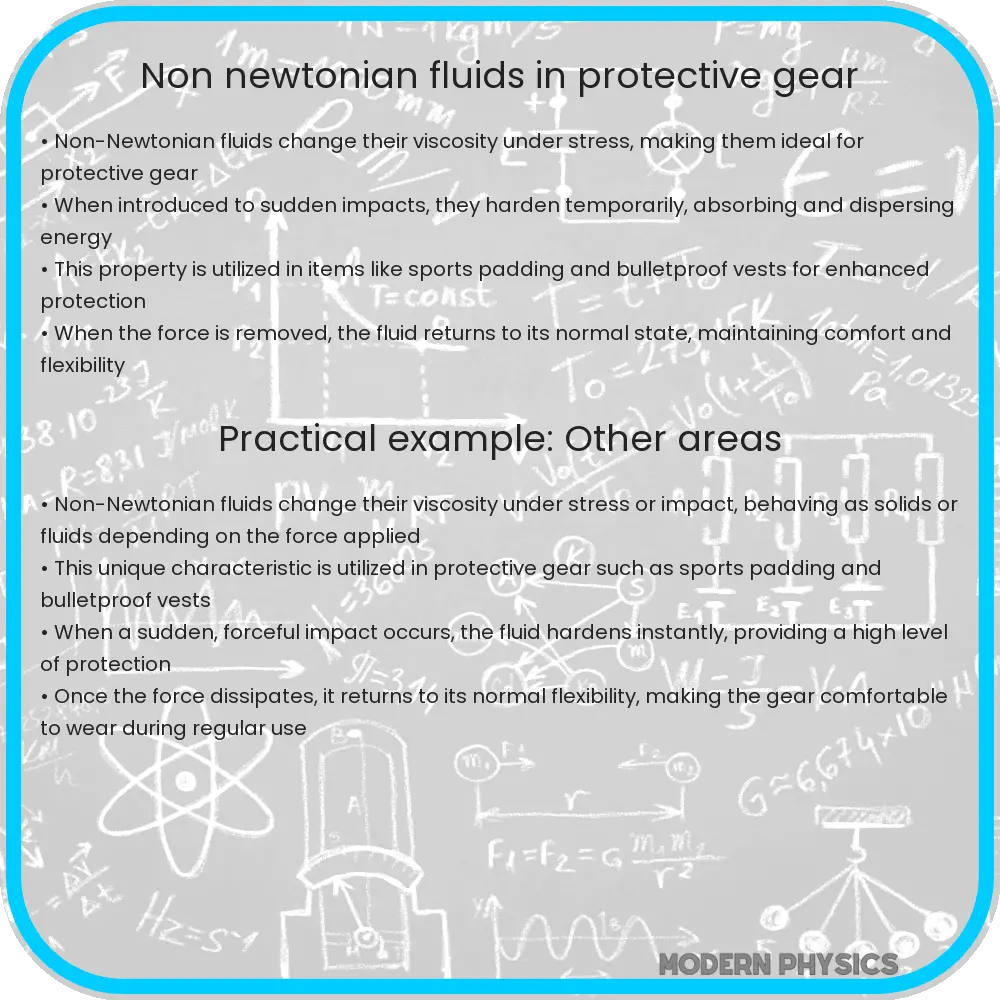
One of the most compelling applications of non-Newtonian fluids is in the development of protective gear. The dynamic viscosity of these fluids makes them excellent at absorbing and dissipating energy, which is crucial in reducing injuries from impacts.
- Sports Equipment: Non-Newtonian fluids are used in the padding of sports gear, like football helmets or shin guards, enhancing protection against sudden strikes by hardening upon impact.
- Military and Law Enforcement: Body armor integrates non-Newtonian materials to improve protection against ballistic impacts and sharp objects. The fluid hardens instantly upon impact, providing a higher level of defense compared to traditional materials.
- Automotive Industry: Non-Newtonian fluids find applications in automotive safety devices, such as seat belts and airbags, where their properties help absorb energy from collisions more efficiently, reducing the risk to occupants.
Innovation in Material Science
The unique properties of non-Newtonian fluids have also spurred innovation in material science. Scientists and engineers are continually exploring new combinations of materials to enhance the responsiveness and durability of these fluids for various industrial applications.
Challenges in Working with Non-Newtonian Fluids
Despite their advantages, non-Newtonian fluids also present unique challenges in both research and practical applications. Consistency in behavior across different conditions, such as temperature and pressure, can be difficult to achieve. Additionally, the complexity in predicting their behavior makes modeling and simulation more demanding compared to Newtonian fluids.
- Manufacturing Complexity: The production of non-Newtonian fluids, especially those designed for specific industrial uses, often requires advanced techniques and precise control, adding to the cost and complexity of manufacturing.
- Environmental and Health Concerns: Certain non-Newtonian fluids may involve substances that are hazardous or difficult to dispose of safely, raising environmental and health issues that must be addressed carefully.
Educational Implications
The intriguing characteristics of non-Newtonian fluids make them an excellent topic for educational purposes, particularly in demonstrating the principles of fluid dynamics. Their unconventional behavior can spark curiosity and engage students more effectively in learning basic to advanced concepts in physics and engineering.
- Classroom Demonstrations: Simple experiments with cornstarch and water can illustrate complex phenomena such as shear thickening, making the learning process interactive and memorable.
- Research Projects: For advanced students, studying the properties of these fluids can lead to projects that encourage problem-solving and innovation, potentially contributing to new scientific understandings and applications.
Conclusion
Non-Newtonian fluids represent a fascinating area of study that bridges theoretical physics with practical engineering. These substances challenge our traditional understanding of how fluids behave, presenting both opportunities for innovation and challenges in application. The advancements they have already enabled in areas ranging from safety gear to culinary arts showcase their versatility and importance. Moreover, their ability to perplex and fascinate continues to make them an invaluable tool in education, making complex scientific principles accessible and engaging. Understanding and harnessing the unique properties of non-Newtonian fluids promises to drive further innovations across a broad spectrum of disciplines, making it a thrilling field to watch as technology and materials science continue to evolve.