
Homogeneous catalysts are catalysts that exist in the same phase as reactants, noted for their efficiency, selectivity, and sustainability in chemical reactions.
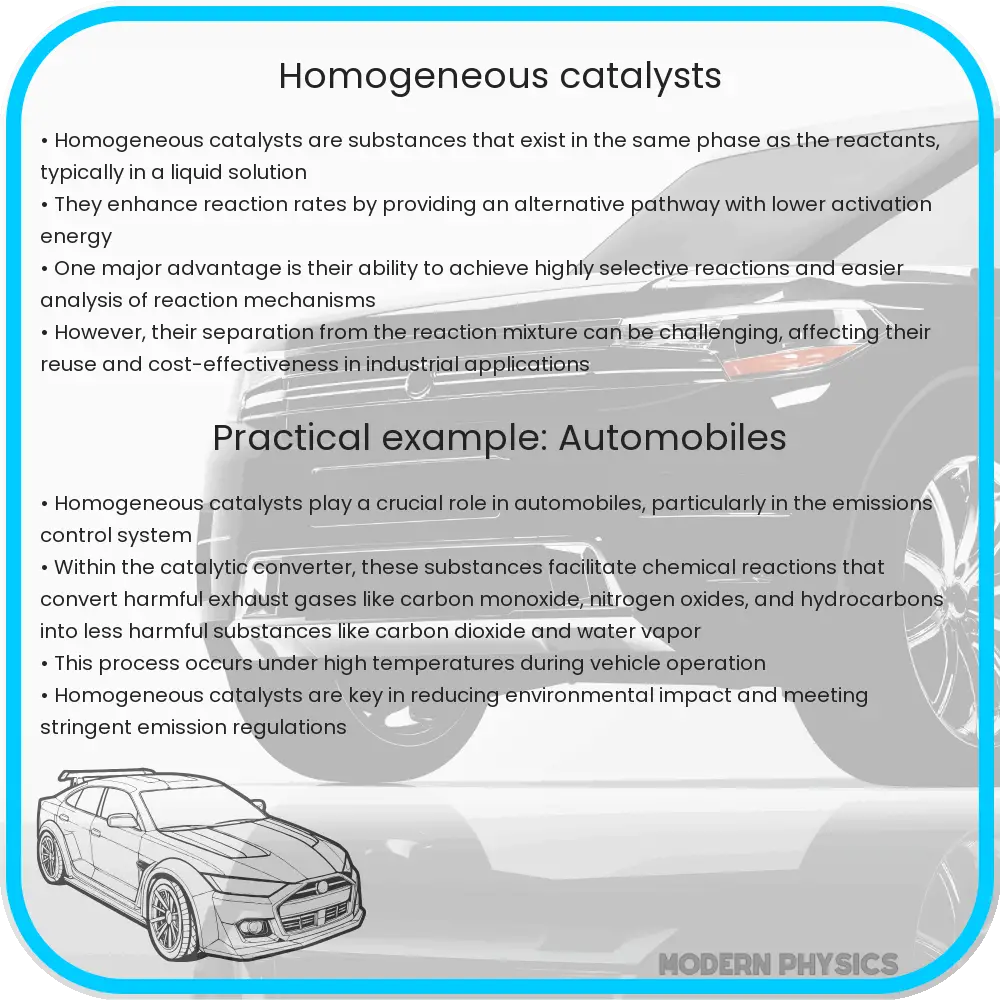
Understanding Homogeneous Catalysts: Efficiency, Selectivity, and Sustainability
Catalysts are substances that speed up chemical reactions without being consumed by the reaction itself. They play a crucial role in industrial processes, environmental management, and the production of pharmaceuticals. Among the various types of catalysts, homogeneous catalysts stand out due to their efficiency, selectivity, and potential for sustainability. In this article, we will explore what homogeneous catalysts are, how they work, and their advantages in various applications.
What are Homogeneous Catalysts?
Homogeneous catalysts are catalysts that exist in the same phase (liquid, gas) as the reactants and products. Typically, these catalysts are soluble in the reaction medium, which allows them to interact more effectively with the reactant molecules. This uniform distribution is a key to their efficiency and selectivity.
How Homogeneous Catalysts Work
The mechanism of action for homogeneous catalysts involves the formation of an intermediate complex with the reactants. This complex lowers the activation energy required for the reaction to proceed, thus speeding up the reaction rate. The catalyst itself remains unchanged after the reaction and can be reused multiple times, highlighting their potential for sustainability in chemical processes.
- Coordination: The first step is the coordination of the catalyst to the reactant molecules. This is facilitated by the soluble nature of the catalyst.
- Reaction: Next, a series of chemical transformations occur, typically involving several intermediate states.
- Regeneration: Finally, the product is released, and the catalyst is regenerated, ready to catalyze another reaction cycle.
Advantages of Homogeneous Catalysts
Homogeneous catalysts boast several advantages that make them particularly attractive for various chemical processes:
- High Efficiency: The ability to uniformly interact with reactants often leads to higher rates of reaction compared to heterogeneous catalysts, where the reactants must diffuse to the catalyst surface.
- Excellent Selectivity: These catalysts can often be designed to selectively produce a desired product, minimizing the formation of by-products and improving yield.
- Adaptability: Homogeneous catalysts can be modified at the molecular level to enhance their properties or to be tailored for specific reactions, giving chemists and engineers precise control over the reaction process.
Moreover, the soluble nature of homogeneous catalysts allows for easier monitoring and optimization of the conditions within the reaction environment, leading to improved outcomes and efficiencies.
Applications of Homogeneous Catalysts
Homogeneous catalysts find applications in a wide range of chemical processes, from the manufacture of everyday products to the synthesis of complex pharmaceuticals. Some notable examples include:
- Polymers Production: Catalysts are used in the polymerization reactions needed to produce various plastics and synthetic rubbers.
- Pharmaceutical Synthesis: Highly selective catalysts are essential for producing active pharmaceutical ingredients with the correct molecular configurations.
- Environmental Catalysis: These catalysts are used in processes designed to remove pollutants from air and water, showcasing their role in sustainable technologies.
As research and technology continue to evolve, the role of homogeneous catalysts in sustainable chemistry is only expected to grow, underscoring their importance in modern industrial processes.
Challenges and Limitations of Homogeneous Catalysts
Despite their many benefits, homogeneous catalysts also face some challenges that can limit their applicability in certain scenarios:
- Separation Issues: Since these catalysts are often soluble in the reaction medium, separating them from the reaction products can be costly and technically challenging, affecting the overall sustainability of the process.
- Sensitivity to impurities: Homogeneous catalysts can be sensitive to impurities in the reaction mixture, which can deactivate them or decrease their effectiveness.
- Cost: The synthesis and structural complexity of many homogeneous catalysts can make them more expensive compared to their heterogeneous counterparts.
Addressing these challenges through continuous research and innovation is essential for broadening the scope of applications of homogeneous catalysts and enhancing their economic and environmental viability.
Future Directions in Homogeneous Catalysis Research
The future of homogeneous catalysis looks promising with several areas of intense research focus:
- Development of more robust catalysts: Research is underway to design catalysts that are less sensitive to impurities and can be easily recovered and reused.
- Enhancement of selectivity and efficiency: Ongoing work aims to further enhance the selectivity and efficiency of these catalysts to make them viable for more complex reactions.
- Environmental impact reduction: Efforts are being made to develop catalysts that require milder condition and less energy, thereby reducing the environmental footprint of chemical processes.
These advancements are likely to open new pathways in the production of pharmaceuticals, environmentally-friendly materials, and energy-efficient processes.
Homogeneous catalysts, by efficiently catalyzing reactions under uniform conditions and offering high selectivity, have proven to be indispensable in modern chemistry and industry. Their ability to be fine-tuned at a molecular level allows for a varying range of applications, from environmental sustainability to pharmaceutical innovations. While challenges such as catalyst recovery and sensitivity to impurities exist, ongoing research and technological advancements promise to widen their applicability and efficiency. The continuous evolution in the field of homogeneous catalysis is a testament to the dynamic nature of scientific research and its potential to drive progress across multiple industries. In light of these aspects, the importance of homogeneous catalysts in advancing chemical processes while embracing sustainability can hardly be overstated.