
Explore the revolutionary world of Liquid Crystal Elastomers (LCEs), their unique properties, applications, and the future of adaptive smart materials.
Liquid Crystal Elastomers: Revolutionizing Material Science
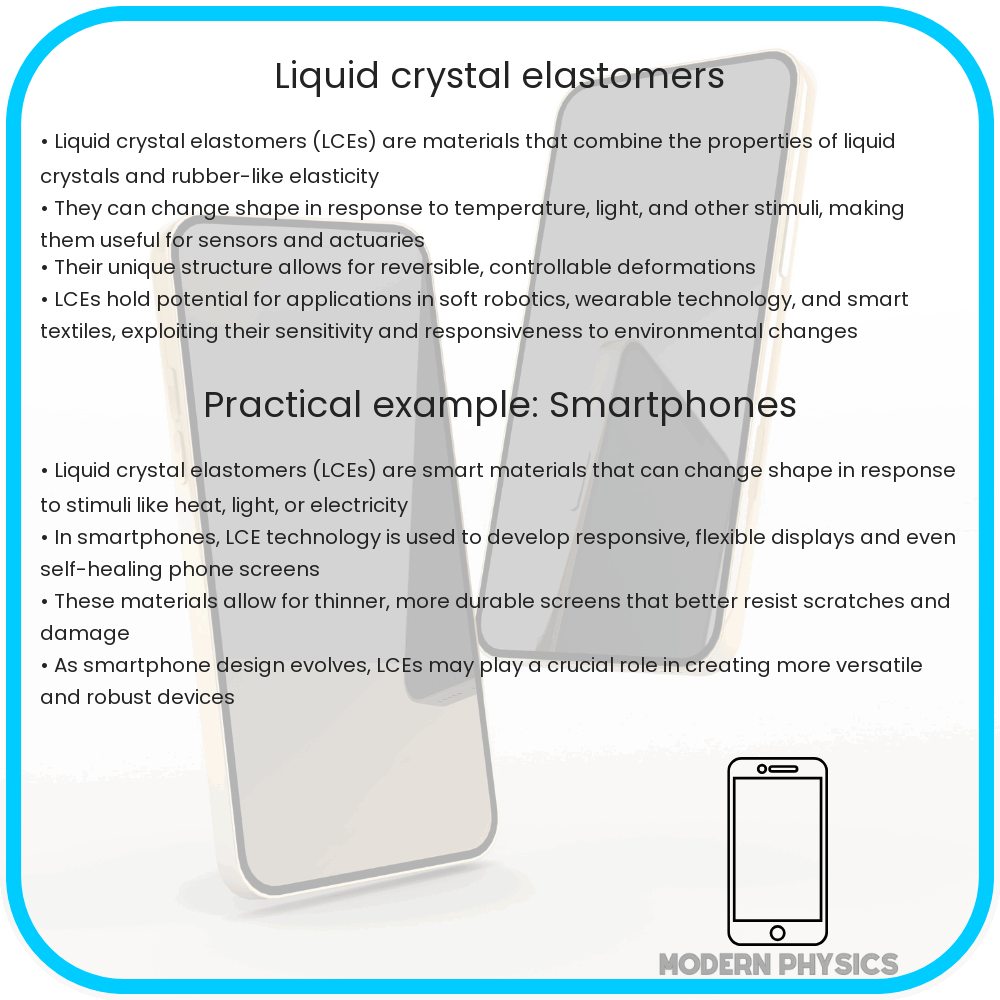
Liquid Crystal Elastomers (LCEs) are emerging as a forefront of innovative materials, combining the unique properties of liquid crystals with the flexibility and robustness of elastomers. These materials exhibit extraordinary capabilities, making them highly adaptive, responsive, and potentially transformative in various applications, from biomedical devices to aerospace engineering.
Understanding the Structure and Composition
LCEs are composed of crosslinked polymer networks integrated with liquid crystalline phases. This unique composition results in materials that can change shape, stiffness, and even color in response to external stimuli such as heat, light, or chemical environment. The molecular alignment within LCEs, typically depicted as (R1R2COO−)n, where R1 and R2 represent variable organic groups, is responsible for their distinct characteristics.
Characteristics and Properties
The hallmark of LCEs lies in their exceptional responsiveness to external stimuli. Unlike traditional materials, LCEs can exhibit significant shape changes; for example, they can elongate, contract, bend, or twist in response to changes in temperature. This behavior, known as thermo-mechanical response, underscores their potential as smart materials capable of performing work or altering their properties on demand.
Responsive and Adaptive Behavior
LCEs’ sensitivity to environmental changes positions them as ideal candidates for adaptive structures and responsive interfaces. Their ability to undergo pre-programmed deformations makes them suitable for applications requiring materials that can adapt their shape or properties autonomously. This adaptability extends to various fields, including soft robotics, where LCEs can mimic the movements of living organisms, and smart textiles, where they can adjust porosity or rigidity in response to environmental conditions.
Applications in Technology and Medicine
The potential applications of LCEs span across diverse sectors. In medical devices, for instance, LCE-based sensors can detect and respond to changes in body temperature or chemical compositions, offering new avenues for patient monitoring and treatment. Similarly, in the realm of aerospace engineering, LCE components can adapt to thermal and mechanical stresses, enhancing the performance and longevity of spacecraft.
Challenges and Future Perspectives
Despite their promising attributes, LCEs face challenges that must be addressed to fully realize their potential. One of the primary hurdles is the complex synthesis and processing methods that are required to produce these materials. Furthermore, ensuring the uniform alignment of liquid crystal molecules within the elastomer matrix remains a significant challenge, as it is crucial for the material’s responsive behavior. Additionally, improving the durability and longevity of LCEs under continuous mechanical stress and environmental exposure is essential for practical applications.
Innovative Research and Development
The future of LCEs is bright, with ongoing research focusing on overcoming existing limitations and expanding their capabilities. Innovations in synthesis methods are aimed at simplifying production processes and enhancing the material’s structural integrity. Advances in molecular engineering are expected to lead to LCEs with more precise and diverse responsive behaviors, opening new possibilities for their application. Moreover, integrating LCEs with other smart materials and technologies, such as sensors and actuators, could lead to the development of even more sophisticated adaptive systems.
Conclusion
Liquid Crystal Elastomers represent a significant advancement in material science, offering a blend of adaptability, responsiveness, and smart functionalities that stand to revolutionize various industries. From creating more effective medical devices to enhancing aerospace components, the potential applications of LCEs are vast and varied. While challenges remain in their development and implementation, the continuous research and innovation in this field are paving the way for a future where smart materials like LCEs are integral to technological advancements and everyday life. As we move forward, the role of LCEs in creating more adaptive, efficient, and intelligent systems cannot be underestimated, marking a new era in the development of responsive and smart materials.