
Explore the unique properties and behaviors of elastomers, focusing on their elasticity, durability, and applications in various industries.
Understanding Elastomers: Essential Properties and Behaviors
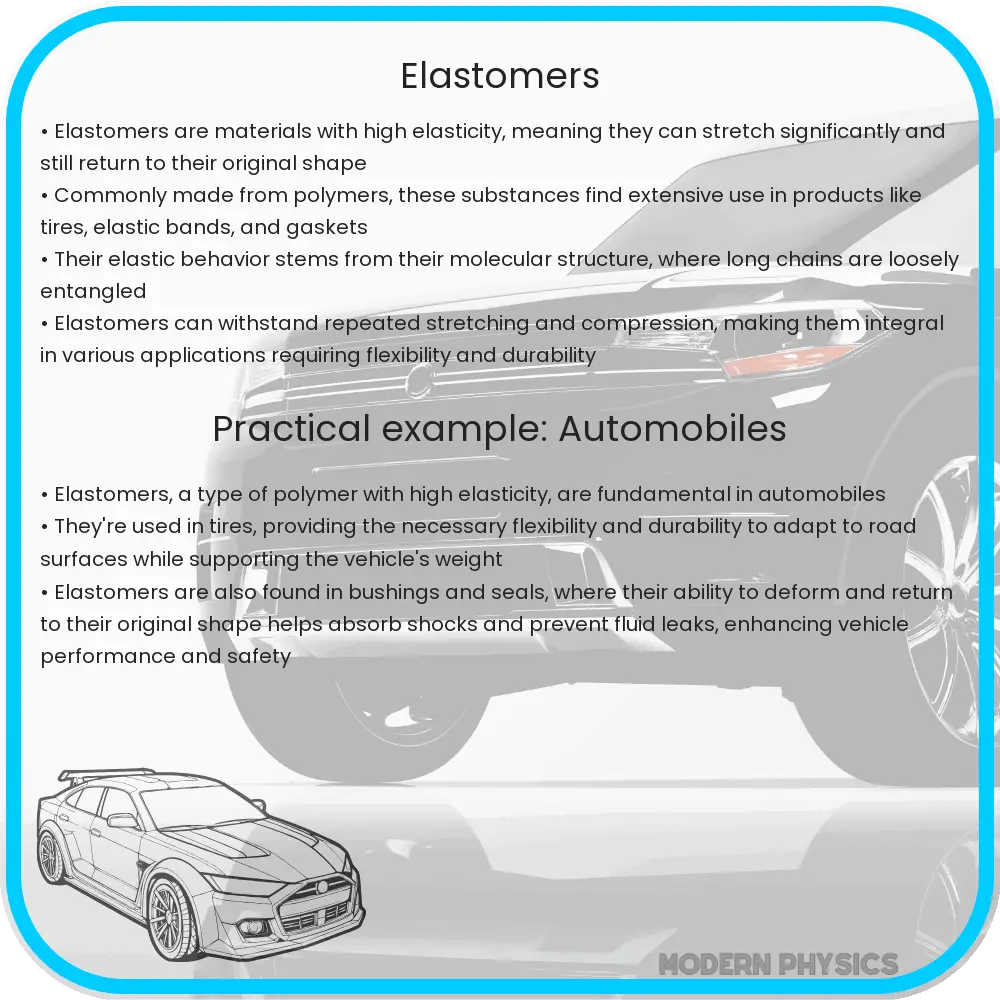
Elastomers, commonly known as rubber materials, are polymers characterized by their extraordinary ability to stretch and then return to their original shape. Unlike rigid materials, elastomers can experience large deformations and still recover fully. This unique property is primarily due to their molecular structure—long, coiled polymer chains that can be extended under force but revert back when the force is removed.
The Science of Elasticity
The elasticity of elastomers can be attributed to two principal factors: the entropy and energy of the polymer chains. When elastomers are stretched, the chains move from a state of disorder (high entropy) to a more ordered state (low entropy). The natural tendency of these chains is to return to a state of maximum disorder, which they achieve by retracting when the stretching force is removed. This behavior can be modeled and predicted using the statistical mechanics of polymers.
Mathematically, the strain (ε) in an elastomer subject to a stretching force can be described by the simple linear relationship in Hooke’s Law for small deformations:
where σ is the stress applied to the elastomer, E is the modulus of elasticity, and ε is the strain. For larger deformations, this relationship becomes nonlinear and more complex to describe.
Durability and Flexibility of Elastomers
The durability of an elastomer is its ability to withstand various conditions such as heat, chemicals, and physical wear over time without significant degradation. The flexibility, on the other hand, refers to the material’s ability to deform under stress without cracking. These properties make elastomers ideal for numerous applications across different industries.
Factors Affecting Durability and Flexibility
Several factors influence the durability and flexibility of elastomers:
- Temperature: Elevated temperatures can cause the polymer chains within elastomers to become more flexible, decreasing their viscosity and potentially leading to permanent deformation or thermal degradation.
- Oxidation: Exposure to oxygen, particularly at high temperatures, can result in the breaking of polymer chains, which deteriorates the mechanical properties of elastomers over time.
- Chemical Exposure: Certain chemicals can interact with the polymers in elastomers, causing swelling, softening, or even dissolution of the material.
- Physical Wear: Repeated stretching and relaxing of elastomers can lead to fatigue, reducing their ability to return to their original shape.
The combination of these factors dictates the life span and effectiveness of elastomers in practical applications. Ionizing radiation, mechanical stress, and environmental conditions like humidity and salinity also play critical roles.
Applications of Elastomers in Everyday Life
Elastomers are integral to many products and applications that we encounter daily. Their unique properties make them especially useful in various sectors:
- Automotive: In vehicles, elastomers are used for tires, hoses, belts, and gaskets, contributing to durability, safety, and fuel efficiency.
- Consumer Goods: Everyday items like elastic bands, footwear soles, and waterproof clothing rely on the flexible properties of elastomers.
- Healthcare: Elastomers play a crucial role in medical devices such as gloves, catheters, and tubing, where flexibility and biocompatibility are essential.
- Construction: In the construction industry, elastomers are used in sealants, adhesives, and insulation materials, enhancing building durability and energy efficiency.
Advancements in Elastomer Technology
Recent developments in polymer science have led to significant improvements in elastomer performance. Innovations such as synthetic elastomers with enhanced chemical and temperature resistance are expanding their usability. Furthermore, the integration of nanotechnology has led to the creation of nano-composite elastomers whose mechanical properties are superior to traditional forms. These advancements open new possibilities for elastomers in high-performance and demanding environments.
Environmental Impact and Sustainability
As the use of elastomers grows, so does the concern for their environmental impact. The production and disposal of elastomers, particularly synthetic types, involve processes that can be harmful to the environment. Efforts are underway to develop more sustainable forms of elastomers, including bio-based options and recycling methods that reduce waste and lower carbon footprints. These innovations are crucial for ensuring that the benefits of elastomers are enjoyed without compromising environmental health.
Conclusion
Elastomers are remarkable materials that combine flexibility, durability, and an extensive range of applications—from everyday items to advanced industrial uses. Understanding the characteristics that govern their behavior, such as elasticity, durability, and flexibility, allows engineers and scientists to innovate and improve their applications further. As technology progresses, the development of more sustainable and high-performance elastomers will continue to play a vital role in various industries, enhancing the quality of products and the efficiency of operations while also addressing environmental concerns. Embracing both the challenges and opportunities related to elastomers is essential for advancing their application and sustainability in the future.