
Explore Ion Cyclotron Resonance Heating (ICRH), a key technology for efficiently heating plasma in nuclear fusion, promising a future of clean and limitless energy.
Understanding Ion Cyclotron Resonance Heating (ICRH)
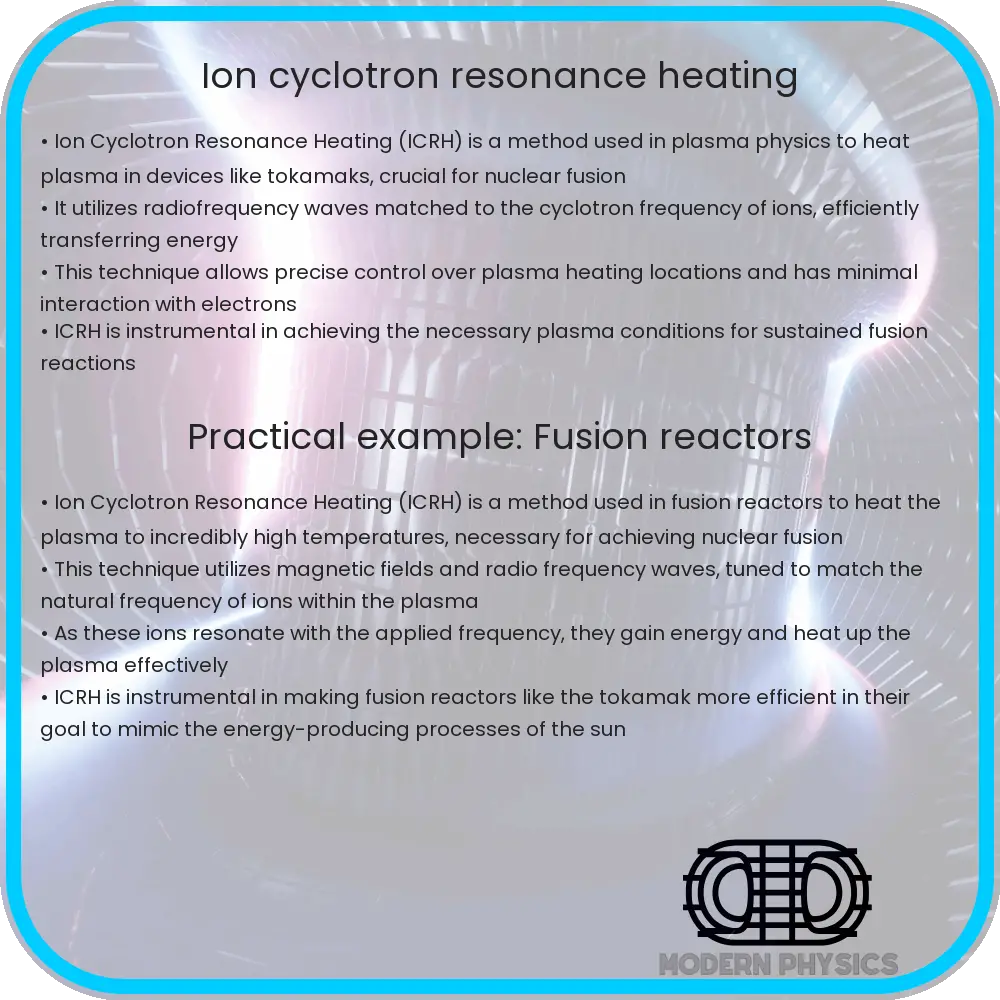
Ion Cyclotron Resonance Heating (ICRH) is a sophisticated method used to heat plasma in the field of nuclear fusion. As the quest for sustainable and clean energy sources intensifies, ICRH offers a promising avenue by efficiently heating plasma to the high temperatures needed for fusion reactions. This technique leverages the principles of magnetic resonance, targeting ions within the plasma with electromagnetic waves to increase their energy levels.
Principles of ICRH
At the heart of ICRH is the concept of cyclotron resonance, where ions in a magnetic field absorb energy from electromagnetic waves at a specific frequency. This frequency, known as the cyclotron frequency, is directly proportional to the magnetic field’s strength and inversely proportional to the ion’s mass. By adjusting the frequency of the electromagnetic waves to match the cyclotron frequency of the ions, ICRH efficiently transfers energy to the plasma, raising its temperature to the requisite levels for fusion.
Advantages of ICRH
- Efficiency: ICRH can selectively heat ions to very high temperatures, making it an efficient method for plasma heating.
- Control: The technique allows for precise control over the heating process, enabling the optimization of fusion conditions.
- Flexibility: ICRH can be adapted to different types of fusion reactors, including tokamaks and stellarators.
Components of an ICRH System
An ICRH system comprises several key components:
- Radio Frequency (RF) Generators: These generate the electromagnetic waves at the desired frequencies.
- Antennas: Positioned close to the plasma, antennas transmit the RF energy into the plasma.
- Magnetic Field System: Essential for creating the conditions for cyclotron resonance, the magnetic field must be precisely controlled.
By manipulating these elements, scientists can fine-tune the ICRH process to achieve optimal heating rates and plasma conditions for nuclear fusion. As research and technology advance, ICRH continues to play a crucial role in the development of fusion energy, offering a glimpse into a future powered by clean and limitless energy.
Challenges and Future Directions in ICRH
Despite its advantages, ICRH faces several challenges that researchers are actively working to overcome. One of the primary concerns is the potential for RF power to be absorbed by electrons instead of ions, which can reduce the efficiency of plasma heating. Additionally, the complexity of the ICRH system and the need for precise control of the electromagnetic waves and magnetic fields demand sophisticated engineering solutions and ongoing optimization.
Future advancements in ICRH technology are closely linked to improvements in materials science, RF technology, and computational modeling. Enhanced materials capable of withstanding the extreme conditions within fusion reactors are essential for the development of more efficient and durable ICRH systems. Furthermore, advances in RF technology could lead to more effective and targeted energy delivery to the plasma, while sophisticated computational models are crucial for predicting and optimizing the interactions between electromagnetic waves and plasma.
Integrating ICRH with Fusion Energy Development
As the global community continues to explore sustainable energy solutions, the integration of ICRH into fusion energy research represents a critical pathway forward. Collaboration between physicists, engineers, and materials scientists is essential to address the challenges and harness the full potential of ICRH. The ongoing development of international fusion projects, such as the ITER (International Thermonuclear Experimental Reactor), underscores the importance of ICRH in achieving practical fusion energy production.
Conclusion
Ion Cyclotron Resonance Heating stands as a cornerstone technology in the pursuit of controlled nuclear fusion, offering a high-efficiency method for heating plasma to the extreme temperatures required for fusion reactions. While challenges remain in optimizing this technology for broader application, the potential benefits of ICRH in enabling a clean, sustainable energy future are undeniable. Continued research and development efforts are crucial to overcome existing hurdles and fully realize the promise of fusion energy, powered in part by the advanced capabilities of ICRH. As we move forward, the integration of ICRH into fusion energy projects symbolizes a significant step towards achieving an energy-abundant and environmentally friendly world.