
Explore the efficiency and precision of Electron Cyclotron Heating (ECH) in plasma physics and its pivotal role in advancing controlled fusion research.
Understanding Electron Cyclotron Heating: Principles and Applications
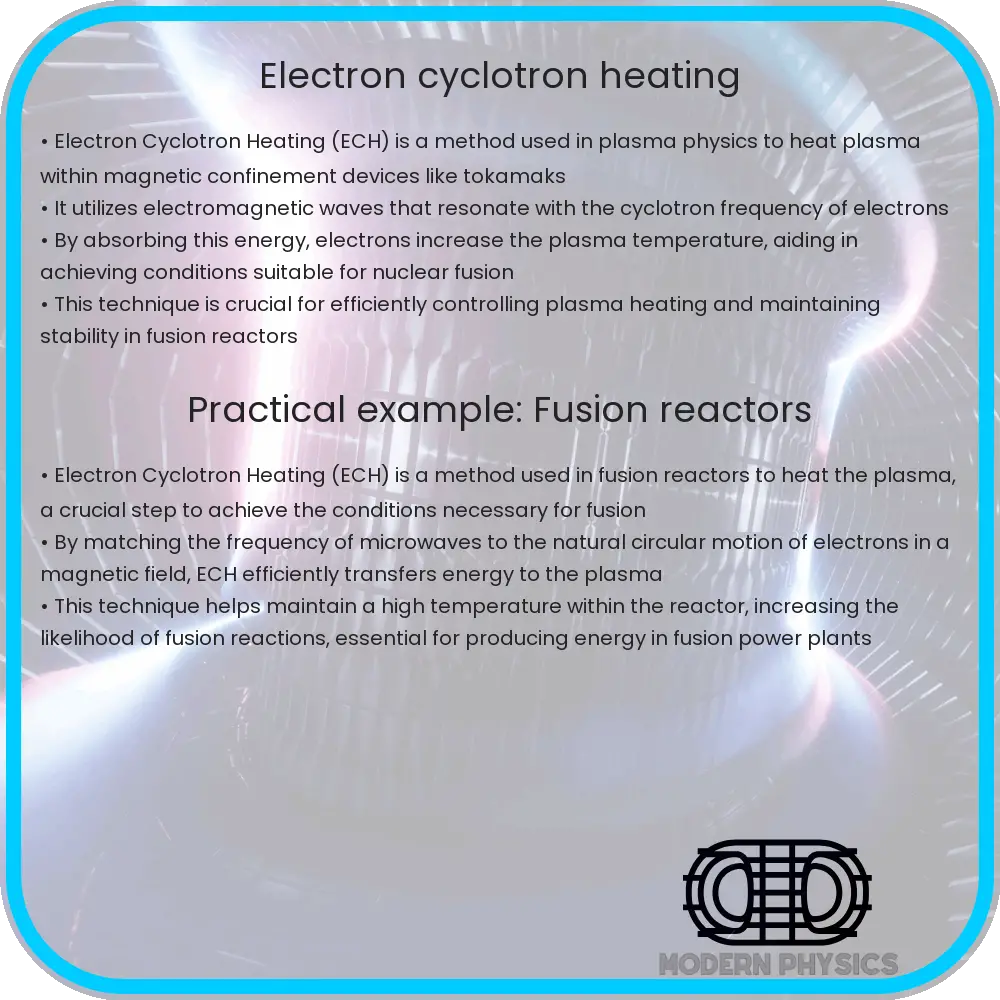
Electron Cyclotron Heating (ECH) is a sophisticated method used in plasma physics and controlled fusion research to heat plasma to extremely high temperatures. This technique utilizes the principle of cyclotron resonance to efficiently transfer energy to electrons in a plasma. The process involves the application of a strong magnetic field and the injection of high-frequency electromagnetic waves into the plasma. These waves are precisely tuned to match the cyclotron frequency of the electrons, ensuring the energy is directly and efficiently absorbed.
The Mechanism of ECH
The core mechanism behind ECH lies in the interaction between the magnetic field and the injected electromagnetic waves. When a magnetic field is applied to a plasma, the charged particles, including electrons, begin to gyrate around the field lines at a specific frequency known as the cyclotron frequency. This frequency is determined by the equation \(f_c = \frac{eB}{2\pi m_e}\), where \(e\) is the electron charge, \(B\) is the magnetic field strength, and \(m_e\) is the electron mass. By adjusting the frequency of the electromagnetic waves to match this cyclotron frequency, ECH ensures that the energy from the waves is resonantly absorbed by the electrons, thereby increasing their kinetic energy and heating the plasma.
Advantages of ECH
- Efficiency: ECH allows for targeted heating of the plasma, making it one of the most efficient methods for achieving the high temperatures required for fusion reactions.
- Precision: The ability to precisely control the frequency of the electromagnetic waves makes it possible to selectively heat specific regions of the plasma, enhancing the overall control over the fusion process.
- Advanced Applications: Beyond its use in fusion research, ECH also finds applications in various scientific and industrial processes, including the production of synthetic diamonds and the study of exotic states of matter.
By leveraging the principles of cyclotron resonance, ECH offers a powerful tool for advancing our understanding and control of plasma physics. Its efficiency, precision, and versatility make it a critical component in the quest for controlled fusion and beyond.
Challenges and Future Directions in ECH Technology
Despite its significant advantages, Electron Cyclotron Heating faces several challenges that must be addressed to further enhance its effectiveness and utility. One of the main hurdles is the engineering and maintenance of the high-power microwave sources and the intricate waveguide systems required to deliver the electromagnetic waves into the plasma. These components must withstand extreme conditions, including high temperatures and intense magnetic fields, posing significant technical challenges.
Additionally, the optimization of ECH systems to maximize the energy transfer efficiency and minimize losses is an ongoing area of research. This involves sophisticated computer simulations and advanced diagnostic tools to monitor and analyze the plasma behavior under different conditions. The goal is to fine-tune the parameters of the ECH system, such as the wave frequency, power, and injection angle, to achieve the most effective heating profile.
Integrating ECH with Other Heating Methods
In the quest for achieving controlled thermonuclear fusion, ECH is often used in conjunction with other heating methods, such as Neutral Beam Injection (NBI) and Ion Cyclotron Resonance Heating (ICRH). This multi-modal approach allows researchers to exploit the strengths of each method and overcome their respective limitations, facilitating a more comprehensive and efficient heating strategy. The synergy between these methods can lead to better plasma performance and stability, bringing us closer to realizing the dream of sustainable fusion energy.
Conclusion
Electron Cyclotron Heating stands out as a pivotal technology in the field of plasma physics and controlled fusion research. Its ability to deliver efficient, targeted, and advanced heating solutions paves the way for significant advancements in energy production and various high-tech applications. Despite the challenges associated with ECH, ongoing research and technological developments continue to enhance its capabilities and potential. By addressing these challenges and further integrating ECH with other heating techniques, the future of fusion energy and plasma-based applications looks increasingly promising. As we continue to unlock the mysteries of plasma and harness its power, ECH will undoubtedly play a crucial role in shaping the future of energy and scientific exploration.