
Explore Ion Cyclotron Emission (ICE), its theory, applications in nuclear fusion, space physics, and material processing, plus future research directions and challenges.
Introduction to Ion Cyclotron Emission
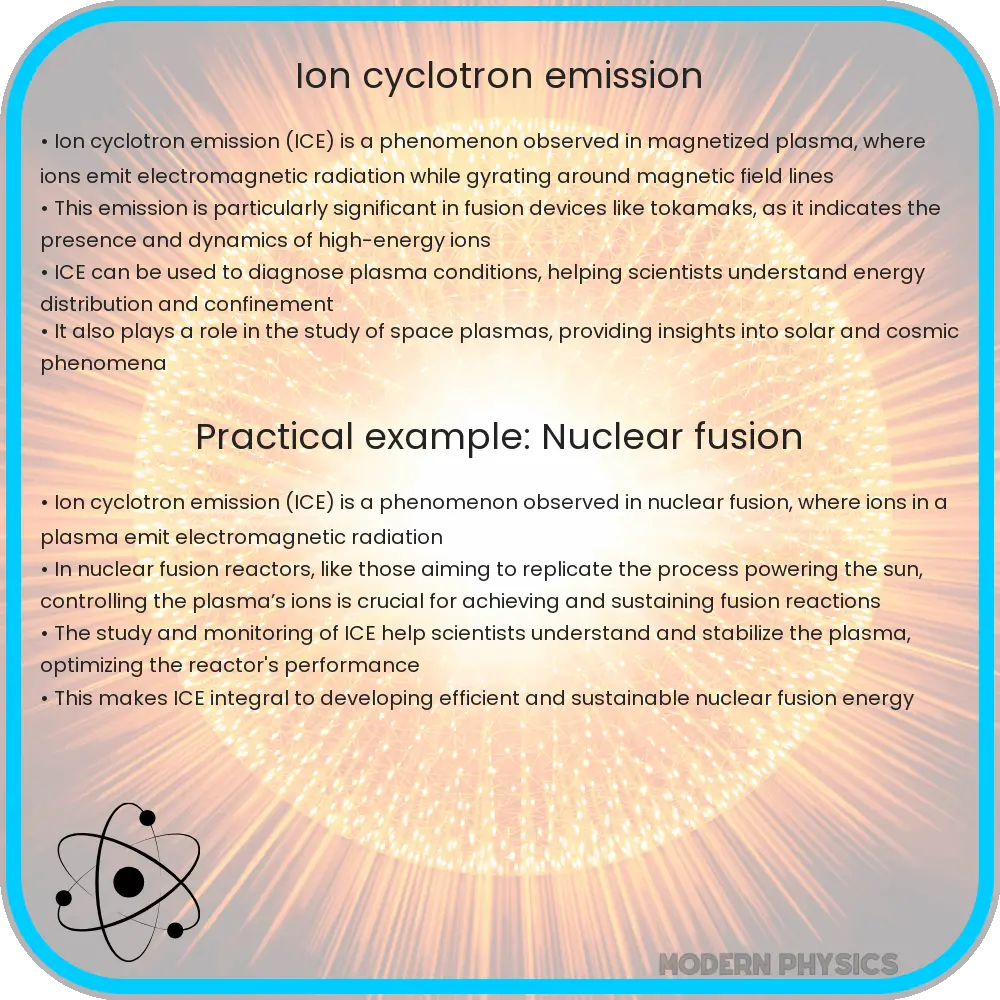
Ion Cyclotron Emission (ICE) represents a fascinating area of plasma physics, offering significant insights into the behaviors of ions within magnetic fields. This phenomenon is primarily observed in magnetic confinement fusion devices, where it plays a critical role in understanding plasma behaviors and facilitating the development of controlled fusion energy. ICE involves the emission of electromagnetic waves by ions gyrating in a magnetic field, a process that is fundamental to numerous applications in both research and industry.
Theory Behind Ion Cyclotron Emission
The theoretical underpinnings of ICE can be traced back to the motion of charged particles in magnetic fields. When ions in a plasma are subjected to a magnetic field, they experience a force perpendicular to both their velocity and the magnetic field direction. This force causes the ions to move in a circular path, known as cyclotron motion, with a specific frequency called the cyclotron frequency. The cyclotron frequency (\(f_c\)) for ions is given by the formula \(f_c = \frac{qB}{2\pi m}\), where \(q\) is the charge of the ion, \(B\) is the magnetic field strength, and \(m\) is the ion’s mass. The cyclotron motion of these ions can lead to the generation of electromagnetic waves, observed as ICE.
Applications of Ion Cyclotron Emission
- Controlled Nuclear Fusion: ICE plays a pivotal role in the study and development of controlled nuclear fusion technology. It provides a non-invasive diagnostic tool for analyzing the behavior of ions in fusion plasmas, aiding in the optimization of plasma confinement and stability.
- Space Physics: The principles of ICE are applicable in understanding the dynamics of space plasmas. Observations of ICE can help in studying the interaction between solar winds and planetary magnetic fields, offering insights into space weather phenomena.
- Material Processing: In industrial applications, ICE-related techniques are used in the processing of materials under plasma conditions. The control of ion behaviors through magnetic fields can lead to advancements in the fabrication of high-quality materials.
Advanced Research and Future Directions
The exploration of Ion Cyclotron Emission is not only confined to current applications but also extends to cutting-edge research that seeks to expand our understanding and utilization of this phenomenon. Scientists are investigating ICE for potential use in plasma heating and current drive in fusion reactors. By precisely tuning the frequency of externally applied electromagnetic waves to match the ion cyclotron frequency, energy can be efficiently transferred to the plasma ions, enhancing the heating process and improving the efficiency of fusion reactors. Furthermore, research into the nuances of ICE signals could lead to improved diagnostic methods for detecting and analyzing high-energy ions, contributing to safer and more effective fusion energy production.
Challenges and Considerations
Despite the promising applications and ongoing research, there are several challenges associated with the practical implementation and study of Ion Cyclotron Emission. One of the primary challenges lies in the complex nature of plasma environments where ICE occurs, requiring sophisticated diagnostic tools and theoretical models to accurately interpret the emissions. Additionally, the integration of ICE-based technologies into commercial fusion reactors and industrial processes demands extensive research and development to ensure efficiency, safety, and economic viability.
Conclusion
Ion Cyclotron Emission stands as a cornerstone in the field of plasma physics, offering profound insights into ion behavior in magnetic fields and facilitating advancements in controlled nuclear fusion, space physics, and material science. The theoretical foundations of ICE provide a framework for understanding and harnessing this phenomenon, while its applications highlight the potential for significant technological and scientific breakthroughs. As research continues to unfold, the challenges associated with ICE offer opportunities for innovation and development, paving the way for future discoveries and enhancements in various fields. Embracing the complexities and possibilities of Ion Cyclotron Emission will undoubtedly contribute to the advancement of plasma science and its applications in energy, space exploration, and beyond.