
Explore the mechanisms and effects of perpendicular ion heating in plasma physics, impacting fusion energy, space phenomena, and plasma stability.
Understanding Perpendicular Ion Heating in Plasma Physics
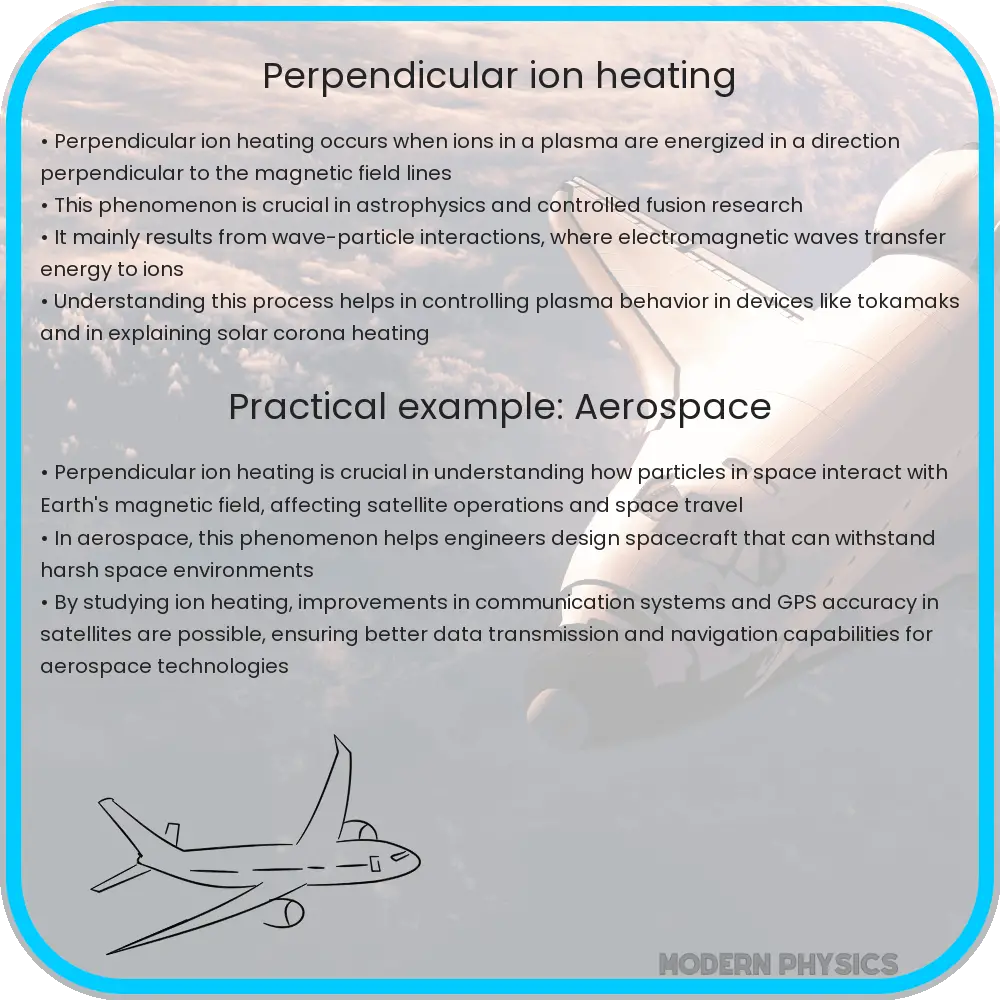
Perpendicular ion heating represents a critical process within the realm of plasma physics, influencing the dynamics and stability of plasma in both natural and laboratory settings. This phenomenon pertains to the increase in ion temperature perpendicular to the magnetic field lines, a scenario commonly observed in various astrophysical environments and controlled fusion experiments. Understanding the mechanisms behind perpendicular ion heating is essential for advancing our knowledge in space weather forecasting, astrophysical phenomena, and optimizing fusion reactors for energy production.
Mechanisms of Perpendicular Ion Heating
The heating of ions in a direction perpendicular to magnetic field lines involves complex interactions between particles and waves within the plasma. Key mechanisms responsible for this process include:
- Cyclotron resonance: Ions gain energy through resonant interactions with electromagnetic waves propagating perpendicular to the magnetic field. This mechanism efficiently transfers energy from waves to ions, increasing their perpendicular motion.
- Landau damping: Although primarily affecting parallel heating, Landau damping can indirectly contribute to perpendicular ion heating through the redistribution of energy within the plasma.
- Turbulent heating: Plasma turbulence, characterized by chaotic and irregular fluid motions, can lead to effective ion heating in the perpendicular direction. The energy from turbulent motions is transferred to ions, enhancing their thermal motion perpendicular to the magnetic field.
Effects of Perpendicular Ion Heating
The implications of perpendicular ion heating are profound, impacting the behavior and evolution of plasma systems:
- Temperature anisotropy: Perpendicular ion heating creates anisotropies in plasma temperature, with ions being hotter in the direction perpendicular to magnetic field lines. This anisotropy can influence plasma stability and wave propagation.
- Magnetic reconnection: Enhanced perpendicular ion temperature can facilitate magnetic reconnection, a fundamental process in plasma physics where magnetic field lines rearrange and release energy. This is crucial in solar flares and magnetospheric substorms.
- Confinement in fusion reactors: Understanding and controlling perpendicular ion heating is vital for the efficiency of magnetic confinement fusion reactors, such as tokamaks, where optimal ion temperature distribution is key to achieving sustainable fusion reactions.
Plasma Transport and Wave-Particle Interactions
The transport of energy and particles across magnetic field lines is significantly affected by perpendicular ion heating. Enhanced perpendicular motion of ions can lead to increased cross-field transport, influencing the confinement properties of fusion plasmas and the dynamics of space plasmas. Furthermore, wave-particle interactions, essential for perpendicular heating, play a pivotal role in energy distribution within plasma, affecting not only temperature gradients but also the overall plasma stability and turbulence levels.
Advancements in Diagnostic and Simulation Techniques
Recent advancements in diagnostic tools and simulation technologies have propelled our understanding of perpendicular ion heating. High-resolution spectroscopy, X-ray imaging, and laser-based diagnostics allow for precise measurements of ion temperatures and their distribution in plasma. Concurrently, sophisticated computational models and simulations provide insights into the complex nonlinear dynamics governing wave-particle interactions and energy transfer processes. These tools are invaluable for designing more efficient fusion reactors and understanding natural plasma phenomena.
Challenges and Future Directions
Despite significant progress, challenges remain in fully understanding and controlling perpendicular ion heating. One major challenge lies in accurately modeling the intricate interplay between various heating mechanisms in turbulent plasma conditions. Additionally, translating laboratory findings to astrophysical scales poses considerable difficulties due to the vast differences in spatial and temporal scales. Future research will likely focus on developing more comprehensive models that integrate multiple heating mechanisms and exploring innovative approaches to manipulate and optimize ion heating in fusion devices.
Conclusion
Perpendicular ion heating is a cornerstone of plasma physics with far-reaching implications for both theoretical understanding and practical applications. The mechanisms driving this phenomenon—cyclotron resonance, Landau damping, and turbulent heating—highlight the complexity of plasma interactions. The effects of perpendicular ion heating, including temperature anisotropy, magnetic reconnection, and influences on plasma confinement, underscore its significance in natural and laboratory plasma environments. With ongoing advancements in diagnostic and simulation techniques, our grasp of these processes continues to improve, paving the way for future breakthroughs in energy production, space exploration, and understanding the universe’s most pervasive state of matter. As challenges persist, the pursuit of knowledge in perpendicular ion heating remains a vibrant field of study, promising exciting developments in plasma physics and related disciplines.