
Explore helical antennas’ unique features: gain, bandwidth, and polarization, and their applications in communication technology advancements.
Understanding Helical Antennas: Gain, Bandwidth, and Polarization
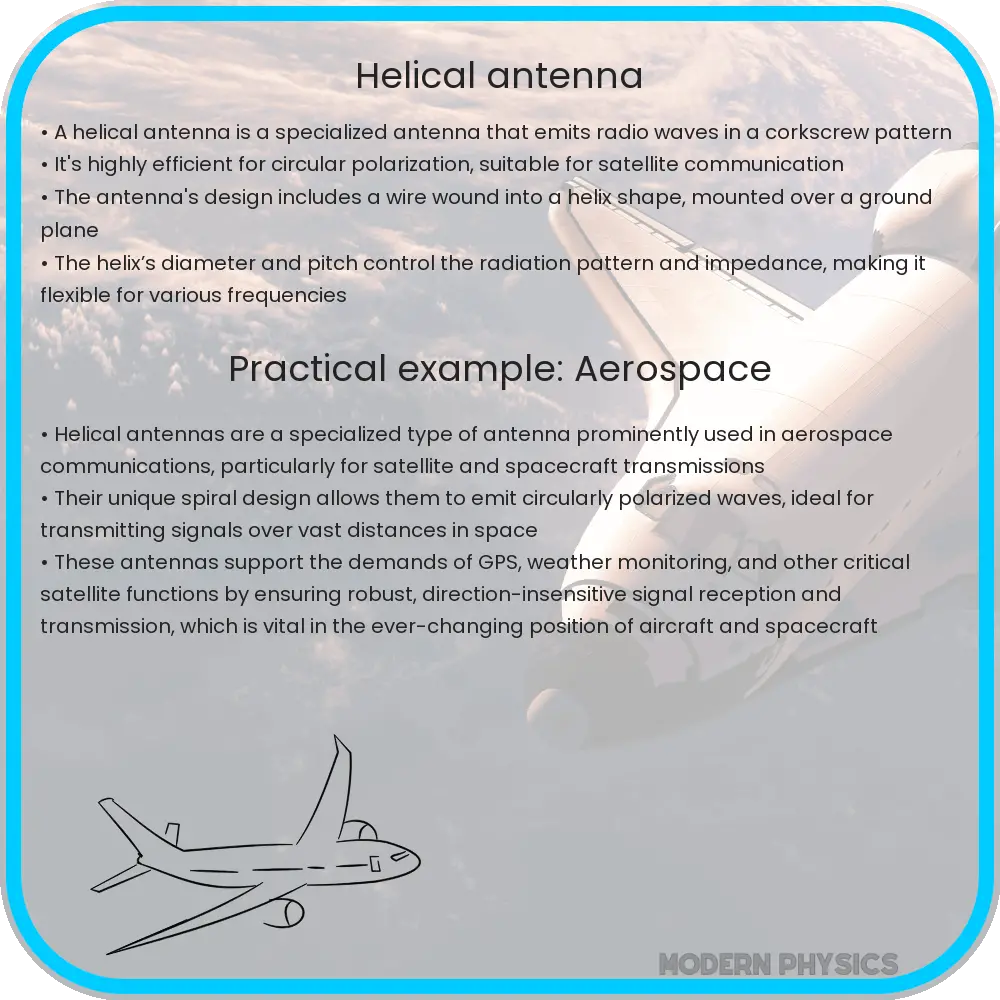
A helical antenna is a specialized type of antenna that is distinguished by its unique helical shape, often resembling a spring. This design contributes to its specific performance characteristics in terms of gain, bandwidth, and polarization, making it a versatile tool in various communication applications.
Gain of Helical Antennas
The gain of a helical antenna refers to its ability to focus radio frequency energy in a particular direction. It is a measure of how well the antenna converts input power into radio waves in a specified direction and is typically measured in decibels (dB). The gain of a helical antenna is influenced by several factors including the number of turns in the helix, the pitch angle, and the diameter of the helix. Generally, a larger number of turns and a greater helix diameter result in higher gain, but at the cost of a narrower bandwidth.
Bandwidth Considerations
The bandwidth of a helical antenna is the range of frequencies over which it can operate effectively. It is an essential factor for ensuring clear and reliable communication. The bandwidth is influenced by the physical dimensions of the helical antenna. Typically, a broader bandwidth can be achieved by reducing the number of turns or by optimizing the spacing between the turns. However, this often leads to a reduction in gain.
Polarization of Helical Antennas
Polarization refers to the orientation of the electromagnetic waves radiated by the antenna. In helical antennas, the polarization can be either circular or elliptical, depending on the design. This is determined by the helix’s pitch angle and the circumference of the turns. Circular polarization is advantageous in many applications because it minimizes the effects of signal reflection and orientation mismatch, which can be critical in satellite and mobile communications.
In conclusion, the helical antenna, with its distinctive spiral design, offers a unique blend of gain, bandwidth, and polarization characteristics. This makes it a valuable component in various communication systems, from satellite communication to mobile networks. Understanding these fundamental aspects is crucial for optimizing its performance for specific applications.
Optimizing Helical Antenna Performance
To maximize the performance of a helical antenna, it’s crucial to consider the interplay between its gain, bandwidth, and polarization. The design and tuning of the antenna must align with the specific requirements of the intended application. For instance, in applications where high gain is essential, like in long-distance communication, the antenna should have more turns and a larger diameter. On the other hand, applications requiring a broader bandwidth, such as in broadband systems, would benefit from a helix with fewer turns and optimized spacing.
Applications of Helical Antennas
Helical antennas are widely used in various fields due to their unique properties. In satellite communications, their ability to produce circular polarization makes them ideal for maintaining consistent communication with orbiting satellites. Additionally, their high gain is advantageous in deep space communication systems. In terrestrial applications, these antennas are often used in mobile communication networks and for GPS systems, where their compact size and robustness against signal interference are highly valued.
Challenges and Future Developments
Despite their advantages, helical antennas face challenges, particularly in terms of size and bandwidth limitations. As technology advances, ongoing research is focused on miniaturizing these antennas while expanding their bandwidth capabilities. This is particularly relevant in the burgeoning field of 5G technology, where the demand for compact, high-performance antennas is continually increasing. Innovations in materials and design techniques are key areas of development, aiming to enhance the overall efficiency and versatility of helical antennas.
Conclusion
In summary, the helical antenna stands out in the realm of wireless communication due to its unique characteristics of gain, bandwidth, and polarization. Its adaptable design makes it suitable for a wide range of applications, from satellite communication to mobile networks. The continuous evolution in its design and application signifies its crucial role in advancing communication technologies. As we move forward, the refinement and innovation in helical antenna designs are expected to play a pivotal role in meeting the ever-growing demands of modern wireless communication systems.