
Explore key factors in radio antenna performance: optimal range, gain, efficiency, and how environmental aspects and tech advances influence them.
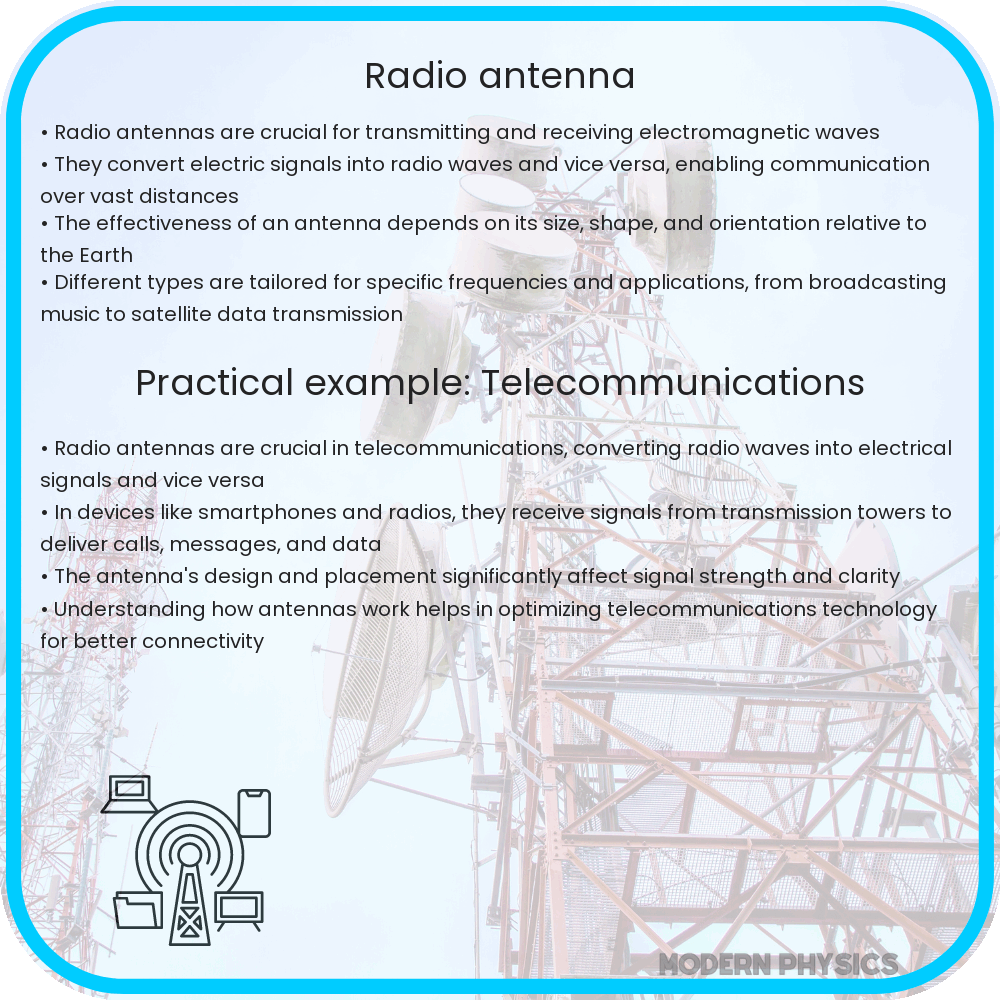
Understanding Radio Antennas: Optimal Range, Gain, and Efficiency
Radio antennas are pivotal components in wireless communication systems. Their primary role is to transmit and receive radio frequency signals. The performance of a radio antenna can be measured through three key aspects: optimal range, gain, and efficiency. Each of these factors plays a crucial role in determining how well an antenna can send and receive signals over various distances and in different conditions.
Optimal Range of Radio Antennas
The optimal range of a radio antenna refers to the maximum distance over which it can effectively transmit or receive signals. This range is influenced by several factors, including the frequency of the signal, the power of the transmitter, and environmental conditions. Higher frequencies generally provide greater resolution but have a shorter range due to higher absorption in the atmosphere. Conversely, lower frequencies can travel longer distances but offer lower resolution.
Gain and How it Influences Antenna Performance
Gain is a measure of an antenna’s ability to direct or concentrate radio frequency energy in a particular direction. It is typically measured in decibels (dB) and is a crucial factor in determining an antenna’s overall effectiveness. A higher gain indicates a more focused signal, which can be beneficial for long-distance communication. However, it’s important to note that increasing gain in one direction usually results in decreased signal strength in others, a phenomenon known as the directivity-gain tradeoff.
Efficiency: The Key to Minimizing Losses
Antenna efficiency relates to the proportion of power that is successfully converted into radio waves. In an ideal world, an antenna would have 100% efficiency, meaning all the power supplied to it would be radiated. However, in the real world, various factors like material quality, design, and environmental interference result in some power loss. An efficient antenna will have minimal power losses and effectively utilize the power it receives.
In summary, the optimal range, gain, and efficiency are interrelated factors that determine an antenna’s performance. Understanding these concepts is crucial for anyone looking to optimize their radio communication setup. In the following sections, we will delve deeper into each aspect, exploring how they interact and impact the overall functionality of radio antennas.
Diving Deeper into Antenna Range, Gain, and Efficiency
The intricacies of antenna design revolve around balancing range, gain, and efficiency. For instance, enhancing the gain of an antenna often leads to a narrower beamwidth, which may limit its effective range in certain applications. This is particularly evident in directional antennas, where a high gain is achieved at the expense of a reduced coverage area. Therefore, selecting the right antenna requires a clear understanding of the specific communication needs.
Environmental Impact on Antenna Performance
Environmental factors play a significant role in the performance of radio antennas. Obstacles like buildings, trees, and terrain can affect signal propagation, thereby impacting the effective range. Additionally, atmospheric conditions such as humidity, temperature, and precipitation can alter signal strength and quality. Understanding these environmental influences is vital for optimal antenna placement and configuration.
Technological Advances in Antenna Design
Recent technological advancements have led to more sophisticated antenna designs. These new designs aim to enhance gain and efficiency while minimizing size and complexity. Innovations like beamforming and MIMO (Multiple Input Multiple Output) technology have revolutionized antenna functionality, allowing for better signal quality and increased data rates in wireless networks.
Another area of progress is in the materials used for antenna construction. Researchers are exploring novel materials and fabrication techniques to create antennas that are more efficient, flexible, and capable of operating across a broader range of frequencies.
Conclusion
In conclusion, the optimal range, gain, and efficiency of a radio antenna are critical factors that determine its performance in a wireless communication system. Balancing these elements is key to achieving the desired transmission and reception capabilities. Environmental conditions and technological advancements also play a significant role in shaping antenna design and functionality. As wireless communication continues to evolve, the importance of understanding and optimizing these antenna parameters cannot be overstated. The future of antenna technology promises even greater efficiencies and capabilities, paving the way for more robust and versatile wireless communication networks.
Whether for personal or professional use, selecting the right antenna requires a nuanced understanding of these concepts. By considering the interplay between range, gain, and efficiency, and keeping abreast of technological advancements, one can ensure optimal communication performance in their chosen application.