
Explore the essentials of antenna radiation patterns, covering key concepts like coverage, directivity, gain, and their impact on wireless technology.
Radiation Pattern of Antennas: Understanding Coverage, Directivity, and Gain
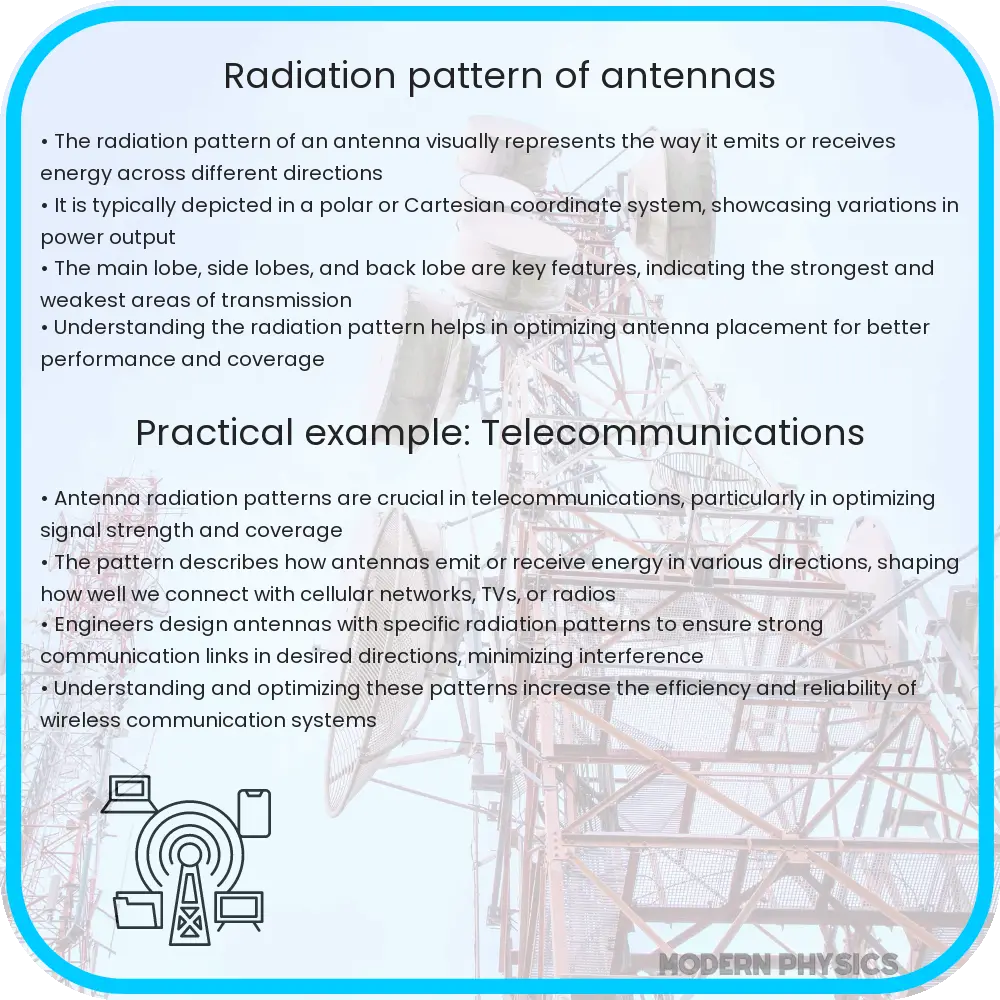
The radiation pattern of an antenna is a critical factor in defining its performance and suitability for specific applications. Essentially, an antenna’s radiation pattern is a graphical representation of the radiation properties of the antenna as viewed from different angles. It includes key aspects like coverage, directivity, and gain, which are paramount in understanding and optimizing antenna functionality.
Coverage
Coverage refers to the area over which an antenna can effectively transmit or receive signals. The shape of the radiation pattern, which can be omnidirectional, bidirectional, or unidirectional, primarily determines this coverage. Omnidirectional antennas radiate or receive signals with approximately equal strength in all horizontal directions, making them ideal for broadcasting and mobile communications where the direction of the receiving station is not fixed. Bidirectional antennas, in contrast, have a figure-eight pattern offering two main lobes of radiation in opposite directions. Unidirectional antennas, like the popular Yagi-Uda, concentrate the signal in a single direction, providing higher coverage in that specific area.
Directivity
Directivity of an antenna is a measure of how ‘focused’ its radiation pattern is in a particular direction. It is quantified as the ratio of the power radiated in the desired direction to the power that would be radiated if the antenna were an ideal isotropic radiator. High-directivity antennas are designed to focus the energy in a particular direction, enhancing the signal’s reach and reducing interference from unwanted directions. This characteristic is crucial in applications like satellite communications and radar systems.
Gain
Gain is a key parameter that combines the directivity and electrical efficiency of an antenna. Technically, it’s the ratio of the power output in a given direction to the power output that would be achieved by an isotropic antenna emitting the same total power. Antenna gain is often expressed in decibels (dB). A higher gain implies a more effective antenna in converting input power into radio waves and focusing them in a specific direction. However, it’s important to note that gain does not imply an increase in total power output; rather, it indicates more focused power distribution.
Understanding these concepts is essential for selecting the right antenna for a given application. The radiation pattern, influenced by antenna design and operating frequency, dictates how well an antenna will perform in its intended environment. Whether it’s for WiFi networks, television broadcasting, or satellite communications, the right balance of coverage, directivity, and gain is vital for optimal performance.
Factors Influencing Radiation Patterns
Several factors influence the radiation patterns of antennas. Physical dimensions and geometry play a crucial role; for instance, the length of a dipole antenna relative to the wavelength of the signal affects its radiation pattern. Environmental factors, such as nearby structures or the ground, can also alter the pattern by reflecting or absorbing radio waves. Furthermore, the material used in antenna construction can impact its performance, particularly in terms of bandwidth and efficiency.
Applications and Implications
The practical applications of understanding radiation patterns are vast. In wireless communication, antennas with specific radiation patterns are selected to optimize coverage and signal quality. For instance, cell phone towers use antennas with patterns that cover large areas, while satellite dishes use highly directive antennas to focus on a specific part of the sky. In navigation systems like GPS, the radiation pattern ensures that signals can be received from multiple satellites, enhancing accuracy. In defense and aerospace, radar systems depend heavily on antenna directivity for detecting and tracking objects.
Challenges and Future Trends
Designing antennas with desired radiation patterns poses several challenges, especially in complex environments or for multifunctional applications. The rapid growth of wireless technology demands antennas that are smaller, more efficient, and capable of operating over broader frequency ranges. Future trends in antenna design are likely to focus on adaptability, where smart antennas can dynamically alter their radiation patterns based on the environment or communication requirements. Such advancements could revolutionize fields like 5G communication, IoT (Internet of Things), and beyond.
Conclusion
The study of antenna radiation patterns is a fascinating and crucial aspect of electromagnetic theory and wireless communication. Understanding the intricacies of coverage, directivity, and gain, along with the factors that influence them, is essential for the effective design and implementation of antennas in various applications. As technology advances, the demand for more sophisticated antennas is likely to grow, paving the way for innovative solutions in wireless communication and beyond. The future holds immense potential for developments in this field, promising enhanced performance and efficiency in our increasingly connected world.