
Explore ferrite beads’ role in noise suppression and signal clarity in electrodynamics, covering their function, applications, and advancements.
Understanding Ferrite Beads: Essential Components for Noise Suppression and Signal Clarity in Electrodynamics
Ferrite beads are integral components in modern electronic circuits, particularly in electrodynamics, where they play a crucial role in suppressing unwanted noise and enhancing signal clarity. This article explores the science behind ferrite beads, their functionality, and their importance in electronic devices.
The Science Behind Ferrite Beads
Ferrite beads are made from ferric oxide (Fe2O3) combined with other metallic elements such as zinc (Zn) or nickel (Ni). These small, cylindrical components are magnetic and have the unique ability to suppress high-frequency electromagnetic interference (EMI). The ferrite material’s composition and structure are tailored to target specific frequency ranges, making them highly effective in noise suppression.
How Ferrite Beads Work
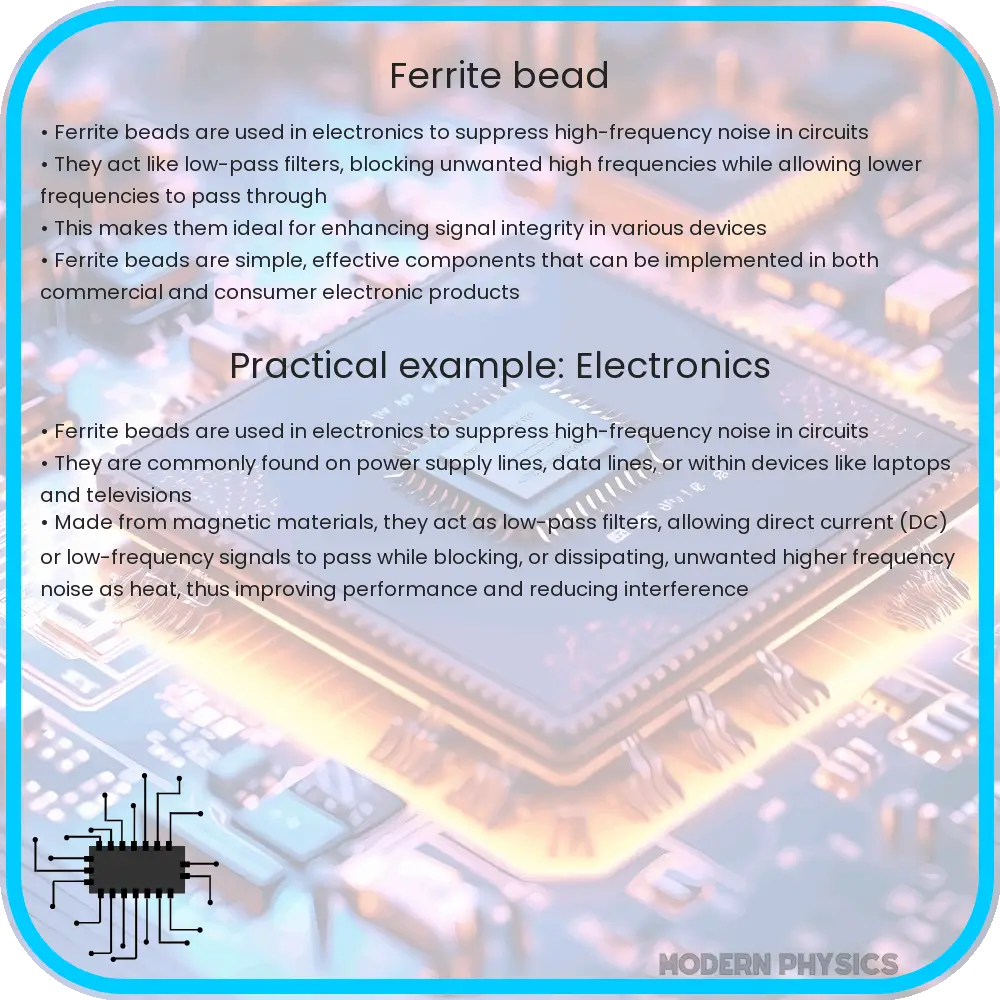
The primary function of a ferrite bead is to attenuate high-frequency noise in electronic circuits. They act as low-pass filters, allowing low-frequency signals to pass through while blocking or reducing the intensity of high-frequency noise. When an electronic signal passes through a ferrite bead, the bead’s magnetic properties create a resistance to high-frequency currents, thus dissipating them as heat and minimizing interference.
Applications in Electrodynamics
In electrodynamics, ferrite beads are used extensively to maintain signal integrity and prevent EMI from affecting sensitive components. They are found in a range of applications, including:
- Consumer electronics like smartphones, laptops, and televisions, where they help in maintaining clear signal transmission.
- Industrial equipment, where they protect against electromagnetic noise that can disrupt precise measurements and controls.
- Automotive electronics, particularly in the increasingly complex electronic systems of modern vehicles, to ensure reliable operation under varying electromagnetic conditions.
Ferrite beads are particularly valuable in applications where space is limited, as their small size allows for effective noise suppression without significant changes to the circuit layout.
Choosing the Right Ferrite Bead
Selecting the appropriate ferrite bead depends on several factors, including the frequency range of the noise, the impedance requirements of the circuit, and environmental conditions. Manufacturers provide detailed specifications to help in choosing the right bead for a specific application. Understanding these specifications is crucial for ensuring optimal performance and reliability of the electronic device.
By effectively filtering out unwanted electromagnetic interference, ferrite beads enhance the overall performance and reliability of electronic circuits, making them indispensable in a wide array of electrodynamics applications.
Optimizing Ferrite Bead Performance
For optimal performance, the placement of ferrite beads within an electronic circuit is critical. They are most effective when placed close to the noise source or at the point where a signal enters or exits a circuit board. This positioning ensures maximum noise suppression, preventing the spread of EMI to other components. Additionally, the physical orientation of the bead can affect its performance, with axial and chip bead configurations offering different levels of noise suppression.
Environmental Factors and Durability
Ferrite beads must also be selected with environmental factors in mind. Temperature changes, humidity, and mechanical stress can impact their performance. High-quality beads are designed to withstand these conditions without degradation in effectiveness. It’s crucial to consider these environmental aspects, especially in applications exposed to harsh conditions, such as automotive or industrial settings.
Advancements in Ferrite Bead Technology
Recent advancements in materials science have led to the development of ferrite beads with improved performance characteristics. These include higher impedance levels at lower frequencies, greater heat dissipation capabilities, and smaller sizes. Such innovations are crucial in keeping pace with the miniaturization and increased complexity of modern electronic devices.
Complementary Noise Suppression Techniques
While ferrite beads are effective, they are often used in conjunction with other noise suppression techniques for enhanced results. These can include shielding, grounding, and the use of other filtering components like capacitors and inductors. A holistic approach to noise suppression ensures that electronic devices operate reliably and efficiently in diverse electromagnetic environments.
Conclusion
Ferrite beads play a pivotal role in ensuring the integrity and reliability of electronic circuits by effectively suppressing electromagnetic interference. Their importance in a wide range of applications, from consumer electronics to industrial machinery, cannot be overstated. With ongoing advancements in technology, ferrite beads continue to evolve, offering more efficient and compact solutions for EMI suppression. As electronic devices become more sophisticated and integrated into all aspects of modern life, the role of ferrite beads in maintaining signal clarity and reducing noise will only grow in significance. By understanding their functionality, applications, and advancements, designers and engineers can continue to harness the benefits of ferrite beads, ensuring the smooth operation of electronic devices in an increasingly interconnected and electromagnetic-rich world.