
Explore the fascinating world of gravitational microlensing, a method used to uncover dark matter, distant planets, and invisible celestial objects in our universe.
Understanding Gravitational Microlensing
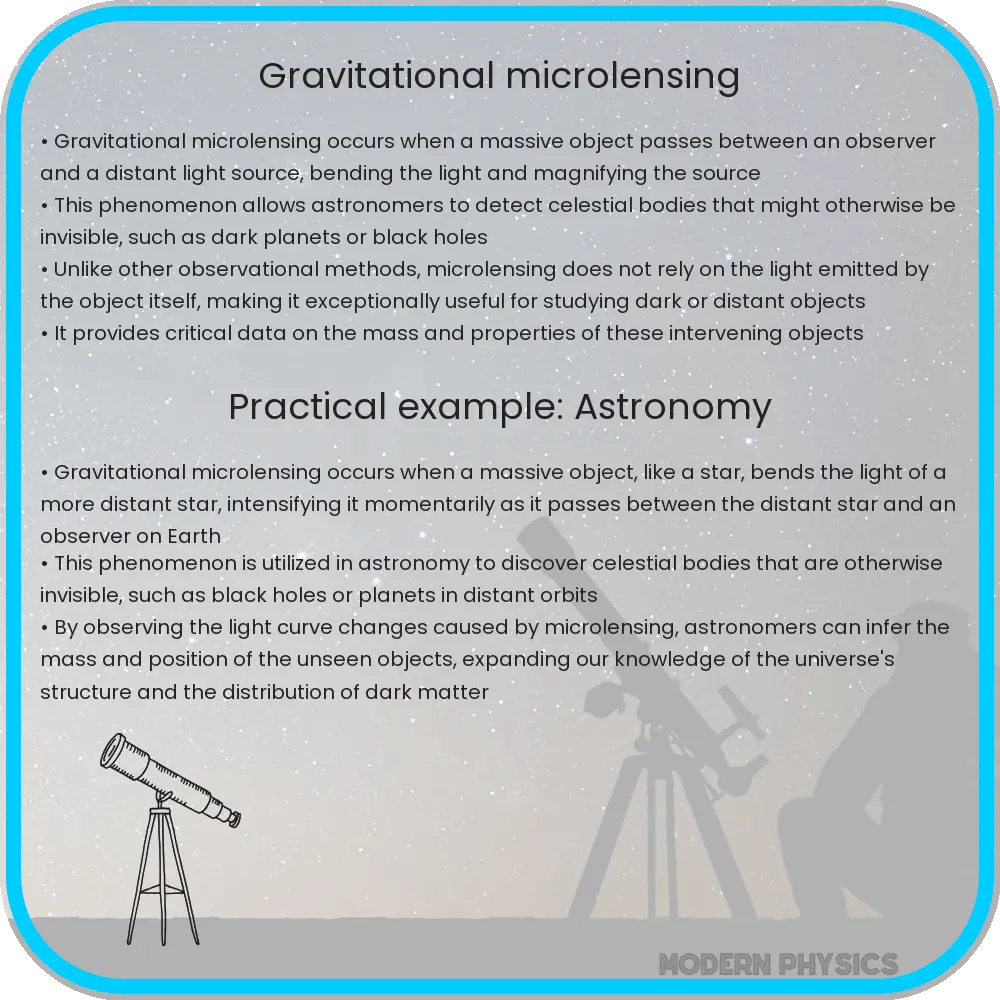
Gravitational microlensing is a celestial phenomenon used in astrophysics to study objects that emit little or no light, such as black holes, dark matter, and distant planets. It is based on the principles of Einstein’s General Theory of Relativity, which predicts that the gravity of a massive object can bend the space around it, acting much like a lens. This effect, known as gravitational lensing, magnifies and distorts the light from objects lying behind the ‘lens’ from the observer’s viewpoint.
Microlensing occurs when the lensing object is relatively small, such as a star or planet, causing a much subtler effect compared to strong lensing by massive clusters of galaxies. In these instances, the foreground object passes directly in front of a distant star, magnifying its light in a way that can be detected and studied from Earth.
Detection and Analysis
The detection of gravitational microlensing events is largely reliant on high-precision monitoring of the brightness of vast numbers of stars. Observatories across the world, including space-based telescopes, continually survey the sky, watching for the distinctive, temporary brightening of stars that indicates a microlensing event. This requires sophisticated software and data analysis techniques to sift through the immense volumes of data collected.
Once identified, the characteristics of a microlensing event, such as its duration and the magnification curve, can provide valuable information about the lensing object. For instance, the duration of an event can offer insights into the mass of the foreground object. Shorter events might indicate smaller objects like planets, while longer events could suggest stars or even black holes.
Analysis involves complex models that factor in the relative motion of the source, lens, and observer. By comparing observed events to these models, astronomers can extract details about the lensing object, including its mass and sometimes even its distance from Earth. This makes microlensing a powerful tool for detecting and studying celestial bodies that are otherwise invisible or difficult to detect through conventional means.
Applications and Challenges
Gravitational microlensing has diverse applications in modern astrophysics. It has become an essential tool for discovering exoplanets, especially those that are too distant or too faint to be detected by other methods. Unlike the transit method, which requires a planet to pass directly in front of its host star from our perspective, microlensing can reveal planets orbiting at greater distances from their stars. This method has contributed significantly to the understanding of the distribution of exoplanets in the Milky Way.
Beyond planet detection, microlensing is also employed to probe the nature of dark matter, another elusive component of the universe. By analyzing the frequency and distribution of microlensing events, scientists can infer the presence of compact dark matter objects, such as black holes or MACHOs (Massive Compact Halo Objects). This research is crucial for unraveling the mysteries of dark matter, which dominates the universe’s mass yet remains invisible.
However, gravitational microlensing also presents significant challenges. One major difficulty is the rarity and unpredictability of microlensing events. They are fleeting and require continuous monitoring of millions of stars to catch them in progress. Furthermore, once a microlensing event has occurred, it is generally not repeatable, making follow-up observations difficult. This uniqueness means that each event must be captured and analyzed extensively in real-time.
Additionally, interpreting microlensing signals can be complex due to the degeneracy of solutions; different combinations of lens mass, distance, and relative motion can produce similar light curves. Advanced modeling and multi-wavelength observations are often required to resolve these ambiguities and glean reliable information from the events.
Conclusion
Gravitational microlensing stands out as a unique and powerful tool in astrophysics, offering a different lens through which to view the cosmos. It enables the study of objects that are otherwise invisible, contributing significantly to our understanding of planetary systems, stars, and the elusive dark matter. Despite its challenges, such as the rarity of events and the complexity of data analysis, microlensing continues to be a field of active research and discovery. As observational techniques and technologies improve, the future of microlensing promises even more exciting insights into the dark and distant corners of our universe.