
Explore how adaptive optics revolutionizes astronomy by correcting atmospheric distortions, enhancing telescope clarity, and unlocking new celestial discoveries.
Understanding Adaptive Optics in Astronomy
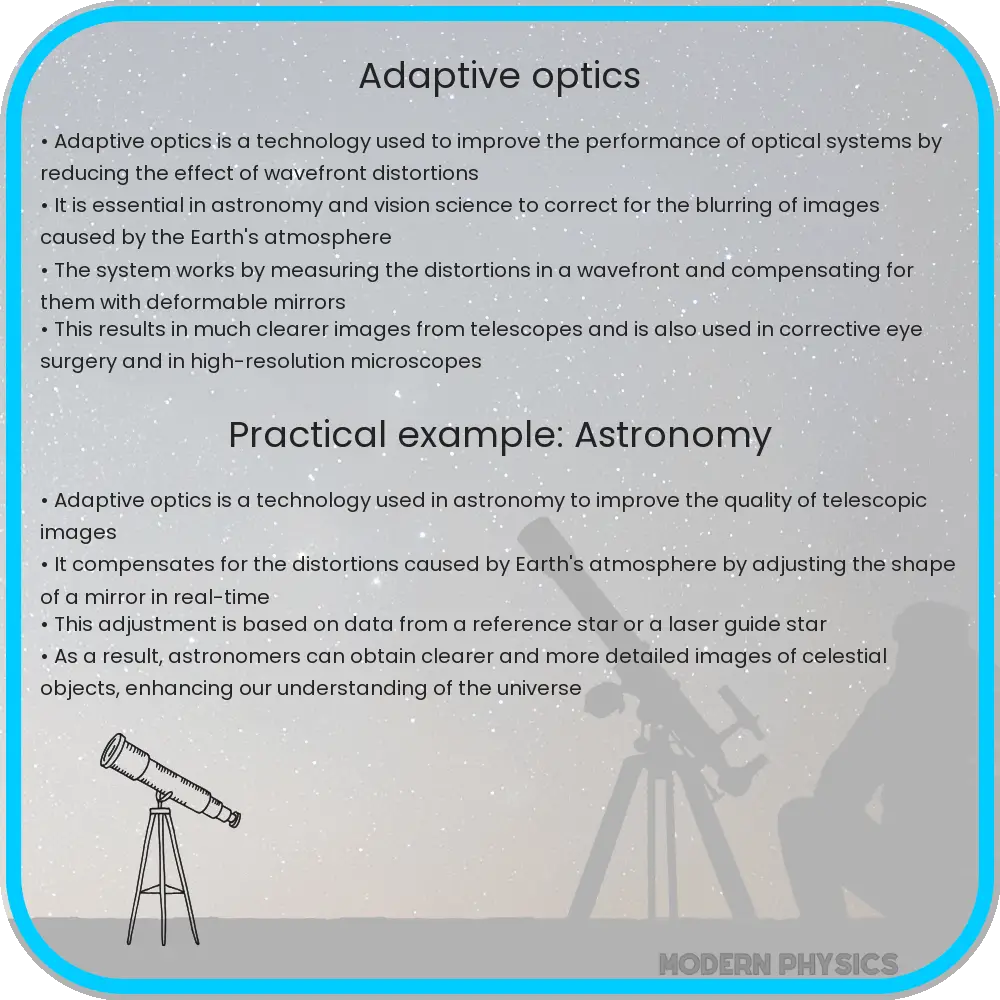
Adaptive optics is a revolutionary technology that has significantly enhanced the capabilities of ground-based telescopes. Traditionally, the Earth’s atmosphere has been a major impediment to clear astronomical observations due to its turbulent nature, which distorts the light coming from celestial objects. Adaptive optics systems aim to correct these distortions in real-time, providing clearer and more detailed images of the universe.
The core of adaptive optics lies in its ability to measure atmospheric distortions and adapt the telescope’s optics to counteract these changes instantly. This is achieved through a combination of wavefront sensors, control systems, and deformable mirrors. The wavefront sensor measures the distortion, the control system calculates the necessary corrections, and the deformable mirror adjusts its shape accordingly, often hundreds of times per second, to correct the incoming light.
Components and Functioning of Adaptive Optics
Adaptive optics systems are comprised of several key components, each playing a crucial role in the correction process:
- Wavefront Sensor: This device measures the distortions in the wavefronts of incoming light. The most common type used is the Shack-Hartmann wavefront sensor.
- Control System: This computational unit processes the data from the wavefront sensor and determines the optimal shape for the deformable mirror to correct the distortion.
- Deformable Mirror: A key component, this mirror can change its shape in response to the control system’s instructions, correcting the distorted wavefront of the light.
The integration of these components allows adaptive optics systems to produce images of celestial bodies with unprecedented clarity and resolution. By compensating for the atmospheric turbulence, astronomers can observe finer details on the surfaces of planets, stars, and galaxies, enhancing our understanding of the universe.
One notable example of adaptive optics in action is the Keck Observatory, which employs advanced adaptive optics systems to study celestial phenomena such as black holes, exoplanets, and the detailed structure of galaxies. This has not only provided clearer images than ever before but also significantly expanded our astronomical knowledge.
Impact and Future of Adaptive Optics in Astronomy
Adaptive optics has profoundly impacted astronomical research and observation. By enabling ground-based telescopes to reach near-diffraction-limited performance, astronomers can conduct detailed studies of the universe from Earth. This has led to numerous discoveries in various fields of astronomy, from the detailed observations of the surfaces of distant planets and moons to the investigation of the very nature of the cosmos itself.
The technology has also been pivotal in the search for exoplanets. Adaptive optics allows for the direct imaging of planets around other stars, providing invaluable data on their atmospheres and orbits. This has accelerated the pace of exoplanet discovery and deepened our understanding of planetary systems beyond our own.
Moreover, adaptive optics has applications beyond traditional astronomy. It is increasingly used in fields such as satellite tracking, deep-space communication, and even in medical imaging techniques like optical coherence tomography, demonstrating its versatility and potential for future technological advancements.
Challenges and Limitations
Despite its advantages, adaptive optics faces several challenges. The complexity and cost of these systems limit their availability and can restrict use to only the most well-funded observatories. Additionally, the effectiveness of adaptive optics can vary with atmospheric conditions and is primarily beneficial for observations at infrared and shorter wavelengths.
There are ongoing efforts to overcome these challenges, such as the development of more sophisticated wavefront sensors and more versatile deformable mirrors. Moreover, new algorithms and computing techniques are being developed to enhance the speed and accuracy of the adaptive corrections.
Conclusion
Adaptive optics represents a significant leap forward in the field of astronomy, offering a powerful tool to overcome the blurring effects of the Earth’s atmosphere. Its ability to provide clearer, more detailed images has revolutionized our understanding of the universe and opened up new avenues for research and discovery. Despite its challenges, the continued development and application of adaptive optics technology promise to further expand our cosmic horizons, bringing the mysteries of the universe into sharper focus. As we look to the future, adaptive optics will undoubtedly continue to play a critical role in unraveling the complexities of the cosmos and enhancing our understanding of the world beyond our planet.