
Explore the mysteries of Galactic Bulge microlensing and its role in uncovering dark matter, gravity’s effects, and the hidden stellar populations within our Milky Way.
Understanding Galactic Bulge Microlensing
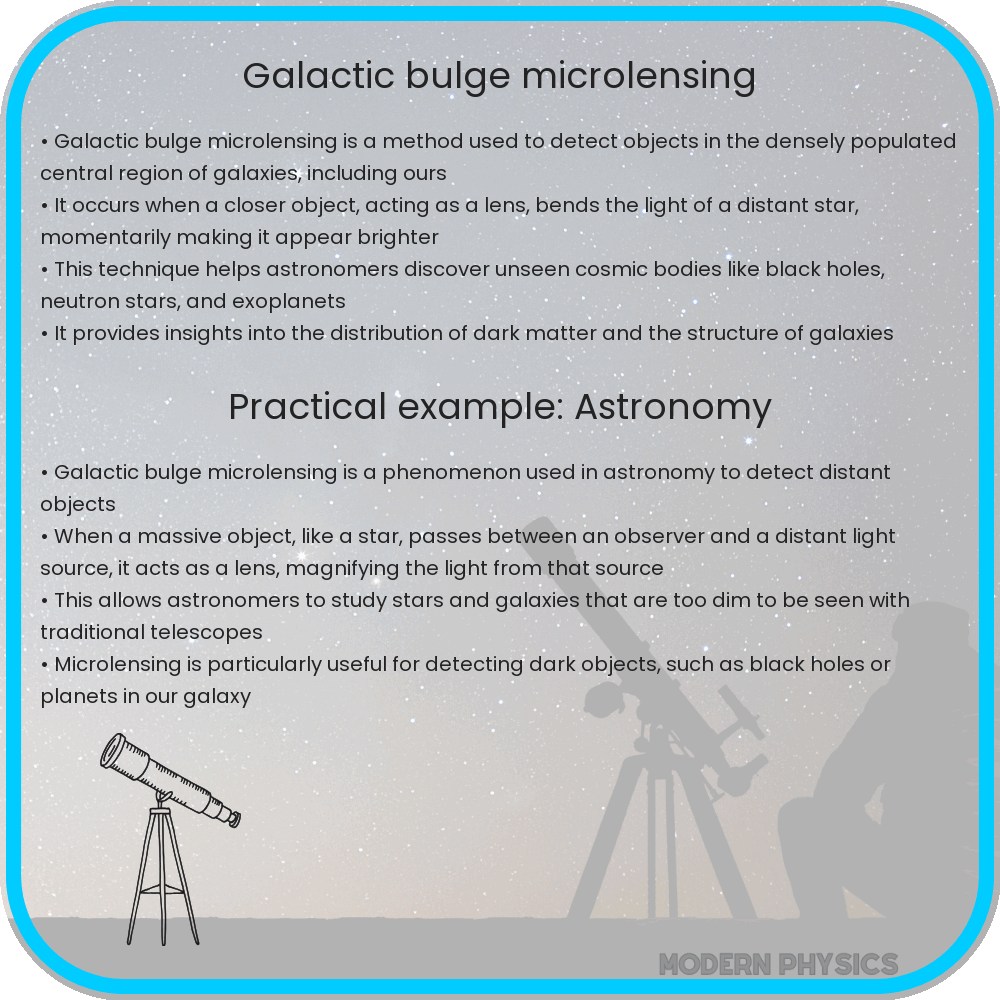
Microlensing is a powerful astronomical phenomenon that allows scientists to study objects that emit little or no light, such as black holes, dark stars, and the elusive dark matter. One of the key areas where microlensing is particularly insightful is within the Galactic Bulge of our Milky Way. The Galactic Bulge is a densely populated region of stars and other celestial bodies at the center of our galaxy. Here, the gravitational forces are immense, making it an ideal location for observing gravitational microlensing events.
Gravitational microlensing occurs when the gravitational field of a massive object, such as a star or a planet, bends the light coming from a more distant background star. This bending of light, predicted by Einstein’s theory of General Relativity, results in a temporary increase in the brightness of the background star, providing a unique opportunity to study the foreground object, even if it is otherwise invisible.
The Role of Dark Matter in Microlensing
One of the most significant aspects of microlensing studies in the Galactic Bulge is their ability to provide insights into dark matter. Dark matter is a mysterious substance that does not emit, absorb, or reflect light, making it completely invisible to current telescopes. However, it exerts gravitational effects on visible matter, such as stars and galaxies. By analyzing microlensing events, astronomers can infer the presence and distribution of dark matter in the Galactic Bulge.
The frequency and distribution of microlensing events can offer clues about the amount and nature of dark matter. For example, if a large number of microlensing events are detected, it could indicate a significant amount of dark matter in the form of compact objects, such as brown dwarfs or black holes. Conversely, a lower than expected number of events might suggest that dark matter is not primarily composed of these compact objects.
Gravitational Microlensing and Stellar Populations
Besides dark matter, microlensing also provides invaluable information about the stars within the Galactic Bulge. The characteristics of a microlensing event, such as its duration and the change in brightness, can reveal details about the lensing object, including its mass and distance from Earth. This allows astronomers to build a more comprehensive picture of the stellar populations in the Galactic Bulge, including stars that are too faint or too obscured by dust to be observed directly.
Challenges and Advancements in Microlensing Observations
Despite its significant potential, galactic bulge microlensing presents numerous challenges. One of the primary difficulties is the need for continuous and precise monitoring of millions of stars to catch the rare and unpredictable microlensing events. Furthermore, distinguishing between microlensing events and intrinsic variability in stars requires sophisticated data analysis techniques. However, advancements in technology and data analysis methods continue to improve the detection and interpretation of these events. Projects like the Optical Gravitational Lensing Experiment (OGLE) and the upcoming Nancy Grace Roman Space Telescope are expected to revolutionize our understanding of microlensing phenomena.
Implications for Astrophysics and Cosmology
The study of microlensing in the Galactic Bulge has far-reaching implications for astrophysics and cosmology. It not only aids in mapping the distribution of dark matter but also enhances our understanding of the structure and evolution of the Milky Way. Additionally, microlensing has the potential to uncover exoplanets orbiting stars in the bulge, contributing to our knowledge of planetary systems beyond our own.
Microlensing events also provide a unique laboratory for testing theories of gravity and the nature of compact objects, offering insights into the fundamental laws that govern the universe. As such, the continued study of galactic bulge microlensing is crucial for advancing our understanding of both visible and invisible components of the cosmos.
Conclusion
Galactic bulge microlensing stands as a cornerstone in modern astronomy, offering a window into the unseen and shedding light on the dark constituents of the universe. By harnessing the power of gravity, astronomers can probe the elusive dark matter, map out the structure of our galaxy, and uncover hidden celestial bodies. Despite the inherent challenges, the future of microlensing research is bright, driven by technological advancements and a growing understanding of the cosmos. As we continue to peer into the heart of our galaxy, microlensing will undoubtedly play a pivotal role in unraveling the mysteries of the dark universe.