
Explore the wonders of strong gravitational lensing in astrophysics: a natural phenomenon used to map dark matter, study distant galaxies, and measure cosmic expansion.
Introduction to Strong Lensing
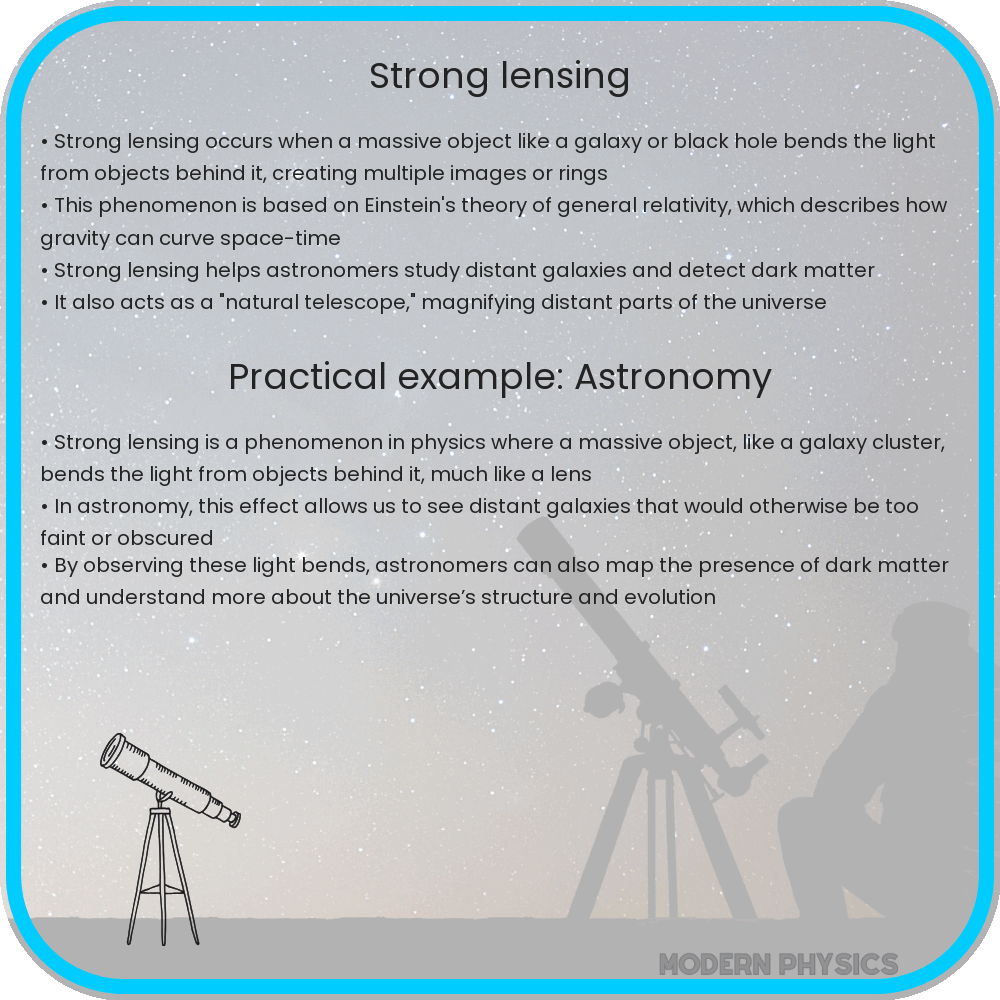
Strong lensing is a fascinating phenomenon in the cosmos where massive celestial bodies like galaxies and black holes bend the fabric of space-time, causing light from distant objects to be magnified and distorted. This effect, predicted by Einstein’s General Theory of Relativity, provides astronomers with a unique tool to probe the universe’s most elusive secrets.
Insights from Strong Lensing
Strong lensing offers profound insights into the cosmos, including the distribution of dark matter, the nature of black holes, and the structure of the universe itself. By analyzing the bending of light, scientists can map out the presence of dark matter, which does not emit light and is otherwise invisible. Additionally, strong lensing allows for the observation of distant galaxies that would typically be too faint to detect, opening new windows into the early universe.
Techniques in Strong Lensing Observation
- Gravitational Arcs and Rings: One of the most striking signatures of strong lensing is the formation of arcs and rings around massive objects. These features are analyzed to determine the mass distribution of the lensing body.
- Time Delay Measurements: When a quasar is strongly lensed, the light can take multiple paths to reach us, each with a different length. By measuring the time delay between these paths, astronomers can estimate the Hubble constant, which describes the rate of the universe’s expansion.
- High-Resolution Imaging: Advanced telescopes equipped with adaptive optics provide the high-resolution images needed to detect and analyze strong lensing effects.
Applications in Astrophysics
Strong lensing has become a pivotal tool in astrophysics, contributing to various areas of research. It aids in the detection of exoplanets and the study of galaxy evolution and structure. Furthermore, it provides critical tests of cosmological models, helping refine our understanding of the universe’s overall geometry and expansion.
Insights into Strong Lensing
Strong gravitational lensing is a powerful phenomenon in astrophysics, governed by Einstein’s theory of general relativity. It occurs when a massive celestial body, like a galaxy or a black hole, bends the fabric of spacetime so intensely that light from objects behind it, such as distant galaxies, is magnified and distorted. This effect creates multiple images, arcs, or even ring-shaped structures known as Einstein rings around the lensing mass. Strong lensing not only magnifies but also provides insights into the dark matter distribution within galaxies and clusters, acting as a natural telescope to observe the early universe.
Techniques in Strong Lensing Analysis
Analyzing strong lensing involves identifying lensing signatures and reconstructing the mass distribution of the lensing object. Techniques include modeling the lensing mass with the help of sophisticated algorithms and observing the distorted images of background galaxies. These models can then be used to calculate the mass of the lensing object, including the elusive dark matter. Additionally, time delays between multiple images of the same astronomical event, such as a supernova, can be measured to estimate the Hubble constant, which describes the rate of expansion of the universe.
Applications of Strong Lensing in Astrophysics
- Dark Matter Mapping: Strong lensing provides a unique method for mapping the distribution of dark matter in galaxies and clusters, revealing structures invisible to traditional telescopic observations.
- Studying Distant Galaxies: The magnifying effect of strong lensing allows astronomers to study the properties and formation of distant, young galaxies that would otherwise be too faint to detect.
- Measuring Cosmic Expansion: The time delays in lensed images serve as a cosmic ruler to measure distances across the universe, offering a way to refine the value of the Hubble constant.
Conclusion
Strong gravitational lensing is a cornerstone of modern astrophysics, offering a unique vantage point to study the cosmos. By turning massive celestial bodies into natural lenses, astronomers can probe the dark constituents of the universe, understand the structure and evolution of distant galaxies, and refine our understanding of the universe’s expansion. As observational techniques and modeling improve, strong lensing will continue to illuminate the dark corners of the cosmos, providing answers to some of the most profound questions in astrophysics.