
Explore the enigmatic world of electron neutrinos, their interactions, and detection methods, unveiling the mysteries of these elusive particles.
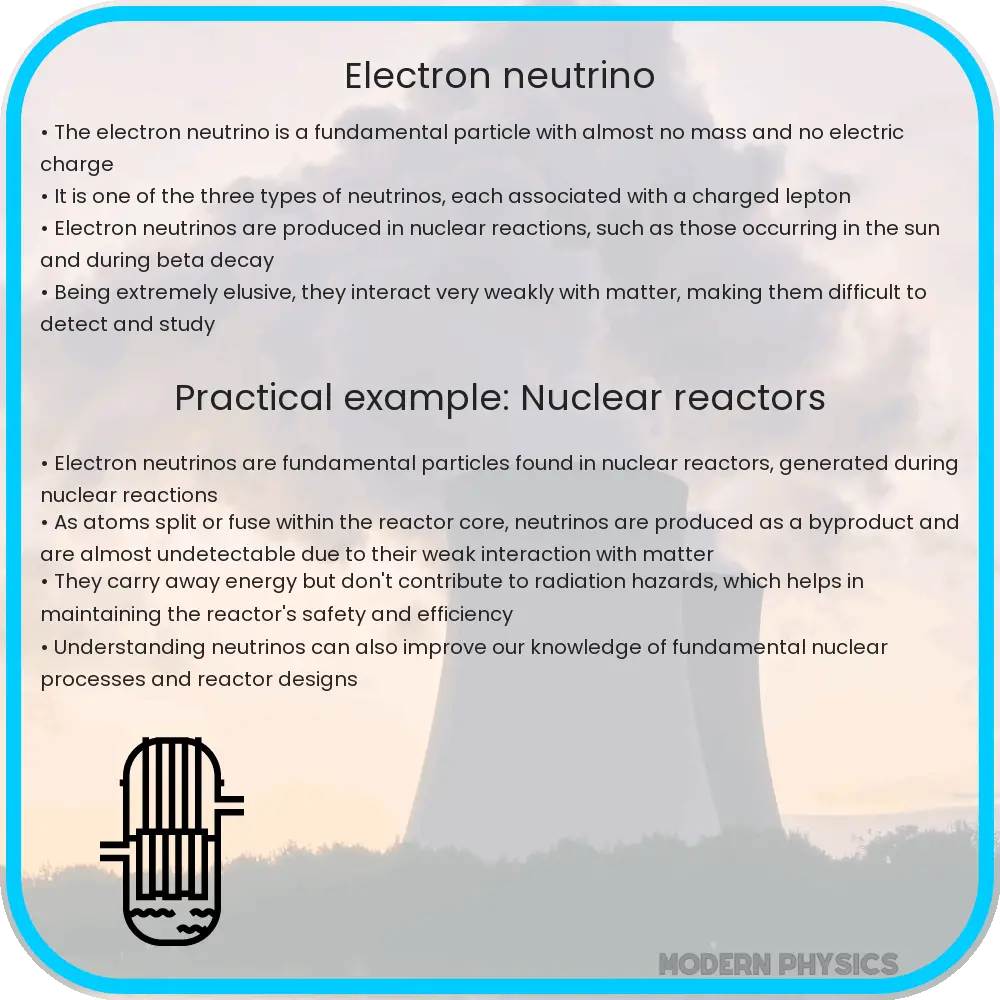
Understanding the Electron Neutrino: A Journey into the Quantum World
The electron neutrino is one of the most enigmatic particles in the universe. Part of the neutrino family, it plays a crucial role in the cosmic ballet of particle physics. Neutrinos are famously elusive, interacting so weakly with matter that billions pass through our bodies every second without leaving a trace. This makes them not just fascinating but also extremely challenging to study and understand.
The Mystery of Neutrinos
Neutrinos were first postulated by Wolfgang Pauli in 1930 to explain the apparent violation of energy conservation in beta decay, a type of radioactive decay. There are three types of neutrinos: electron neutrinos, muon neutrinos, and tau neutrinos, each associated with their respective leptons. The electron neutrino, often symbolized as νe, is linked to the electron in particle processes. Despite their initial theoretical prediction, neutrinos remained undetected for over two decades, earning them the nickname ‘ghost particles.’
Interactions of Electron Neutrinos
Neutrinos interact with other particles through the weak nuclear force, one of the four fundamental forces of nature. This interaction is incredibly rare due to the weak force’s short range and the low mass of neutrinos. Electron neutrinos, specifically, are produced in vast quantities during nuclear reactions, such as those occurring in the sun, during supernova explosions, or artificially in nuclear reactors and particle accelerators. However, due to their weak interaction, detecting them requires large, sensitive detectors and often involves deep underground facilities to shield from cosmic radiation and other background noise.
Detection Techniques and Challenges
Detecting electron neutrinos is a monumental task that has evolved significantly since their first discovery. Initial detection methods involved large tanks of water or heavy water, where neutrinos would interact with the atoms inside, producing detectable light signals in a process known as Cherenkov radiation. Modern experiments use even more sophisticated techniques, including liquid argon time projection chambers and massive arrays of photodetectors, to capture the rare interactions of neutrinos with matter. The main challenge in neutrino detection lies in differentiating these rare events from the myriad of other particles and noise in the detector environment.
The Mysterious World of the Electron Neutrino
Electron neutrinos are fundamental particles belonging to the lepton family, known for their extremely light mass and lack of electric charge. They play a crucial role in various astrophysical and nuclear processes, including the fusion reactions that power the sun and other stars. Despite their ubiquity and importance, electron neutrinos are shrouded in mystery due to their elusive nature.
Interactions of Electron Neutrinos
Electron neutrinos interact with matter through the weak nuclear force, one of the four fundamental forces in the universe. This interaction is famously known for its weakness, making neutrinos extremely difficult to detect. They are able to pass through most matter virtually undetected, earning them the nickname ‘ghost particles’. Electron neutrinos are produced in vast numbers by the sun and other stars as a byproduct of nuclear fusion reactions, where four hydrogen nuclei combine to form a helium nucleus, two positrons (e+), and two electron neutrinos (νe).
Detection of Electron Neutrinos
Detecting electron neutrinos requires sophisticated and large-scale experimental setups. One of the most common detection methods involves large tanks filled with a substance like water or heavy water, where neutrinos interact with electrons or nuclei, creating detectable light flashes. This method, utilized by experiments such as the Super-Kamiokande in Japan, has significantly advanced our understanding of neutrino properties, including their mass and oscillation behavior.
Neutrino Oscillation: A Quantum Phenomenon
One of the most intriguing aspects of electron neutrinos is their ability to oscillate between different types. This quantum phenomenon implies that neutrinos can change their type (or ‘flavor’) as they travel through space. This discovery has profound implications for our understanding of the universe, suggesting that neutrinos have mass and challenging the Standard Model of particle physics.
Conclusion
The study of electron neutrinos continues to be a vibrant field of research, offering insights into the fundamental laws governing the universe. Their elusive nature and unique properties challenge our understanding of the microscopic world, pushing the boundaries of modern physics. As detection techniques become more sophisticated, we anticipate unraveling more mysteries surrounding these ghostly particles, further illuminating the dark corners of our universe.