
Explore Fock Space in Quantum Mechanics: Understand its role in particle physics, quantum field theory, and the dynamics of variable particle systems.
Understanding Fock Space in Quantum Mechanics
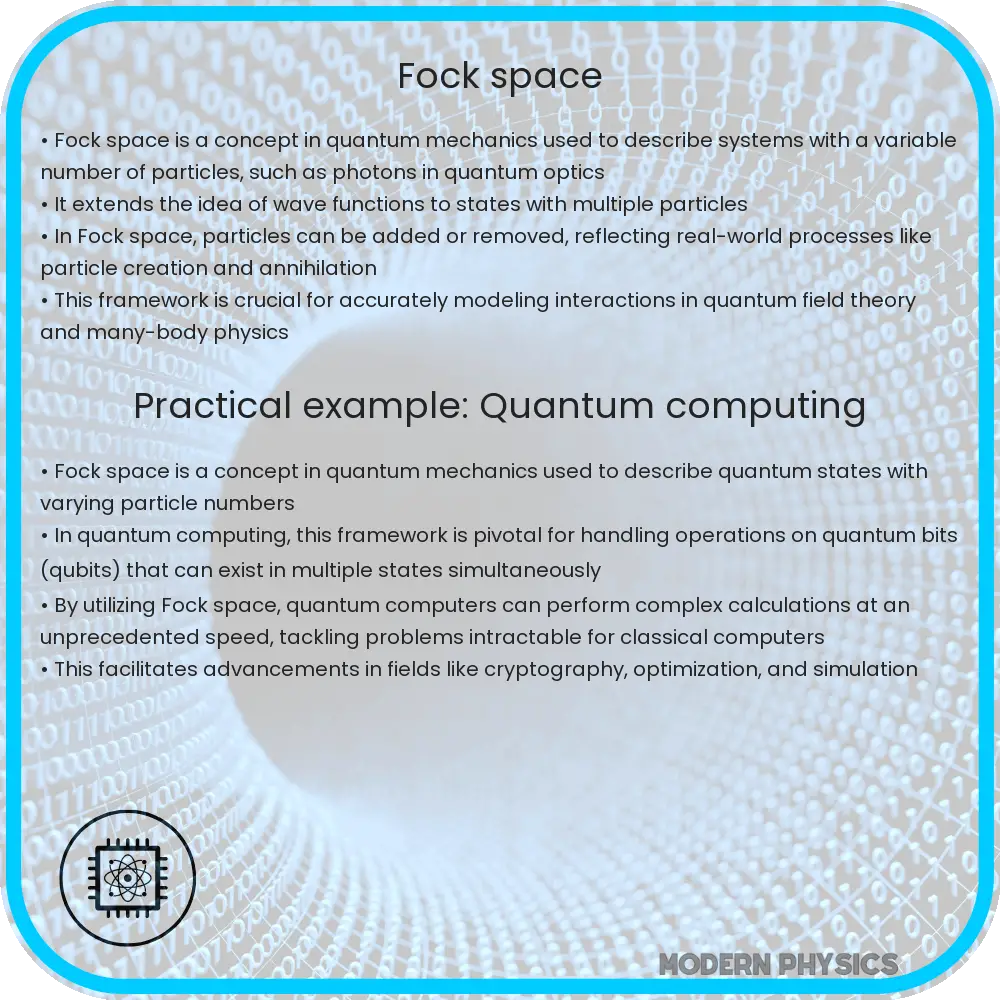
Fock space, a concept integral to quantum mechanics and quantum field theory (QFT), provides a framework for understanding systems with a variable number of particles. It’s named after the Russian physicist Vladimir Fock, who developed this concept in the 1930s. This space allows for a more comprehensive description of quantum states, especially in systems where the number of particles is not fixed, such as in field dynamics and particle physics.
The Basics of Fock Space
At its core, Fock space is a type of Hilbert space, which is a mathematical structure used in quantum mechanics to describe the quantum states of a system. However, unlike the standard Hilbert space, which is used for fixed-particle systems, Fock space accommodates systems where the particle number can change. This adaptability makes it crucial for studying processes like particle creation and annihilation, common in high-energy physics.
Quantum States in Fock Space
In Fock space, quantum states are represented as a superposition of states with different particle numbers. For instance, a state in Fock space might be a combination of a state with no particles (the vacuum state), a state with one particle, a state with two particles, and so on. Mathematically, this is expressed using creation and annihilation operators, which add or remove particles from a given state. These operators obey specific commutation or anticommutation relations, depending on whether the particles are bosons (which obey Bose-Einstein statistics) or fermions (which obey Fermi-Dirac statistics).
Field Dynamics and Quantum Field Theory
Fock space becomes particularly important in the context of quantum field theory, which combines quantum mechanics with special relativity to describe particle physics. In QFT, particles are seen as excitations of underlying fields, like the electromagnetic field. The dynamics of these fields, and consequently the behavior of particles, are governed by the field’s quantum state in Fock space. This approach allows physicists to predict outcomes of high-energy particle interactions, such as those observed in particle accelerators.
By utilizing Fock space, physicists can effectively study complex systems where the number of particles is not conserved. This is essential for understanding phenomena like particle-antiparticle pair production and annihilation, which are key aspects of quantum field theory and essential for explaining the fundamental nature of the universe.
Applications and Implications of Fock Space
Fock space is not just a theoretical construct; it has practical applications in various fields of physics. In quantum optics, for example, Fock states (states with a definite number of particles) are used to describe light in terms of photons. This perspective is crucial in understanding phenomena like the quantum nature of lasers and photon entanglement, which underpin quantum information theory and quantum computing.
In condensed matter physics, Fock space provides insight into the behavior of electrons in solids, aiding in the study of superconductivity and semiconductor physics. The versatility of Fock space in handling systems with varying particle numbers makes it indispensable for modeling and predicting the behavior of these complex systems.
Challenges and Future Directions
Despite its successes, working with Fock space presents significant challenges. The mathematical complexity increases rapidly with the number of particles, making calculations for large systems extremely difficult. This complexity is a significant hurdle in quantum computing and simulating quantum systems, driving ongoing research in computational methods and algorithms.
Additionally, the extension of quantum field theory and Fock space concepts to gravity and cosmology remains an open area of research. Theories like quantum gravity attempt to reconcile the principles of quantum mechanics with general relativity, and Fock space plays a role in these explorations.
Conclusion
Fock space is a fundamental concept in quantum mechanics and quantum field theory, providing a powerful framework for understanding and predicting the behavior of systems with variable particle numbers. From the microcosm of particle physics to the macrocosm of cosmology, its applications are far-reaching. While challenges remain in its computational aspects and extension to other theories, Fock space continues to be a crucial tool in the physicist’s arsenal. As research progresses, it will undoubtedly yield deeper insights into the quantum nature of our universe and drive technological advancements in fields like quantum computing and quantum communication.