
Explore Fock Space Formalism’s role in quantum mechanics and field dynamics, from particle interactions to quantum optics applications.
Understanding Fock Space Formalism in Quantum Mechanics
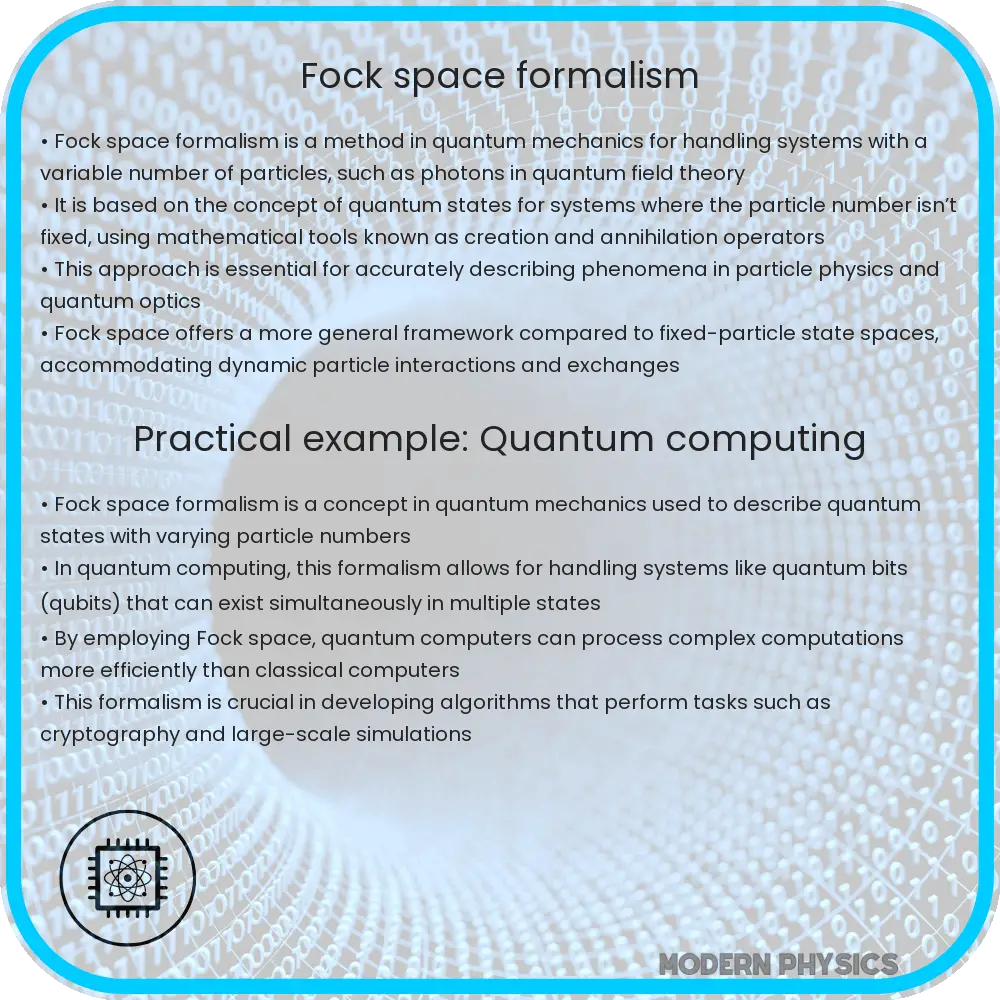
The Fock space formalism is a fundamental concept in quantum mechanics and field theory, providing a framework to describe systems with a varying number of particles. This approach is particularly useful in quantum field theory (QFT) where the number of particles can change due to creation and annihilation processes.
In essence, Fock space is an extension of the concept of Hilbert space, used to describe quantum states. While a Hilbert space is suitable for a fixed number of particles, Fock space accommodates states with different particle numbers. It’s constructed as a direct sum of Hilbert spaces, each representing a specific number of particles.
Quantum States in Fock Space
In Fock space, a quantum state of ‘n’ particles is represented by a vector in the corresponding ‘n’-particle Hilbert space. For example, a single particle state lies in the one-particle space, a two-particle state in the two-particle space, and so on. The beauty of Fock space lies in its ability to handle superpositions of states with different particle numbers.
Mathematically, a state in Fock space is denoted as |ψ⟩, which can be a superposition of states with varying numbers of particles. This flexibility is crucial in quantum field dynamics where interactions often change the number of particles.
Field Dynamics in Quantum Mechanics
Quantum field dynamics describe how fields, like the electromagnetic field, evolve in space and time. In this framework, particles are seen as excitations of the underlying field. The dynamics of these fields are governed by quantum field theories, like Quantum Electrodynamics (QED) for the electromagnetic field.
In QED, for instance, the electromagnetic field is quantized, and its quantum state is represented in Fock space. Field operators act on these states, creating or annihilating particles. For example, the creation operator \( a^\dagger \) adds a particle to a state, while the annihilation operator \( a \) removes a particle.
The interaction between particles is described by terms in the Hamiltonian that involve both creation and annihilation operators. This allows for the dynamic creation and annihilation of particles, a feature that is central to understanding processes like particle collisions in high-energy physics.
Thus, Fock space formalism and its application to field dynamics provide a comprehensive framework for understanding the quantum mechanical behavior of systems with variable particle numbers. This approach is indispensable in the study of complex quantum phenomena and forms the backbone of modern quantum field theories.
Applications and Implications of Fock Space in Quantum Field Theory
Fock space formalism plays a pivotal role in the practical application of quantum field theory (QFT). It is instrumental in the calculation of scattering amplitudes, which are probabilities of various outcomes in particle collisions. Using the creation and annihilation operators in Fock space, physicists can effectively model interactions in high-energy particle accelerators, like the Large Hadron Collider.
Another significant application is in the field of quantum optics. In quantum optics, Fock space is used to describe states of light, including single-photon states and more complex quantum states. This has implications for developing quantum communication and quantum computing technologies.
Challenges and Future Directions
Despite its wide usage, the Fock space formalism is not without challenges. One of the primary issues is the treatment of infinite degrees of freedom, which can lead to divergences in calculations. Renormalization techniques have been developed to address this, but they add complexity to the theory.
Looking ahead, the continued development of quantum field theory and its applications in various domains like condensed matter physics, cosmology, and quantum information science, will rely heavily on the concepts rooted in Fock space formalism. Innovations in computational techniques and theoretical models are expected to overcome current limitations and expand our understanding of quantum phenomena.
Conclusion
The Fock space formalism is a cornerstone in the study of quantum mechanics and field dynamics, offering a versatile framework for understanding systems with varying numbers of particles. Its application extends from fundamental particle physics to the emerging field of quantum technologies. Despite its complexities and challenges, Fock space remains an essential tool in the physicist’s arsenal, enabling deeper insights into the quantum realm. As we continue to explore the quantum world, the principles and methodologies of Fock space formalism will undoubtedly play a crucial role in shaping future discoveries and innovations in quantum science.