
Explore the role of Fock Space in QED, understanding quantum states, particle interactions, and fields, and its impact on modern physics.
Understanding Fock Space in Quantum Electrodynamics (QED)
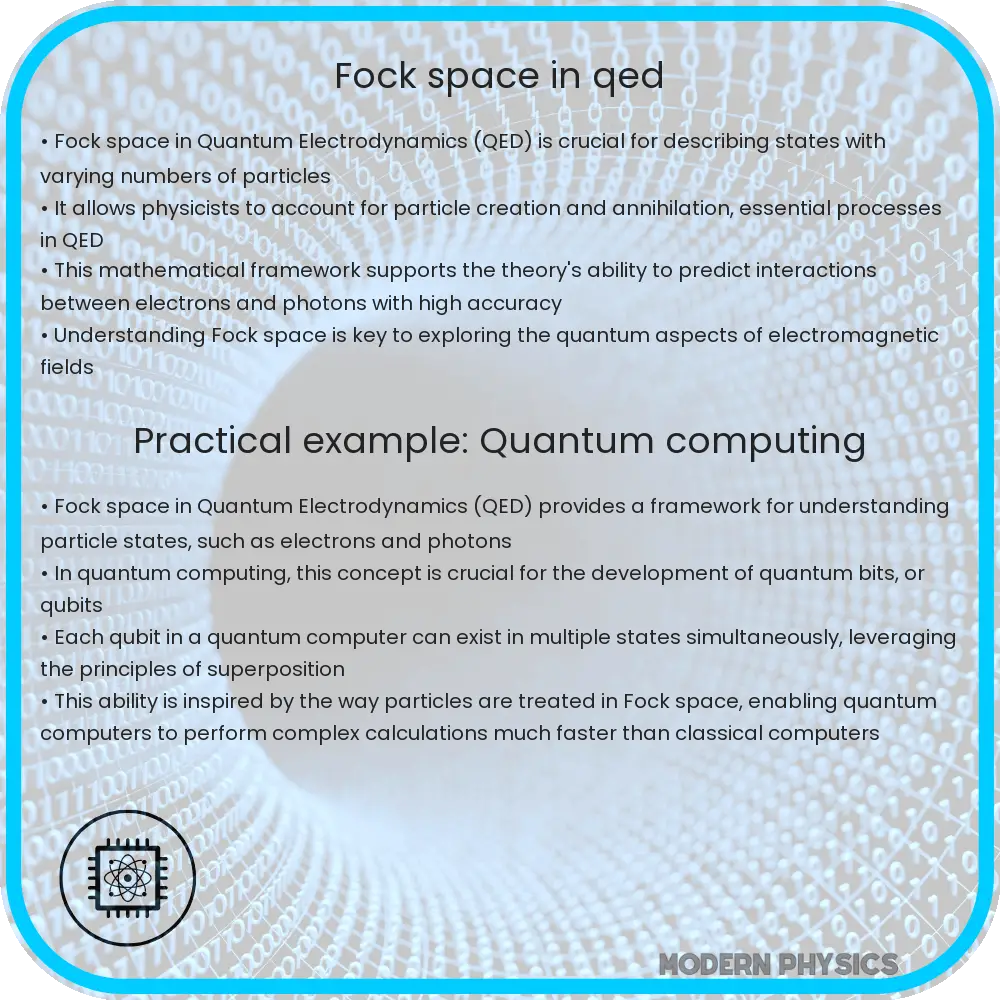
Quantum Electrodynamics (QED) stands as a cornerstone of modern physics, providing a quantum theory of electromagnetism. At the heart of QED lies the concept of Fock Space, a mathematical framework essential for understanding the quantum states of particles and their interactions. In this exploration, we delve into the intricacies of Fock Space, shedding light on its role in particle interactions and field theories.
Quantum States and Fock Space
In QED, particles like electrons and photons are treated as quantum states. These states are not just simple wavefunctions but are elements of a more complex structure known as Fock Space. Fock Space is a Hilbert space, a mathematical construct used to describe quantum systems. However, unlike the Hilbert space of single-particle systems, Fock Space accommodates the possibility of having an arbitrary number of particles. This feature is crucial in QED, where particle creation and annihilation are common phenomena.
Fock Space can be visualized as a collection of many ‘layers,’ each representing a different number of particles. For instance, the first layer corresponds to states with one particle, the second layer to states with two particles, and so on. This layered structure allows physicists to describe states where the number of particles is not fixed, a scenario often encountered in high-energy processes.
Particle Interaction in QED
Particle interactions in QED are fundamentally about the exchange of force-carrying particles, primarily photons. When two electrons repel each other, for example, they do so by exchanging virtual photons. These interactions are mathematically represented using Feynman diagrams, which not only depict the particles involved but also their interaction through time.
In Fock Space, these interactions are described using operators that act on the quantum states. Creation and annihilation operators are particularly important. The creation operator adds a particle to a state, while the annihilation operator removes a particle. The mathematics of these operators is governed by rules that ensure the conservation of energy and momentum, as well as compliance with the principles of quantum mechanics.
The versatility of Fock Space in describing various particle numbers and interactions makes it an indispensable tool in QED. Its framework provides a deeper understanding of how particles like electrons and photons interact, illuminating the quantum nature of electromagnetic forces.
Fields in QED
At the core of QED is the concept of fields. In classical physics, fields are continuous entities that permeate space, like the electromagnetic field. However, in the quantum realm, these fields acquire particle-like properties. Quantum fields can be thought of as being composed of an infinite number of oscillators, each corresponding to a possible particle state.
In Fock Space, these quantum fields are represented by field operators. These operators, when applied to the vacuum state (the state with no particles), create particle states. This is how particle creation is conceptualized in QED: as excitations of the underlying quantum fields.
The elegant interplay between particles and fields in QED, as encapsulated by Fock Space, is not just a theoretical curiosity. It has profound implications for our understanding of the universe, from the microcosm of subatomic particles to the vast reaches of cosmological phenomena.
The Role of Fock Space in Particle Physics and Beyond
Fock Space extends its utility beyond the confines of Quantum Electrodynamics, playing a pivotal role in other areas of particle physics. For instance, in Quantum Chromodynamics (QCD), which deals with the strong force and the interactions of quarks and gluons, Fock Space provides a framework for understanding the complex states these particles form. Similarly, in the study of condensed matter physics, Fock Space helps in exploring phenomena like superconductivity and superfluidity, where particle number variance is significant.
Computational Challenges and Fock Space
One of the challenges in applying Fock Space to real-world problems is computational complexity. As the number of particles increases, the dimensionality of Fock Space grows exponentially, making calculations increasingly difficult. This complexity is a major hurdle in simulating large quantum systems. However, advancements in computational methods and the advent of quantum computing hold promise for overcoming these challenges, potentially unlocking new understandings of quantum phenomena.
Quantum Field Theory and the Unification of Forces
Fock Space’s application extends into the broader realm of Quantum Field Theory (QFT), of which QED is a subset. QFT seeks to unify the fundamental forces of nature under a single theoretical framework. The success of QED and the Fock Space formalism in describing electromagnetic interactions gives hope that a similar approach could be extended to include the weak and strong nuclear forces, and possibly even gravity, leading to a grand unified theory.
Conclusion
The exploration of Fock Space in Quantum Electrodynamics unveils a fascinating and complex landscape where quantum states, particle interactions, and fields coalesce into a coherent theory. This mathematical framework has not only deepened our understanding of electromagnetic interactions but also laid the groundwork for exploring other fundamental forces. The challenges and possibilities that Fock Space presents in various fields of physics highlight its importance as a foundational concept in our quest to comprehend the quantum world. As computational capabilities evolve and new theories emerge, the role of Fock Space in advancing our understanding of the universe continues to be of paramount significance.