
Fock Space in QCD is a mathematical framework used to describe quantum states with varying particle numbers, crucial for modeling particle transformations.
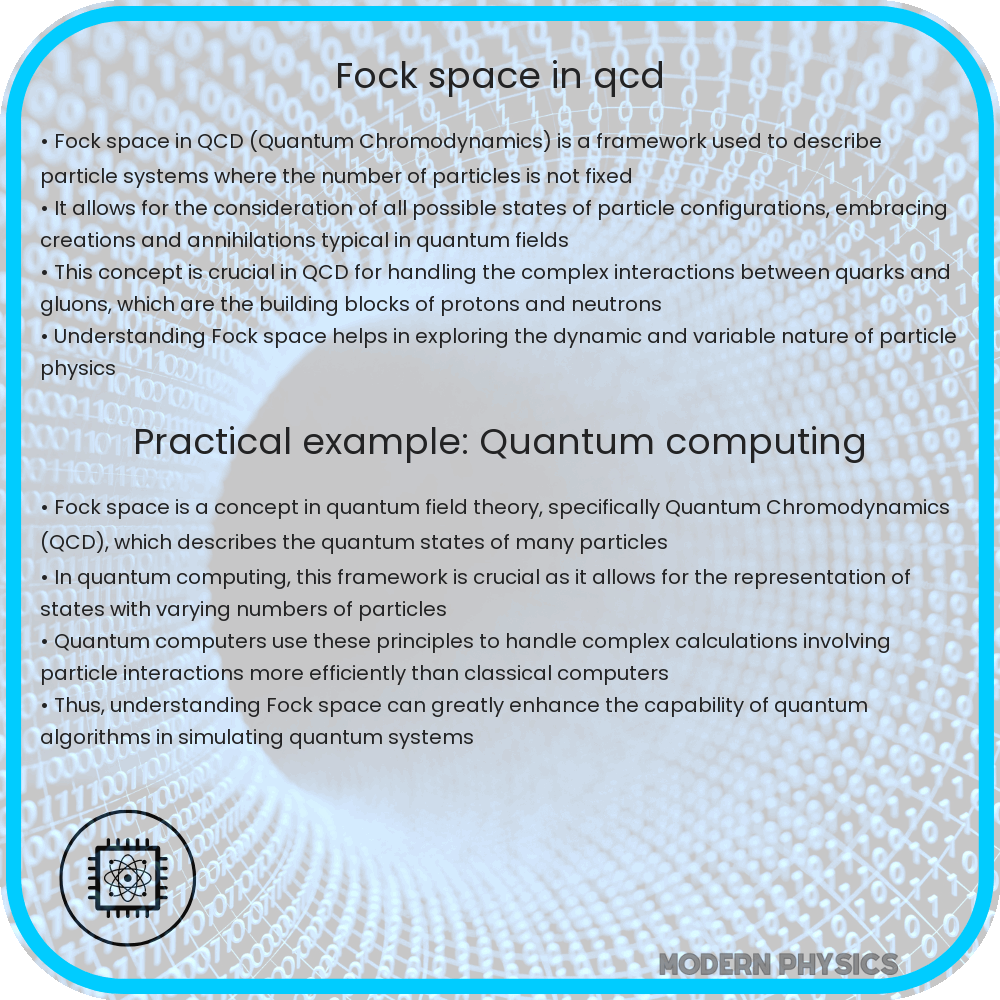
Understanding Fock Space in Quantum Chromodynamics (QCD)
Quantum Chromodynamics (QCD) is a cornerstone of modern physics, forming part of the Standard Model of particle physics, which describes the strong interaction between quarks and gluons. These particles are the fundamental building blocks of protons, neutrons, and thereby, of all atomic nuclei. To understand the complex interactions in QCD, we need a robust mathematical framework—and that’s where Fock Space becomes invaluable. Let’s explore how Fock Space is utilized in QCD to describe quantum states, gauge theory, and particles.
Fock Space: The Basics
Fock Space is a type of mathematical space used extensively in quantum mechanics to describe quantum states of a varying number of particles. Unlike the simpler Hilbert Space, which describes quantum systems with a fixed number of particles, Fock Space can accommodate systems where the particle number changes due to creation or annihilation processes. This characteristic makes it particularly useful in fields like QCD where particle interactions frequently involve the transformation from one type of particle to another.
Quantum States in QCD
In QCD, quarks and gluons are perpetually interacting and can transform through a variety of processes. For instance, a quark may emit or absorb a gluon, and gluons themselves can split into quark-antiquark pairs or other gluons. To capture the multiparticle nature of these states, physicists employ Fock Space. In Fock Space, a state vector might represent, for instance, a proton as a superposition of different combinations of quarks, antiquarks, and gluons, each with their own probabilities.
- Creation and Annihilation Operators: These are fundamental tools in manipulating Fock Space. The creation operator adds a particle to a state, while the annihilation operator removes a particle. These operators are crucial in describing processes like gluon emission (creation) or absorption (annihilation).
- Quantum State Notation: In the Fock space notation, a quantum state in QCD could be written as |nq, ng>, where nq and ng represent the number of quarks and gluons, respectively. Each term in such an expansion represents a different possible configuration of particles.
Gauge Theory and Its Representation in Fock Space
Gauge theories are a type of field theory where the Lagrangian (which describes the dynamics of a physical system) is invariant under certain local transformations—these are key to understanding forces in particle physics. QCD, specifically, is a non-Abelian gauge theory, meaning the gauge transformations form a group that does not necessarily commute. This introduces complexity in dealing with the mathematical representation of particle interactions.
In the context of Fock Space, each configuration or state in the space can be connected through gauge transformations. Describing these transformations accurately is vital for making precise predictions in particle physics experiments. The flexibility of the Fock space allows physicists to describe these varied states collectively, considering all possible transformations and interactions between quarks and gluons.
Particles and Interaction Dynamics in Fock Space
The interactions between quarks and gluons in QCD are governed by the strong force, characterized by the exchange of gluons. These exchanges can significantly alter the state of a system, illustrating the need for a dynamic approach like that provided by Fock Space. Here’s how particle interactions in QCD can be explained using Fock Space:
- Gluon Exchange: Key to the binding of quarks within protons and neutrons, gluon exchange can be effectively represented in Fock Space as a series of creation and annihilation events, each altering the quantum state of the system.
- Color Confinement: In QCD, color charge (analogous to electric charge in electromagnetism) must be neutralized. Fock Space helps model how quarks combine to form color-neutral hadrons, despite the complex interactions involved.
Through the use of creation and annihilation operators, and the flexible framework of Fock Space, physicists can delve into the probabilistic nature of particle states in QCD. This not only helps in predicting experimental outcomes but also enhances our understanding of the fundamental components of matter.
Implications of Fock Space in Advanced QCD Research
The use of Fock Space extends beyond basic representations of particle interactions to more complex scenarios encountered in high-energy physics experiments. For example, in the study of particle collisions, such as those observed in particle accelerators, Fock Space provides a framework that can account for the high number of particles and range of possible states generated during these events.
- High Energy Collisions: In collisions at high energies, multiple particles are produced, and these can be described collectively within Fock Space. This allows physicists to model and statistically analyze the outcomes of particle collisions.
- Quantum Field Theory Calculations: Fock Space plays a critical role in performing detailed calculations in Quantum Field Theory, which are essential for predicting particle behavior at quantum levels.
Teaching and Learning Applications
Fock Space is not only important for research but also for educational purposes. It helps in simplifying the complex concepts of QCD for students and enthusiasts. By understanding the operations within Fock Space, learners can better grasp the quantum mechanical behaviors of particles under strong forces.
- Visualization Tools: Modern physics education often utilizes visual aids and computer simulations that rely on the principles of Fock Space to demonstrate the dynamic behavior of quarks and gluons.
- Advanced Courses and Research: Higher education institutions incorporate Fock Space in advanced courses on quantum mechanics and particle physics, enabling students to perform research-based projects and simulations.
Conclusion
Fock Space is not merely a theoretical construct but a powerful tool that enhances our understanding of Quantum Chromodynamics and the fundamental nature of the universe. By bridging the gap between abstract quantum state changes and measurable physical phenomena, Fock Space enables physicists to explore and explain the behavior of quarks and gluons under the strong force. Its application in educational tools and advanced research promotes a deeper understanding of particle interactions, equipping the next generation of physicists with the necessary skills to explore the atomic and subatomic world. Ultimately, the study and application of Fock Space in QCD not only push the boundaries of theoretical physics but also pave the way for future technological advancements derived from the profound understanding of the most fundamental aspects of nature.