
Explore the ins and outs of barcode scanners, focusing on their accuracy, speed, and the optical technology that powers them. Learn how they revolutionize inventory and sales tracking.
Understanding Barcode Scanners: Accuracy, Speed, and Optical Technology
Barcode scanners are pivotal tools in the retail, manufacturing, and logistics sectors, streamlining operations and enhancing inventory management. Their efficiency relies on accuracy, speed, and the underlying optical technology, which together ensure seamless data capture and processing. This article delves into these critical aspects, providing insights into how barcode scanners optimize operational workflows.
Accuracy: The Cornerstone of Reliable Data Capture
Accuracy in barcode scanners is paramount, as even a minor error can lead to significant discrepancies in inventory tracking and customer transactions. Advanced imaging technology and error correction algorithms play a crucial role in ensuring that scanners accurately decode barcodes, even if they are damaged, dirty, or poorly printed. The precision of these devices directly impacts the integrity of data in supply chain management, making accuracy a non-negotiable feature.
Speed: Keeping Pace with High-Volume Transactions
Speed is another critical factor, especially in high-traffic retail environments and during peak logistic operations. Modern barcode scanners are designed to quickly capture data, reducing wait times and increasing throughput. Laser and imager scanners, the two main types, excel in different scenarios. Laser scanners are renowned for their swift decoding capabilities, ideal for fast-moving checkout lines. Conversely, imager scanners capture images of the barcode and decode the information, offering flexibility in handling various barcode orientations and types, including 2D barcodes.
Optical Technology: The Backbone of Scanning Efficiency
The heart of a barcode scanner’s functionality lies in its optical technology. This encompasses the light source, sensor, and lens, which work together to capture the barcode’s image. Laser scanners use a coherent light source to illuminate the barcode, with a photodiode sensor detecting the reflected light to decode the information. Imager scanners, on the other hand, use a camera to take an image of the barcode, employing complex algorithms to interpret the barcode’s data. The advancement in CCD (Charge Coupled Device) and CMOS (Complementary Metal-Oxide-Semiconductor) technologies has greatly enhanced the performance of imager scanners, making them increasingly popular in various industries.
Is this conversation helpful so far?
Bar Code Scanners: Unveiling the Efficiency of Optical Technology
Bar code scanners are indispensable tools in various sectors, including retail, logistics, and healthcare, owing to their ability to streamline operations by offering quick and reliable decoding of information. These devices leverage advanced optical technology to enhance accuracy and speed, thereby improving overall productivity and efficiency.
Understanding the Mechanics
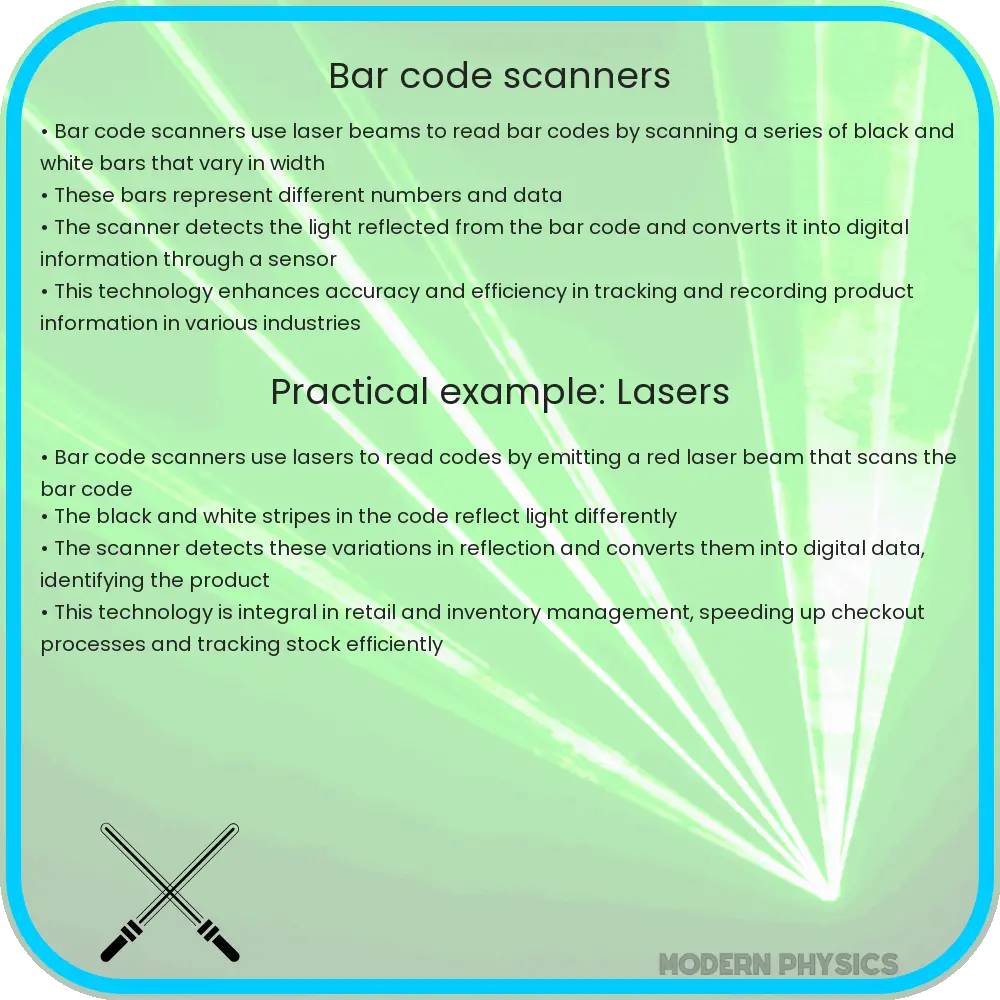
At the heart of bar code scanning technology lies the optical system, which typically consists of a light source, a lens, and a light sensor translating optical impulses into electrical signals. The scanner illuminates the bar code with a red light emitted from the light source. The black bars absorb light, while the white spaces reflect it back towards the sensor. This contrast between dark and light patterns enables the scanner to interpret and decode the information contained within the bar code.
Accuracy and Precision
The accuracy of bar code scanners is paramount, as even the slightest error can lead to significant discrepancies in inventory tracking, pricing, and data management. Modern scanners are equipped with sophisticated algorithms that not only decode bar codes but also correct errors caused by smudges, wrinkles, or other physical damages on the label. This ensures high levels of precision, essential for maintaining the integrity of data in critical applications.
Speed: The Competitive Edge
Speed is another critical factor that defines the effectiveness of bar code scanners. The ability to quickly read and process information from bar codes allows businesses to expedite checkout processes, enhance customer service, and improve inventory management. High-speed scanning is achieved through the use of powerful processors and advanced decoding software, enabling these devices to interpret hundreds of bar codes per second.
Optical Technology Enhancements
The evolution of optical technology has significantly contributed to the advancements in bar code scanning. Innovations such as laser scanning, CCD (Charge Coupled Device) technology, and image-based scanning have expanded the capabilities of bar code scanners, allowing for greater flexibility in how and where they can be used. Laser scanners, for instance, offer exceptional precision and can read bar codes from greater distances, while image-based scanners capture an image of the bar code and analyze it digitally, making it possible to read even damaged or poorly printed codes.
Conclusion
Bar code scanners stand as a testament to the power of optical technology in enhancing operational efficiency across various industries. Through improvements in accuracy, speed, and the application of cutting-edge optical innovations, these devices continue to evolve, offering businesses a reliable and efficient tool for data management and process optimization. As technology progresses, we can anticipate even more sophisticated bar code scanning solutions, further revolutionizing how businesses manage inventory, process transactions, and interact with customers. The integration of these optical technologies into bar code scanners not only boosts productivity but also paves the way for future advancements in automatic identification and data capture (AIDC) technologies.