
Explore the efficiency, speed, and security benefits of optical communication systems, from fiber optics to key technologies and advantages.
Introduction to Optical Communication Systems
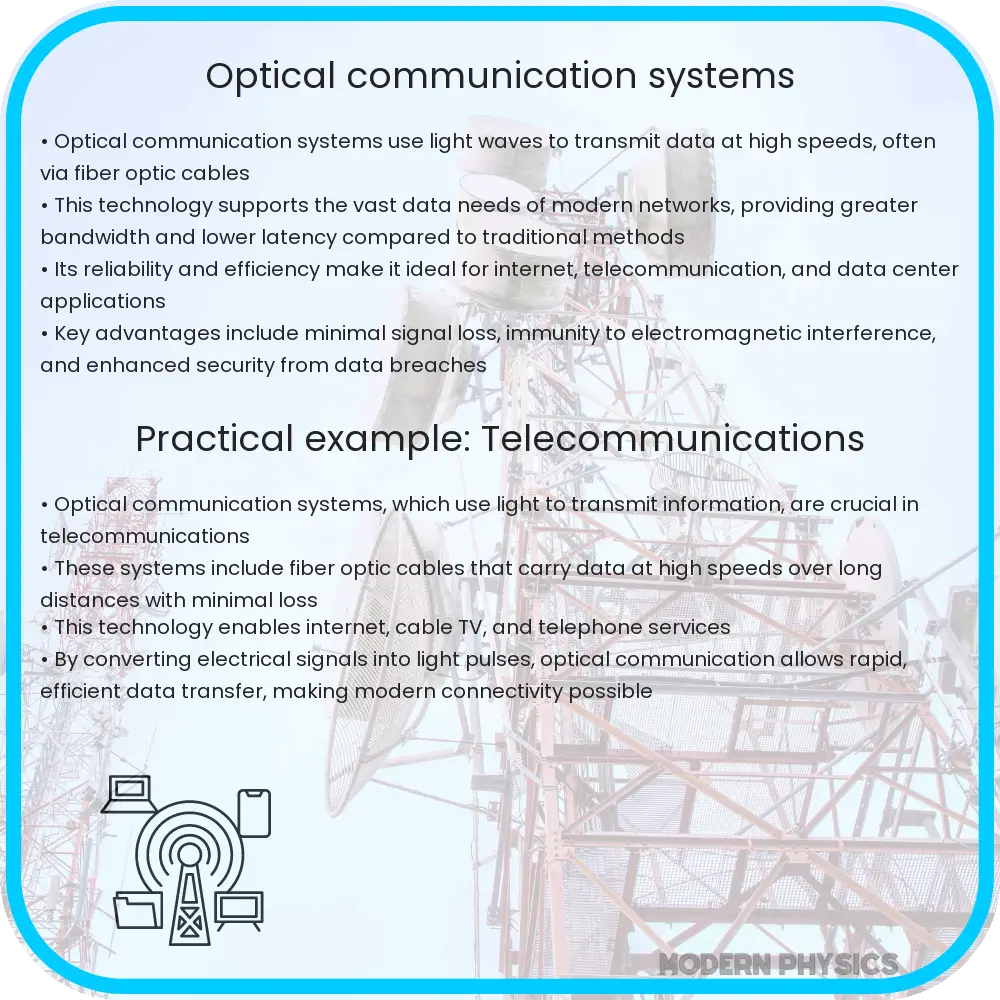
Optical communication systems represent a pivotal technology in the global telecommunications sector, providing a foundation for the high-speed, efficient, and secure transmission of data over long distances. Leveraging the power of light to carry information, these systems offer unparalleled advantages over traditional electronic communication methods, including higher bandwidth, reduced latency, and immunity to electromagnetic interference.
Core Principles of Optical Communication
At the heart of optical communication is the use of light waves as a medium to transmit information. This is typically achieved through fiber optic cables, which consist of a core and a cladding layer that together guide light effectively. The information is encoded into light signals using various modulation techniques, allowing vast amounts of data to be sent with incredible speed across vast distances.
Key Components and Technologies
- Transmitters: Convert electrical signals into optical signals using lasers or LED sources.
- Fiber Optic Cables: Act as the medium through which light travels, designed to minimize loss and maintain signal integrity.
- Optical Amplifiers: Boost the strength of the optical signal to extend its reach without the need for conversion back to electrical form.
- Receivers: Convert the optical signals back into electrical signals, ready for processing and use.
Advantages of Optical Communication
Optical communication systems offer significant advantages over their electronic counterparts. These benefits include:
- High Bandwidth: Optical fibers provide a much wider bandwidth than copper cables, supporting the transmission of large volumes of data at high speeds.
- Low Signal Attenuation: Signals in optical fibers degrade less over distance, allowing for longer transmission without significant loss of quality.
- Security: Optical communication is inherently more secure, as it is difficult to tap into a fiber optic cable without detection.
- Resistance to Electromagnetic Interference: Being based on light rather than electrical currents, optical systems are immune to interference from electromagnetic sources, ensuring cleaner signal transmission.
Emerging Trends and Future Directions
The field of optical communication is rapidly evolving, driven by relentless demand for faster, more reliable, and secure data transmission. Innovations such as Dense Wavelength Division Multiplexing (DWDM) allow for the simultaneous transmission of multiple signals at different wavelengths on the same fiber, exponentially increasing the data capacity of optical networks. Additionally, advancements in photonic integrated circuits are making optical systems more compact, energy-efficient, and cost-effective.
Challenges and Solutions
Despite its advantages, optical communication faces challenges such as signal degradation over extremely long distances, which necessitates the use of repeaters or amplifiers to maintain signal integrity. The industry is also working on reducing the complexity and improving the scalability of optical networks to accommodate growing data traffic and emerging applications like the Internet of Things (IoT) and 5G networks.
Secure Optical Communication
Security in optical communication systems is paramount, especially in an era where data breaches and cyber-attacks are rampant. Quantum cryptography presents a promising solution, offering theoretically unbreakable encryption based on the principles of quantum mechanics. This, alongside conventional encryption methods, ensures that optical communication remains one of the most secure forms of data transmission available today.
Conclusion
Optical communication systems are at the forefront of revolutionizing the way we transmit data, offering a blend of speed, efficiency, and security that is unmatched by traditional electronic systems. With ongoing advancements in technology and the continual push for higher bandwidth and lower latency, optical communication is set to play a crucial role in the future of global telecommunications. Whether it’s enabling the next generation of internet infrastructure or supporting the vast data needs of modern computing, optical communication systems are a key driver of technological progress and innovation. As we look to the future, the potential of optical communication is boundless, promising to unlock new possibilities in connectivity, information sharing, and beyond.