
Understanding the nuanced interactions of electrons within atoms and molecules, crucial for accurate quantum mechanical predictions.
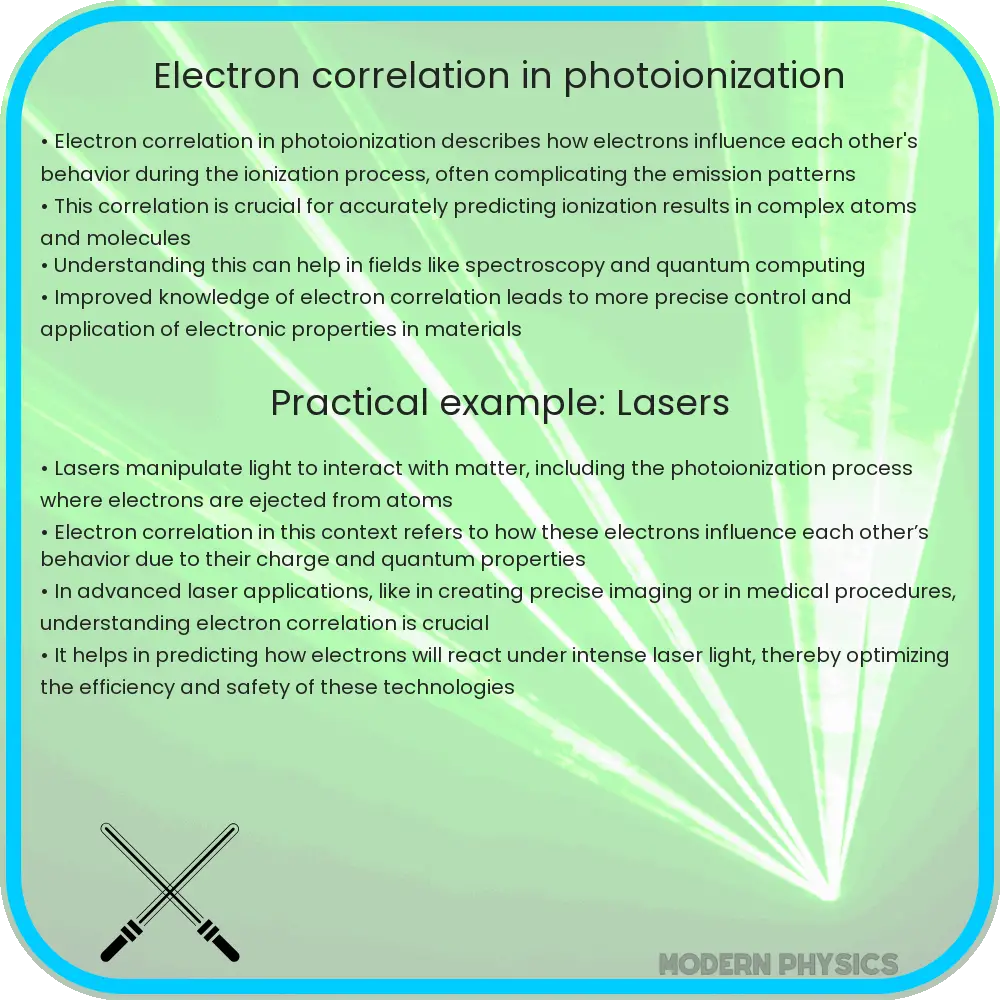
Understanding Electron Correlation and Photoionization Basics
Electron correlation and photoionization are fundamental concepts in the field of quantum mechanics, particularly influencing the study of atomic and molecular systems. This article aims to clarify these complex phenomena in a comprehensible manner, helping you grasp their significance and applications.
What is Electron Correlation?
Electron correlation refers to the interactions between electrons in an atom or molecule which are not accounted for by the Hartree-Fock approximation, a method used to estimate the structure and behavior of such particles. In reality, electrons are indistinguishable and interact electromagnetically. This interaction leads to the need for accounting electron correlation to accurately describe electronic systems.
In simpler terms, electron correlation acknowledges that the movement of one electron in an atom or molecule affects the movement of all other electrons. This is often visualized as “avoidance behavior”, where electrons tend to avoid each other due to their like charges, leading to a distribution in space that minimizes their repulsion. The necessity of including electron correlation in quantum mechanical calculations allows for more precise predictions of properties such as bond energy, electron affinity, and magnetic and optical properties.
Basics of Photoionization
Photoionization is the process by which an atom or molecule absorbs light (photons) and releases one or more electrons, becoming ionized. This process is crucial for studying electronic structures and dynamics in physics and chemistry, specifically through techniques like photoelectron spectroscopy.
The photoionization process can be described by the basic equation:
\[h \nu = E_{\text{kin}} + E_{\text{ion}}\]
Where:
- \(h\) is Planck’s constant,
- \(\nu\) is the frequency of the incident photon,
- \(E_{\text{kin}}\) is the kinetic energy of the ejected electron, and
- \(E_{\text{ion}}\) is the ionization energy of the atom or molecule.
The energy of the photon must be greater than or equal to the ionization energy for photoionization to occur. This concept is pivotal in techniques such as mass spectrometry and atmospheric sciences, where understanding the ionization of various elements and compounds is crucial.
Interplay Between Electron Correlation and Photoionization
When studying the photoionization process, considering electron correlation is indispensable. Electron correlation can significantly affect the ionization energy and the kinetic energy of ejected electrons. Inaccuracies in considering these interactions can lead to significant discrepancies in experimental and theoretical results.
Understanding the depth of electron correlation in photoionized systems helps in refining the interpretation of spectroscopic data and enhancing the accuracy of quantum mechanical models in predicting physical properties of matter. Researchers and scientists utilize advanced computational methods and experiments to quantify and integrate these interactions in their assessments.
Applications of Electron Correlation and Photoionization
Both electron correlation and photoionization are pivotal in various scientific and technological fields. Photoelectron spectroscopy, for instance, exploits photoionization to measure the energy levels and binding energies in an atom or molecule. This technique is invaluable in materials science, chemistry, and condensed matter physics, providing insights into surface compositions and chemical bonding.
On a larger scale, the concept of electron correlation plays a crucial role in the development of superconductors and materials for electronic devices. Accurately accounting for electron interactions assists scientists in designing materials with desired electronic properties, which are fundamental for the advancement of technology in industries like semiconductors and nanotechnology.
In environmental science, photoionization detectors are employed to identify and quantify volatile organic compounds in the atmosphere, contributing significantly to air quality monitoring and pollution control strategies.
Challenges and Future Perspectives
Despite significant advancements, the precise computation of electron correlation and control of photoionization processes remain challenging. The computational cost associated with accurately modeling electron correlation is high, and simplifications often have to be made. Additionally, the experimental setups required to study photoionization can be complex and sensitive to external conditions.
Looking forward, the development of better computational models and more efficient algorithms are key areas of research. These advances will potentially minimize the limitations currently faced in the calculations and enhance the accuracy of predictions. Moreover, improvements in experimental techniques will continue to provide deeper insights into the interplay of photon-matter interactions.
Conclusion
Understanding electron correlation and photoionization provides a framework for examining many processes in physics, chemistry, and engineering. Knowing how electrons interact within atoms and how they respond to external photon beams allows scientists and engineers to manipulate matter on the molecular level, paving the way for innovations in materials science, electronics, and environmental technology. Despite the complexities and challenges involved, the continued exploration in these areas holds the promise of significant technological advancements and increased theoretical understanding in the future. As computational power grows and experimental techniques refine, the potential applications and implications of mastering these atomic and molecular interactions seem boundless.