
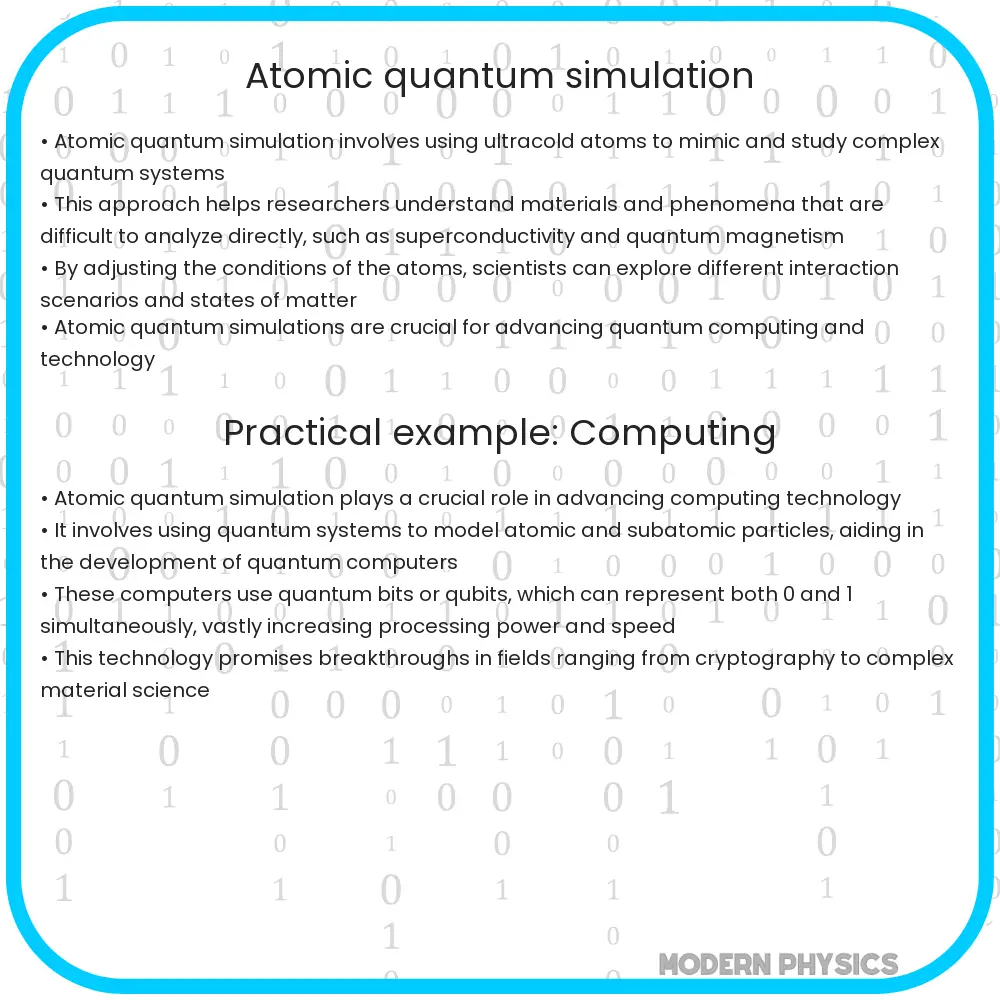
Atomic quantum simulation uses controlled quantum systems to mimic complex interactions, enabling the study of phenomena like superconductivity and magnetism at the atomic level.
Understanding Atomic Quantum Simulation
Atomic quantum simulation is a cutting-edge field in physics that involves using isolated and controlled quantum systems to simulate complex interactions that are otherwise difficult to study using classical computational methods. This field leverages the principles of quantum mechanics to explore and predict the behavior of matter at an atomic scale under various conditions.
Basics of Atomic Quantum Simulation
At its core, atomic quantum simulation uses atoms or ions that are manipulated using lasers and electromagnetic fields in a controlled environment, typically at ultra-cold temperatures. These atoms or ions act as ‘quantum simulators’ because they mimic other quantum systems, allowing physicists to study phenomena such as superconductivity, magnetism, and quantum phase transitions in a controlled setting.
The basic idea is grounded in the concept of quantum superposition and entanglement, which are the central pillars of quantum mechanics. Quantum superposition allows particles to be in multiple states at the same time, enabling complex simulations. Entanglement links the properties of particles so that the state of one (no matter how far apart) is dependent on the state of another. Together, these properties allow quantum simulators to model systems exponentially more complex than those representable on traditional computers.
Uses of Atomic Quantum Simulations
Atomic quantum simulations have wide-ranging applications in various fields, including:
- Material Science: Understanding and predicting properties of new materials at the quantum level can lead to the development of more efficient and powerful semiconductors, superconductors, and magnetic materials.
- Chemistry: By simulating chemical reactions at the quantum level, researchers can discover new chemical processes and catalysts, potentially revolutionizing industries like energy, pharmaceuticals, and materials engineering.
- High-Energy Physics: Quantum simulators offer insights into particle interactions under extreme conditions similar to those found in high-energy colliders, possibly presenting new particles and fundamental forces.
The technique is not just limited to theoretical applications; practical implementations of quantum simulations are being developed to study complex biological systems, optimize algorithms in cryptography, and even in the emerging field of quantum computing itself. By simulating quantum phenomena, scientists are better equipped to design quantum computers that can solve problems infeasible for classical computers.
One of the most prominent uses of atomic quantum simulation today involves the exploration of high-temperature superconductivity. By manipulating and observing the quantum states of atoms in simulated environments, scientists hope to uncover the mechanisms that drive superconductivity at temperatures much higher than previously deemed possible. This could have profound implications for everything from power grids to transportation systems.
Challenges in Atomic Quantum Simulation
Despite its vast potential, atomic quantum simulation comes with its own set of challenges. Firstly, maintaining the stability of quantum states in the presence of external disturbances, known as ‘decoherence,’ is a major issue. As these quantum states are incredibly sensitive, even minor fluctuations in temperature or electromagnetic interference can disrupt simulations. Engineers and physicists are continuously devising methods to isolate and shield these experiments from environmental factors.
Another significant challenge is scalability and complexity. Scaling up quantum simulations to tackle larger and more complex systems requires intense computational resources and highly sophisticated control of numerous quantum bits (qubits). Currently, managing a large number of qubits with high fidelity is one of the most critical barriers to advancing this technology.
Future Prospects of Atomic Quantum Simulation
The development of atomic quantum simulation holds great promise for future breakthroughs in multiple disciplines. As researchers overcome the challenges of decoherence and scalability, we may begin to see more practical applications that could transform entire industries. For example, the potential to discover new materials with exotic properties might revolutionize the field of electronics and energy storage. Moreover, ongoing progress in quantum computing could dramatically enhance the complexity and types of simulations possible, opening up further exploratory avenues in other branches of physics and chemistry.
Furthermore, collaborations between theoretical physicists, experimentalists, and engineers are fostering interdisciplinary approaches, which enrich the field and accelerate the innovation of quantum technologies. Such cooperative efforts are essential in turning theoretical knowledge into practical solutions that can benefit society at large.
Conclusion
In summary, atomic quantum simulation represents a monumental leap in our ability to model and understand the quantum realm. With its ability to manipulate and study quantum phenomena in ways that classical computing cannot, it offers a new lens through which we can explore and harness the intricate properties of the universe. As technology progresses and we overcome the existing technical challenges, the future applications of atomic quantum simulations are bound to expand, potentially leading to groundbreaking developments in material science, medicine, computing, and beyond. The ongoing refinement of these tools will undoubtedly unlock new scientific territories, previously thought to be within the realm of theoretical speculation.