
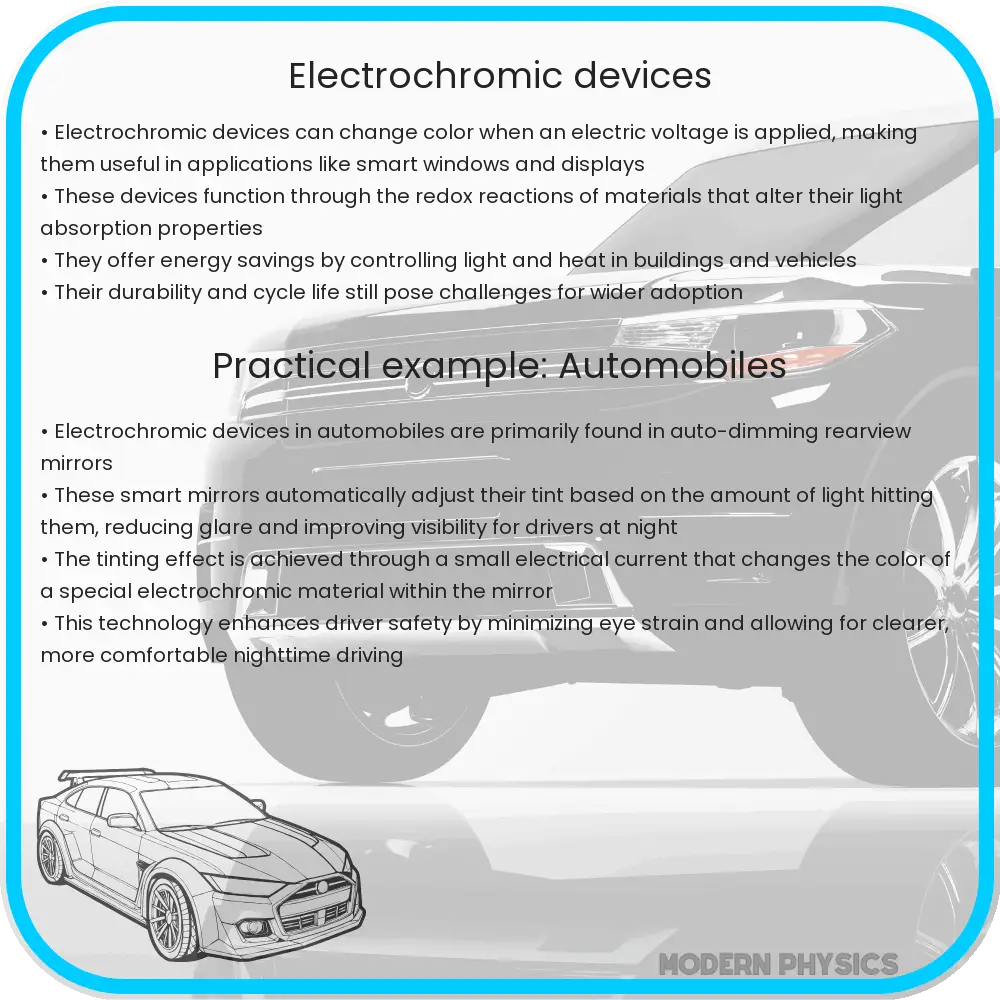
Electrochromic devices are materials that adjust color or opacity under applied electrical voltage, utilized in smart windows, displays, and more.
Understanding Electrochromic Devices: Principles and Efficiency
Electrochromic devices (ECDs) are a fascinating category of materials and components that change color or opacity when an electrical voltage is applied to them. These changes are reversible, making ECDs incredibly useful in a variety of applications. The functionality of electrochromic devices hinges on the electrochemistry that enables the reversible change in the optical properties of materials.
How Electrochromic Devices Work
The basic operation of electrochromic devices involves the movement of ions and electrons through a conducting layer when a voltage is applied. This process alters the optical properties of electrochromic materials. Typically, an ECD consists of five layers: two transparent conductors, two electrode layers, and an ion conductor layer (also known as an electrolyte) in between the electrodes.
When a voltage is applied across the electrodes, ions such as H+ (protons), Li+, or Na+ are driven into the electrochromic layer, reducing or oxidizing the material. This ionic intercalation changes the material’s ability to absorb or reflect light, thereby changing its color or opacity. Removing the voltage reverses this ion movement, returning the material to its original state.
Energy Efficiency of Electrochromic Devices
One of the significant advantages of electrochromic devices is their energy efficiency. Unlike technologies that require continuous power input to maintain visibility or opacity, ECDs need energy only during the switching process. Once the color change is effected, no further energy is required to maintain the new state. This “memory effect” contributes to the overall energy efficiency of electrochromic devices in applications like smart windows, which can significantly reduce heating and cooling costs.
Innovation in Electrochromic Technology
Recent innovations in electrochromic technology have focused on improving the durability, switching speed, and coloration efficiency. Advances in materials science, such as the development of novel nanostructured materials, have led to more rapid color changes and enhanced cycle life, meaning that devices can switch thousands or even millions of times without a loss in performance.
Emerging technologies also explore the integration of electrochromic devices with other functionalities, such as photovoltaic cells to create self-powering systems, or integration into flexible substrates for use in wearable technology.
Applications of Electrochromic Devices
The versatility of electrochromic technology allows for its use in a wide range of applications. Perhaps the most well-known application is in ‘smart windows’ for buildings and vehicles. Here, electrochromic glass can control the amount of heat and light passing through, effectively helping in energy conservation while providing comfort to the occupants. Other applications include:
- Adjustable rear-view mirrors in automobiles that can change reflectance to prevent glare from headlights at night.
- Information displays that use electrochromic materials to show or hide information on demand.
- Large-scale displays where conventional electronic displays are not practical due to size or energy consumption constraints.
Recent developments extend even to consumer electronics, where ECDs are used to create privacy screens on demand or dynamically adjustable sunglasses that can change tint with changes in sunlight intensity.
Challenges in Electrochromic Device Implementation
Despite numerous advantages and innovations, electrochromic devices face several challenges. One of the primary issues is the long-term stability and reliability of the materials used. Frequent switching can lead to degradation of the electrochromic materials, which impacts their performance and lifespan. Additionally, manufacturing costs and the complexity of integrating these devices into existing systems pose significant challenges that must be addressed to increase their market adoption.
Another technical hurdle is the optimization of the materials and device architectures to achieve faster switching speeds without sacrificing the optical quality or energy efficiency. Research is ongoing to develop materials that can provide quicker response times and higher durability under varying environmental conditions.
Environmental Impact and Sustainability
Electrochromic devices not only offer benefits in terms of energy conservation but also have a relatively lower environmental impact compared to other electronic devices. The materials used in ECDs are typically less harmful, and the production processes can be designed to be more environmentally friendly. However, the full environmental impact depends significantly on the lifecycle management of these devices, including production, usage, and disposal stages.
Efforts are being directed towards making ECDs more recyclable and less dependent on rare or toxic materials. This approach aligns with global sustainability goals and helps mitigate the environmental footprint of modern electronic devices and technologies.
Conclusion
Electrochromic devices represent a dynamic intersection of materials science, chemistry, and electronic engineering. With their ability to significantly alter their optical properties in response to electrical input, ECDs offer promising applications in energy-saving smart windows, glare-reducing mirrors, and privacy-enhancing technologies. While challenges remain in terms of material durability, manufacturing costs, and integration complexities, ongoing research and innovation continue to broaden the potential applications and efficiency of these versatile devices.
The future of electrochromic technology looks bright as it moves towards more sustainable, faster, and robust solutions that could revolutionize how we manage light and energy in our environments. As developments continue and more applications become commercially viable, electrochromic devices are set to play a crucial role in our move towards more energy-efficient and environmentally friendly technology solutions.