
Photocatalysts are materials that drive chemical reactions using light, important for environmental cleanup and energy production.
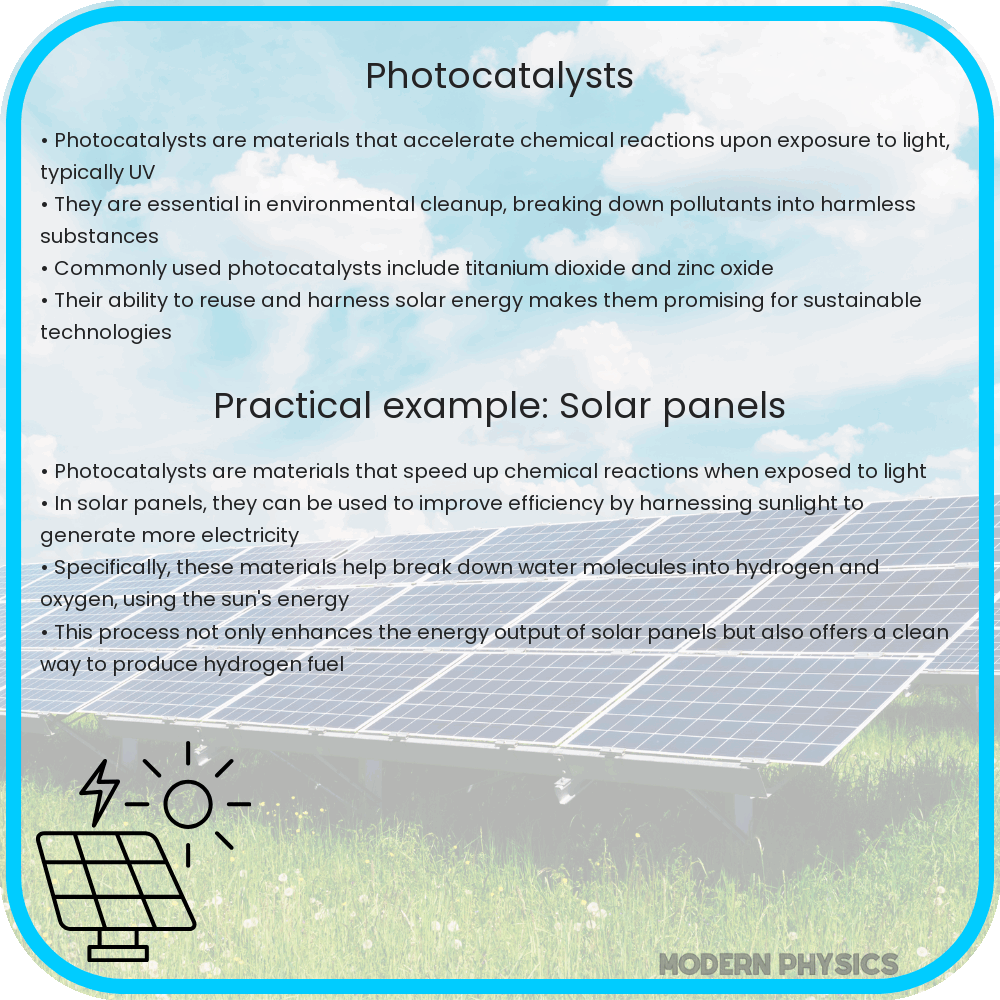
An Introduction to Photocatalysts
Photocatalysts are materials that use light energy to drive chemical reactions. They have surged in importance for their applications in cleaning pollutants, splitting water to generate hydrogen fuel, and even in the reduction of carbon dioxide. Today, let’s delve into what photocatalysts are, how they work, and why they are so valuable in increasing reaction efficiency and purity in various processes.
Understanding Photocatalysis
The process of photocatalysis involves the acceleration of a photoreaction in the presence of a catalyst. In simpler terms, when light is illuminated onto a catalyst, it excites an electron from a lower energy state to a higher one, creating what is known as an electron-hole pair. This state of excitement allows the catalyst to induce a chemical transformation.
Central to this process is the photocatalyst, which remains unchanged throughout the reaction. Often, these catalysts are semiconductor materials like titanium dioxide (TiO2), which is popular due to its stability, non-toxicity, and strong oxidative power. Upon activation by light, usually UV light, these semiconductors can generate free radicals capable of breaking down organic pollutants in air and water.
The Role of Light
Light plays an essential role in photocatalysis, acting as the energy source that drives the reactions. The energy from light must be sufficient to overcome the band gap of the semiconductor—that is the energy difference between the valence band (where electrons are present) and the conduction band (where electrons can move freely). When light with energy equal to or greater than the band gap hits the photocatalyst, it excites electrons to the conduction band, facilitating chemical reactions.
- UV Light: Most common photocatalysts require UV light to initiate reactions because of the high energy associated with UV rays.
- Visible Light: Developing photocatalysts that operate under visible light is a significant area of research, aiming to utilize the abundant energy of the sun more efficiently.
The Importance of Photocatalysts in Modern Technology
Photocatalysts hold the potential to address some of the urgent environmental challenges faced today. Their ability to purify water, decontaminate air, and facilitate the production of clean energy sources makes them indispensable in the quest for sustainable technologies. The use of photocatalysts in self-cleaning surfaces and anti-bacterial coatings are additional examples of their diverse applications.
In the context of reaction efficiency and purity, photocatalysis stands out by offering a method to conduct chemical processes at ambient temperatures and pressures, often resulting in fewer byproducts and higher purities. This characteristic is particularly beneficial in industries where the environmental impact and energy efficiency are crucial considerations.
Key Challenges in Photocatalysis
Despite its advantages, photocatalysis is not without its challenges. The efficiency of photocatalysts can be affected by factors such as recombination of the electron-hole pairs, light intensity, and the presence of contaminants that can act as electron traps. Research is continuously underway to design more efficient photocatalytic materials that can overcome these hurdles.
Advancements aim to extend the lifetime of the excited states, broaden the absorption to the visible light spectrum, and enhance the migration of charge carriers to the surface of the catalyst where reactions occur.
Exploring the Future of Photocatalysis
As research progresses, the future of photocatalysis looks promising with potential applications expanding into areas like artificial photosynthesis and the reduction of CO2. This ongoing development not only paves the way for innovative technologies but also supports global sustainability efforts.
Stay tuned as we delve deeper into specific applications and the latest innovations in photocatalysts in the upcoming sections.
Specific Applications of Photocatalysts
Photocatalysts are not just limited to environmental applications; they are also being integrated into various commercial products. One notable example is in self-cleaning windows and paints, where titanium dioxide (TiO2) coated surfaces break down organic dirt when exposed to sunlight, reducing the need for chemical cleaning agents. Another innovative application is in water bottles designed to purify water using sunlight, making clean drinking water more accessible, especially in remote areas.
In the realm of energy, photocatalysts contribute to producing hydrogen, a clean fuel, through the photolysis of water. This process splits water into oxygen and hydrogen gases using sunlight, presenting a renewable way to produce energy without emitting greenhouse gases. Furthermore, advances in photocatalytic technology may soon allow us to process atmospheric carbon dioxide into organic compounds, effectively turning a potent greenhouse gas into useful products such as plastics, fuels, and other chemicals.
Conclusion
Photocatalysts represent a blend of nature’s principles with human ingenuity, providing solutions that support ecological sustainability and technological advancement. By harnessing the power of light, these materials help mitigate pollution, reduce energy use, and offer pathways for the creation of new, clean technologies. While challenges in efficiency and technology integration persist, the ongoing research and development in photocatalysis hold promise for a future where clean air, water, and energy are more accessible.
The exploration into the potentials of photocatalysis is just beginning, and each discovery brings us a step closer to a more sustainable planet. As professionals continue to develop and refine this technology, the possibilities for its application are vast and impactful. Through understanding and supporting the advancement of photocatalysts, we can all contribute to a healthier and cleaner world. Keep an eye out for future items in this series that will help you further understand how these materials are set to change our world.