
Explore the fundamentals of Dove Prisms, focusing on precision, image inversion, and polarization, and their pivotal role in modern optical technologies.
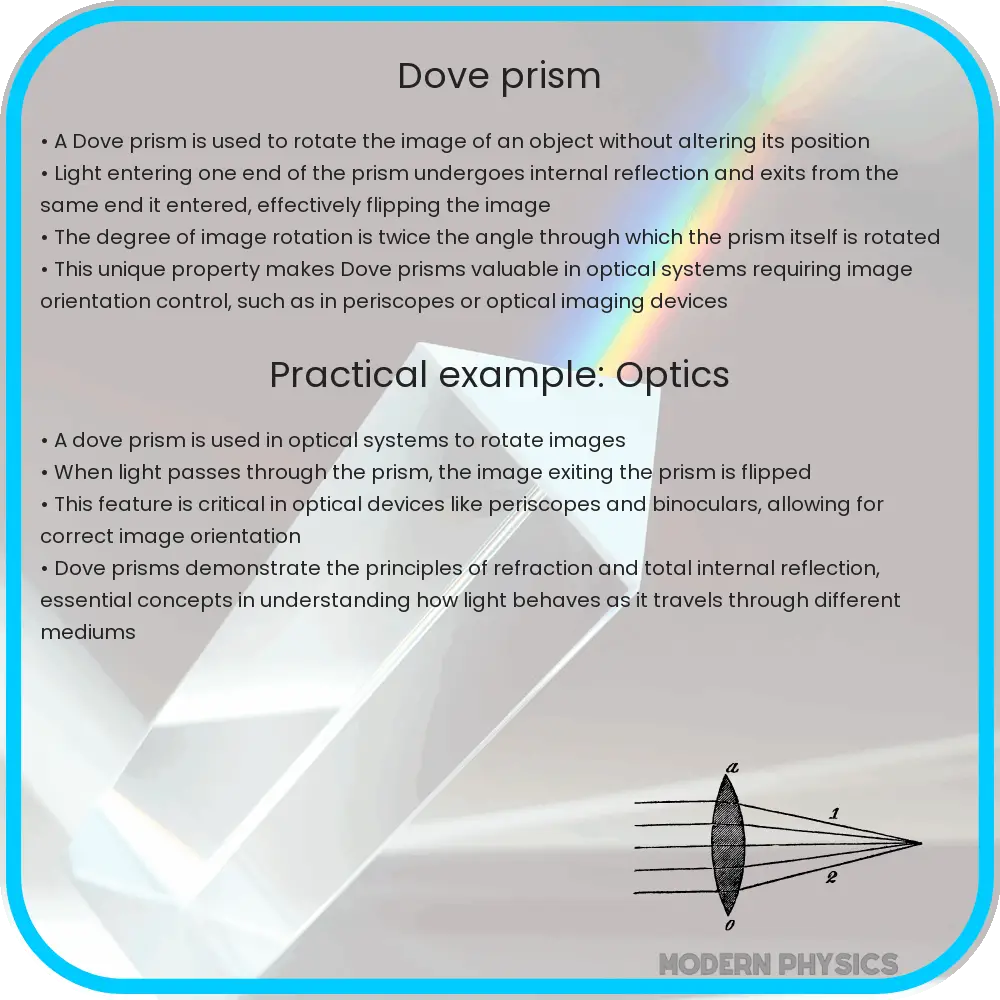
Understanding Dove Prisms: Fundamentals of Precision, Inversion, and Polarization
Dove Prisms, named after their inventor, Heinrich Dove, are a unique type of optical prism that finds extensive applications in various scientific and engineering fields. Characterized by their ability to invert an image and precision in manipulating light, these prisms also play a significant role in experiments involving light polarization. This article delves into the principles behind Dove Prisms, highlighting their functionality and the critical aspects of precision, inversion, and polarization.
Principle and Design
At its core, a Dove Prism is a truncated triangular prism made from high-refractive-index materials. The key feature of this optical device is its ability to invert an image along the axis of the prism when light passes through it. This inversion is a result of the total internal reflection that occurs within the prism, a phenomenon that depends on the angle of incidence and the material’s refractive index.
Precision in Light Manipulation
The precision of Dove Prisms in manipulating light is unparalleled. By adjusting the prism’s orientation, one can control the direction of the image inversion. This precise control over light directionality is crucial in applications such as optical coherence tomography (OCT), where the clarity and orientation of the image are paramount for accurate diagnostics.
Image Inversion Explained
One of the hallmark features of the Dove Prism is its ability to flip an image upside down. This inversion is particularly useful in optical systems where the orientation of the image needs to be corrected or manipulated for analysis or transmission purposes. Unlike other prismatic devices that may also rotate or displace the image, the Dove Prism maintains the integrity of the image’s lateral dimensions while inverting it, ensuring that the image quality is not compromised.
Impact on Polarization
While Dove Prisms primarily affect image orientation, they also influence the polarization state of the transmitted light. When light traverses the prism, its polarization can be altered depending on the material’s properties and the angle of incidence. This effect is beneficial in polarization-sensitive applications, where controlling the light’s polarization state is necessary for enhancing image contrast or conducting specific types of optical analyses.
Applications of Dove Prisms in Modern Optics
The versatility of Dove Prisms extends beyond basic image inversion and polarization control. These prisms are integral components in a variety of optical systems, including but not limited to, precision instrumentation, laser beam steering, and even in quantum computing research where precise manipulation of light properties is essential. Their ability to maintain the integrity of beam alignment while modifying image orientation makes them invaluable in telescopic systems, enhancing astronomical observations and satellite imaging technologies.
Advanced Polarization Techniques
In advanced optical setups, Dove Prisms can be used to implement sophisticated polarization techniques. By integrating these prisms with polarizers and other optical elements, scientists can create complex light states such as circular or elliptical polarization. These states are crucial in studies of light-matter interaction, optical trapping, and even in the encryption of information in optical communication systems.
Challenges and Considerations
Despite their numerous advantages, the application of Dove Prisms comes with its set of challenges. Precision in manufacturing is paramount; any imperfections in the prism can lead to aberrations that degrade image quality. Furthermore, the material choice is critical to ensure minimal absorption and scattering of light, especially in applications requiring high levels of light throughput and minimal signal loss.
Future Prospects
The future of Dove Prisms looks promising as advancements in optical fabrication techniques continue to improve their precision and versatility. Researchers are exploring novel materials and coatings to enhance the prisms’ performance, particularly in minimizing optical losses and maximizing polarization control. With ongoing developments in optical physics and engineering, Dove Prisms are set to play a pivotal role in the next generation of optical devices and systems.
Conclusion
Dove Prisms stand out as a cornerstone in the realm of optical engineering, offering precise control over image inversion and polarization with a simplicity of design that belies their underlying complexity. Their ability to manipulate light with high precision makes them indispensable in a wide array of applications, from medical imaging to astronomical telescopes. As optical technologies advance, the role of Dove Prisms is expected to expand, driving innovation in fields as diverse as telecommunications, quantum computing, and beyond. Their continued development and integration into optical systems promise to unlock new possibilities in the manipulation and analysis of light, cementing their status as a key tool in the optical engineer’s toolkit.