
Explore the role of rhomboid prisms in bending light with precision, maintaining symmetry in optical devices, and their vast applications in modern optics.
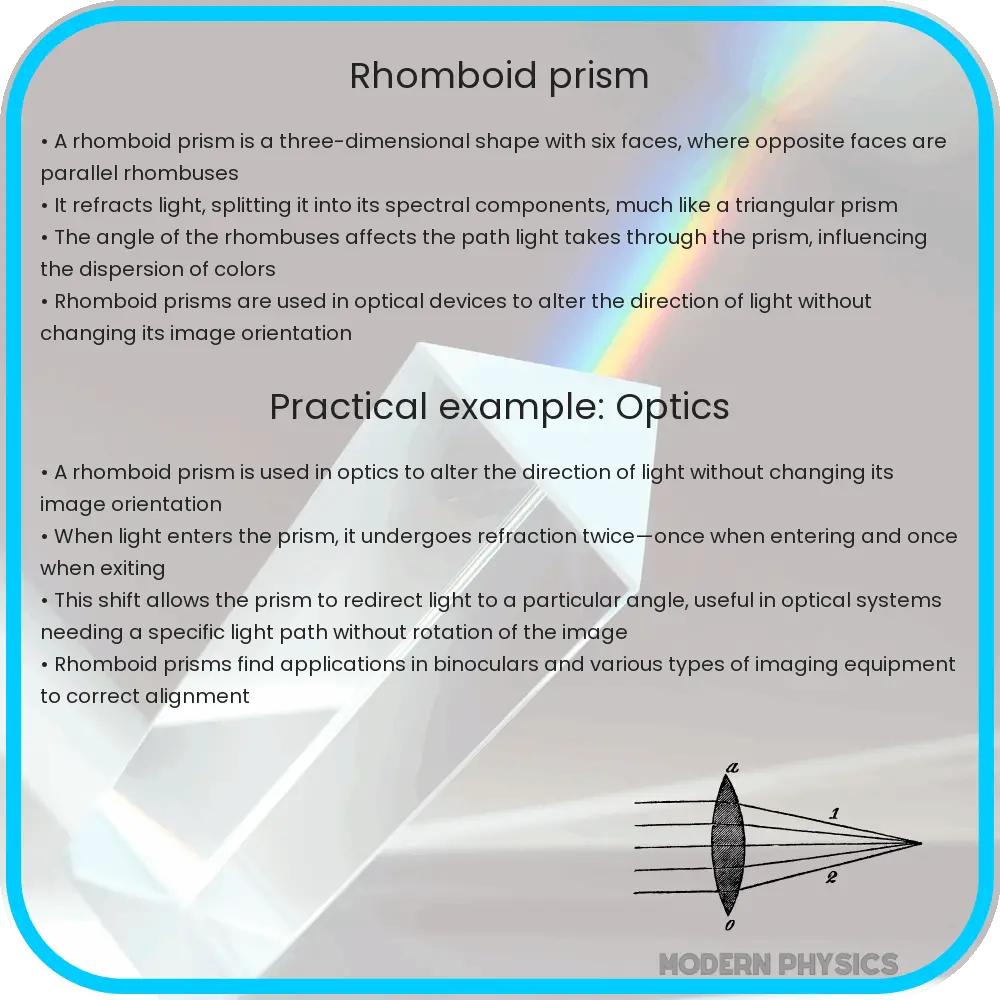
Rhomboid Prism: An Exploration of Light Bending, Precision, and Symmetry
The rhomboid prism stands as a cornerstone in the realm of optical instruments, known for its unique ability to refract light without altering its polarization. This intriguing property makes it an invaluable tool in precision optics, where controlling light direction and maintaining its integrity are paramount. The rhomboid prism’s design and symmetry not only facilitate a broad range of applications but also exemplify the elegance of geometric precision in manipulating light.
Understanding the Rhomboid Prism
A rhomboid prism is characterized by its parallelogram-shaped sides and angled faces, which differ from the more common triangular prisms seen in many optical experiments. When light enters this prism, it undergoes two refractions: once upon entry and again upon exit. This process bends the light path, but due to the symmetry and angles of the faces, the light exits parallel to its original direction. This unique characteristic is pivotal for applications requiring the shift of a light beam’s path without altering its orientation.
Light Bending and Precision in Optical Systems
The precision with which a rhomboid prism bends light is of great significance in optical engineering. This precision is derived from the meticulous angles at which the prism’s faces are cut. The angles determine the extent of light bending and are critical for applications such as laser targeting, optical alignment, and the precise manipulation of light paths in complex optical systems. The symmetry of the rhomboid prism ensures that light remains undistorted, a feature essential for high-quality imaging and precise optical measurements.
Applications in Modern Optics
Rhomboid prisms are extensively utilized in a variety of modern optical devices. From periscopes and binoculars to sophisticated scientific instruments like spectrometers and interferometers, the ability to precisely direct light beams without compromising their integrity is crucial. In advanced optical systems, rhomboid prisms play a key role in beam steering, alignment, and even in the correction of image orientation.
The application of rhomboid prisms extends beyond mere light direction. Their usage in polarization-sensitive systems showcases their versatility. Unlike prisms that can alter or degrade the polarization state of light, rhomboid prisms maintain the polarization integrity, making them indispensable in polarimetry and other polarization-dependent optical technologies.
Enhancing Optical Performance with Precision and Symmetry
The precise engineering behind the rhomboid prism’s design is a testament to the importance of symmetry and precision in optical performance. The exact angles and parallel sides are not just a matter of geometric satisfaction but are crucial for achieving the desired light path adjustments with minimal loss of quality. This level of precision ensures that optical devices can deliver clearer, more accurate results, whether it’s in the sharpness of an image or the precision of a laser beam.
Challenges and Considerations in Rhomboid Prism Design
Despite their numerous advantages, designing and implementing rhomboid prisms come with its own set of challenges. The production of these prisms demands extremely high precision in cutting and aligning the glass or crystal material. Any slight deviation from the intended angles can significantly affect the prism’s ability to redirect light correctly. Additionally, the material choice plays a crucial role in determining the prism’s efficiency, especially in applications requiring a specific light wavelength range.
The Future of Rhomboid Prisms in Optical Technologies
The potential for rhomboid prisms in advancing optical technology is vast. As research progresses, we may see innovations in materials and manufacturing processes that enhance the prisms’ performance and versatility. For example, the integration of nanotechnology could lead to smaller, more efficient prisms capable of being incorporated into a wider array of devices, including miniaturized optical sensors and next-generation imaging systems.
Moreover, the ongoing exploration of new optical properties and applications could expand the use of rhomboid prisms beyond traditional realms. Their unique ability to manipulate light while preserving its characteristics could be pivotal in emerging fields like quantum computing and communication, where precise light control is essential.
Conclusion
The rhomboid prism embodies the intricate balance between form and function, illustrating how geometric precision can be harnessed to manipulate light in sophisticated ways. Its role in optical technology highlights the importance of precision and symmetry in achieving desired outcomes, from improving image quality to ensuring the accurate direction of laser beams. As optical technology evolves, the rhomboid prism’s unique properties and potential for innovation continue to make it a focal point of research and development. With its ability to bend light without compromising its integrity, the rhomboid prism remains an indispensable tool in the advancement of optical science and technology.