
Explore the Dove Prism’s role in precision image rotation for optical systems, covering its operation, applications, advantages, and customization.
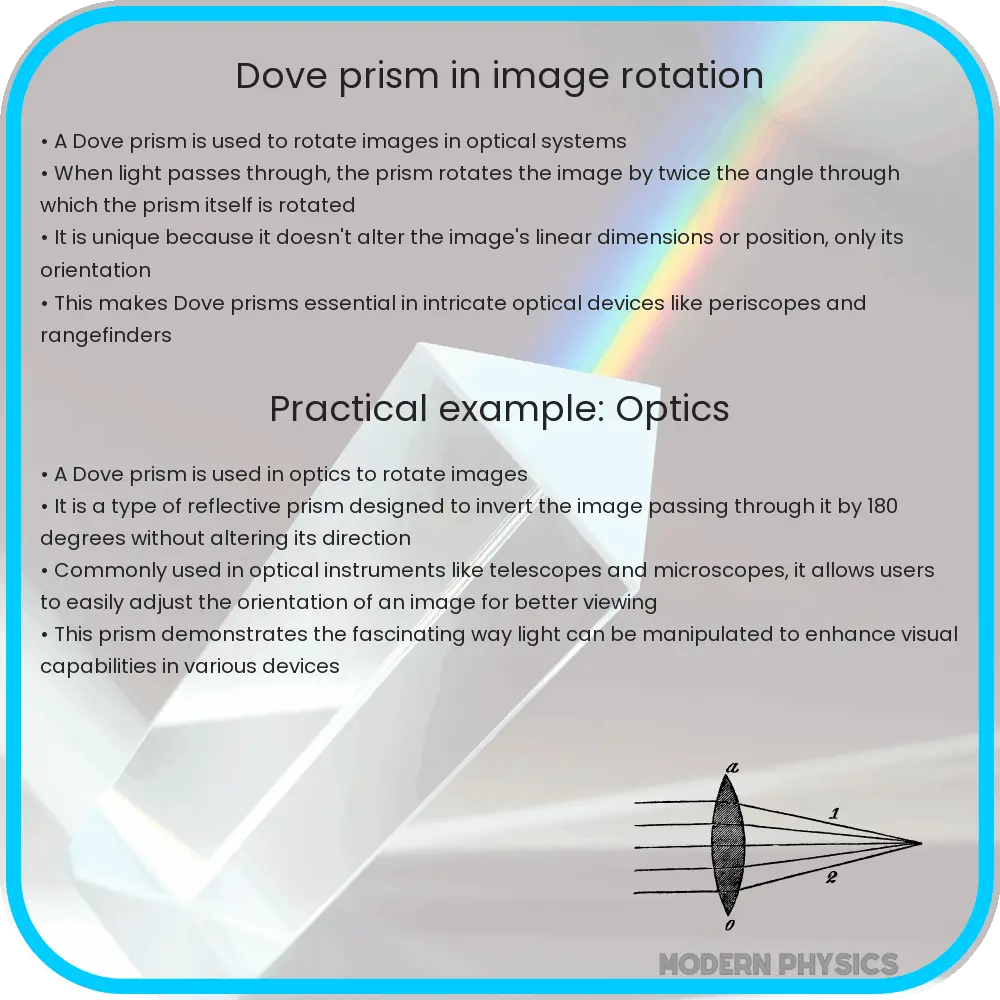
Dove Prism: Revolutionizing Precision Image Rotation in Optics
The Dove Prism stands as a pivotal component in the realm of optical instruments, offering unparalleled precision in image rotation. This unique optical device, named after its inventor Heinrich Wilhelm Dove, is renowned for its ability to invert an image without altering its handedness. Its utility spans across various scientific and industrial applications, making it an indispensable tool in the advancement of optical technologies.
Principle of Operation
The Dove Prism operates on the principle of total internal reflection. Fabricated from a high-refractive-index material, it is shaped like a truncated right-angled triangle. Light entering one of the shorter faces of the prism undergoes reflection inside the prism’s hypotenuse face twice before exiting. This double reflection results in the inversion of the image along the axis perpendicular to the prism’s length, effectively rotating the image by 180 degrees.
Applications in Optical Systems
- Precision Alignment: The Dove Prism is instrumental in systems requiring precise alignment of images, as it allows for the rotation of an image to a very high degree of accuracy without affecting the image’s other properties.
- Telescope Systems: In astronomical telescopes, Dove Prisms are utilized to correct the orientation of celestial images, making observations more intuitive and aligned with celestial maps.
- Optical Interferometry: Their application in interferometric setups, such as in Michelson interferometers, is crucial for adjusting the orientation of interference patterns, thereby enhancing measurement precision.
Advantages of Dove Prism
One of the most compelling advantages of the Dove Prism is its simplicity and effectiveness in rotating images without introducing distortion. This attribute is particularly beneficial in applications where maintaining the integrity of the optical path is critical. Moreover, its design allows for easy integration into existing optical systems, offering a versatile solution for image orientation challenges. The Dove Prism’s ability to work with a wide range of wavelengths further broadens its applicability in various optical devices.
Enhancing Optical Instrumentation with Dove Prisms
The versatility of Dove Prisms extends beyond simple image rotation. They are also pivotal in the development of sophisticated optical instrumentation. For instance, in optical coherence tomography (OCT), Dove Prisms are used to rotate the scanning beam, thereby providing comprehensive cross-sectional images of tissues. This application is particularly important in medical diagnostics, where detailed imagery can aid in early detection of diseases.
Customization and Material Considerations
The performance of Dove Prisms can be tailored through careful selection of materials and coatings. Using materials with high transparency and appropriate refractive indices for the intended wavelength range enhances the prism’s efficiency. Additionally, anti-reflective coatings can be applied to the prism’s surfaces to minimize losses due to reflection, thereby ensuring maximum transmission of light through the prism. This customization enables Dove Prisms to be optimized for specific applications, ranging from laser systems to advanced imaging technologies.
Challenges and Solutions
Despite their advantages, Dove Prisms pose certain challenges, such as sensitivity to alignment and potential chromatic aberration in broadband applications. Precise mounting and alignment mechanisms can mitigate these issues, ensuring that the prism performs optimally within an optical system. Moreover, selecting materials with low dispersion characteristics can help reduce chromatic aberration, maintaining image quality across different wavelengths.
Conclusion
The Dove Prism is a testament to the elegance and simplicity of optical design, offering a unique solution for precision image rotation. Its applications span across a myriad of fields, from enhancing astronomical observations to improving medical imaging techniques. The adaptability of Dove Prisms, combined with their capacity to maintain the integrity of optical paths, makes them an invaluable tool in the advancement of optical science and technology. As optical systems continue to evolve, the Dove Prism will undoubtedly play a pivotal role in shaping the future of optical instrumentation, proving that sometimes the simplest solutions are the most revolutionary.
Is this conversation helpful so far?