
Explore the precision and clarity of Penta Prisms in optics, their design, materials, and wide-ranging applications in photography, surveying, and beyond.
Penta Prism: Enhancing Optical Precision and Clarity
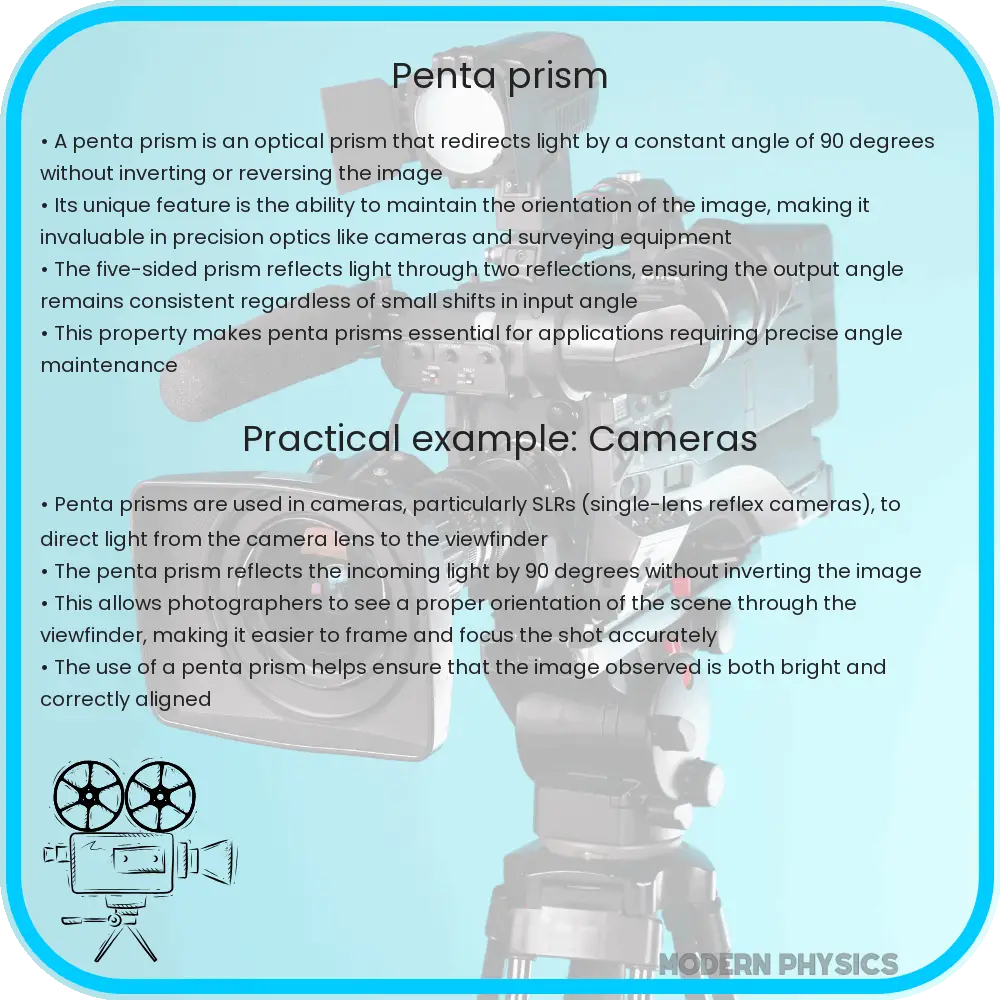
The Penta Prism, a five-sided prism used extensively in optical instruments, stands out for its unique ability to redirect light beams without inverting or reverting the image. This remarkable feature makes it indispensable in devices requiring precise alignment and clarity, such as SLR cameras, surveying instruments, and optical tooling. The design and precision of Penta Prisms are pivotal for achieving high-quality optical performance.
Understanding the Design and Functionality
The essence of a Penta Prism lies in its geometric precision. Shaped from a block of high-quality glass, its two reflective sides are coated with a metallic or dielectric layer, enhancing reflectivity. This design ensures that light entering one face of the prism is reflected twice, emerging from a face adjacent to the entry point. The key is that the light path is deviated by exactly 90 degrees, regardless of the angle of entry, as long as it’s within the acceptance angle of the prism. This characteristic is vital for applications requiring a constant orientation of the output beam.
Material Selection for Peak Performance
Choosing the right material for Penta Prisms is crucial for their performance. Optical glass types, such as BK7 or fused silica, are commonly used for their excellent transparency and low dispersion characteristics. BK7, with its formula SiO2 69%, B2O3 10%, BaO 3%, Na2O 11%, K2O 7%, is favored for applications not demanding the utmost in thermal stability or UV transmission. Fused silica, on the other hand, excels in these areas, making it ideal for more demanding environments. The choice between these materials depends on the application’s specific requirements for optical clarity, thermal stability, and wavelength range.
Accuracy in Fabrication: The Cornerstone of Quality
The manufacturing precision of Penta Prisms directly impacts their effectiveness in optical systems. Advanced fabrication techniques, such as ultra-precision CNC machining and high-precision polishing, are employed to ensure that the angles and surfaces meet stringent specifications. The alignment of the reflective coatings also plays a critical role, requiring meticulous application to achieve uniformity and optimal reflectivity. This level of precision ensures that the prisms can direct light accurately, maintaining the integrity of the optical path and delivering clear, precise images.
Applications Across Industries: From Photography to Precision Engineering
Penta Prisms are pivotal in a wide array of applications, demonstrating their versatility and importance. In photography, they are the heart of single-lens reflex (SLR) cameras, enabling the viewfinder to display an upright, unreversed image directly through the lens. This feature is crucial for photographers requiring real-time composition and framing accuracy. In the realm of surveying and construction, Penta Prisms are integral to theodolites and levels, providing precise angle measurements and alignment, essential for constructing buildings, bridges, and infrastructure with exacting standards.
Beyond these, Penta Prisms find applications in scientific research, where precision and reliability in optical instrumentation are non-negotiable. They are used in spectrometers, laser systems, and optical bench setups, facilitating accurate light path control and measurement. The aerospace and defense sectors also rely on these prisms for optical systems in navigation, targeting, and guidance instruments, where clarity and precision can be matters of critical importance.
Future Trends: Innovations in Penta Prism Technology
As optical technology advances, so too does the development of Penta Prisms. Innovations in materials science are producing even more transparent and durable glasses, enhancing prism performance in challenging conditions. Additionally, advancements in coating technologies promise higher reflectivity and durability, further improving light transmission efficiency and prism longevity. The integration of Penta Prisms with digital and laser technologies opens new avenues for applications, including augmented reality (AR) systems and advanced optical computing devices, heralding a new era of precision and clarity in optical applications.
Conclusion
The Penta Prism embodies a perfect synergy of precision, clarity, and design in the realm of optics. Its unique geometric configuration and the meticulousness in its fabrication ensure that it remains a cornerstone in technologies requiring precise light manipulation. As we look towards the future, the ongoing innovations in Penta Prism technology promise to expand its applications, further cementing its role in advancing optical engineering and technology. Whether in the hands of a photographer, mounted on a surveyor’s theodolite, or integrated into cutting-edge scientific research equipment, the Penta Prism continues to be a key player in translating optical challenges into clear, precise visual solutions.