
Explore the fascinating world of cosmic ray detection and its role in understanding the universe. Learn about techniques, advancements, and astrophysical applications.
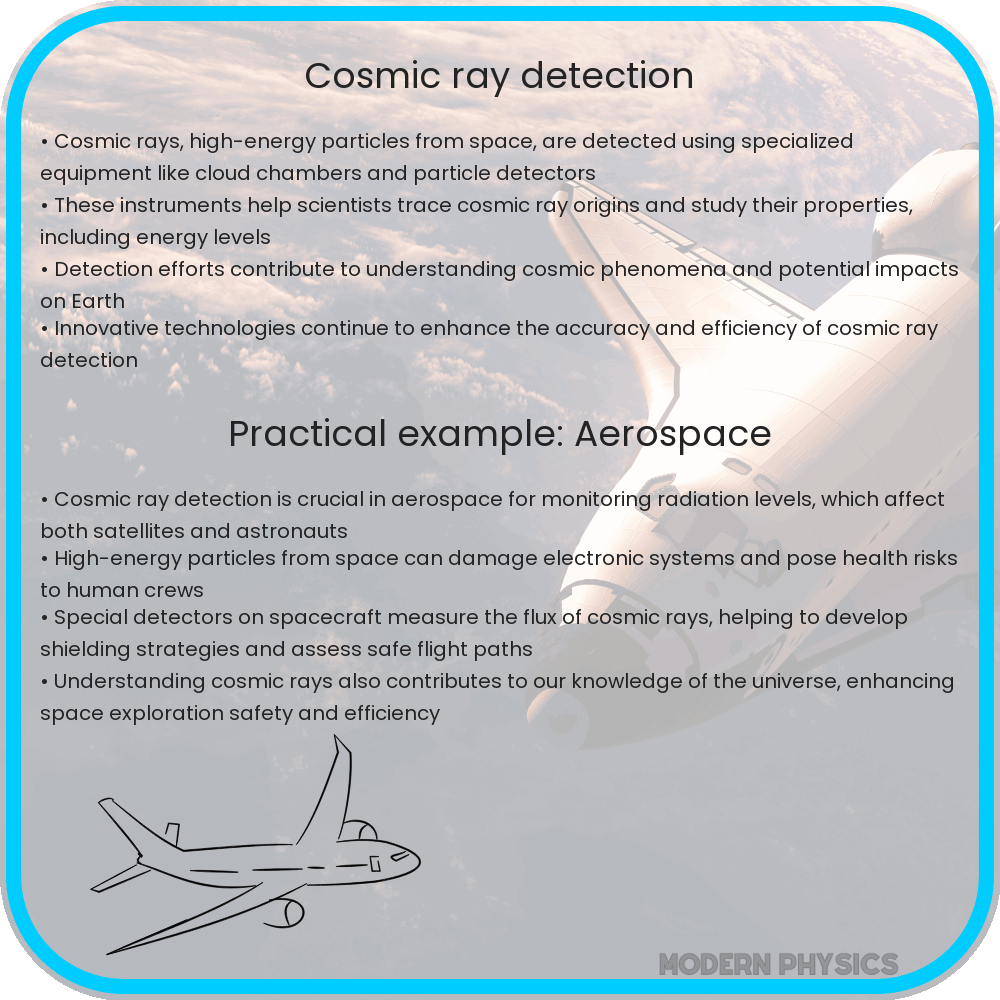
Cosmic Ray Detection: Unlocking the Mysteries of the Universe
Cosmic rays, high-energy particles that travel through space, have captivated scientists and astronomers for decades. Originating from the Sun, distant galaxies, and unknown sources, these particles hold the keys to understanding the universe’s most profound mysteries. This article explores the techniques used in cosmic ray detection, recent advancements, and their significant uses in astrophysics.
Techniques in Cosmic Ray Detection
The detection of cosmic rays involves several sophisticated techniques, each designed to capture different types of particles and energies. The primary methods include:
- Ground-based Detectors: These instruments, such as the extensive air shower arrays, detect secondary particles created when cosmic rays collide with Earth’s atmosphere. Facilities like the Pierre Auger Observatory and Telescope Array use this method to study high-energy cosmic rays.
- Space-based Detectors: Satellites like the Fermi Gamma-ray Space Telescope and the Alpha Magnetic Spectrometer (AMS) are equipped with detectors that capture cosmic rays in space, avoiding atmospheric interference and providing direct measurements of cosmic rays.
- Underground and Underwater Detectors: Laboratories built deep underground or underwater, such as the IceCube Neutrino Observatory, are designed to detect neutrinos, a type of elusive particle that is also a component of cosmic rays. These facilities can detect neutrinos that pass through Earth, providing valuable information about cosmic events.
Advancements in Cosmic Ray Detection
Recent years have seen significant advancements in cosmic ray detection technology, enabling more precise and comprehensive measurements. Innovations include:
- Enhanced detection capabilities, allowing scientists to measure lower-energy cosmic rays with greater accuracy.
- Improved data analysis techniques, utilizing machine learning and artificial intelligence to sift through vast amounts of data for significant findings.
- International collaborations, leading to the construction of large-scale observatories that combine multiple detection methods for comprehensive coverage.
These advancements have not only improved our understanding of cosmic rays but also helped to address fundamental questions in astrophysics, such as the origins of these particles and their role in the universe.
Uses of Cosmic Ray Detection in Astrophysics
Cosmic ray detection has wide-ranging applications in astrophysics and beyond. Here are some of the key uses:
- Studying the Universe’s Composition: Cosmic rays provide valuable information about the composition of the universe. By analyzing the types of particles that reach Earth, scientists can infer the processes happening in distant galaxies and stars.
- Understanding Cosmic Events: Cosmic rays originate from high-energy events like supernovae, gamma-ray bursts, and active galactic nuclei. Studying these particles helps scientists understand the physics behind these cosmic phenomena.
- Investigating Dark Matter: Some cosmic rays might originate from dark matter decay or annihilation. Detecting these can provide indirect evidence of dark matter, shedding light on one of astrophysics’ most significant mysteries.
- Space Weather Forecasting: Cosmic rays affect the Earth’s atmosphere and can interfere with electronics and communication systems, particularly in space. Monitoring cosmic rays helps in predicting and mitigating the effects of space weather on satellites and astronauts.
Conclusion
The field of cosmic ray detection is a crucial area of research in astrophysics, offering insights into the fundamental forces and constituents of the universe. The techniques employed in detecting these high-energy particles—ranging from ground-based to space-based observatories—have evolved significantly, enabling more precise and comprehensive measurements. Recent advancements have bolstered our understanding of cosmic phenomena, contributing to our knowledge of the universe’s composition, the events shaping it, and even the mysterious dark matter.
As technology advances and international collaborations expand, we can expect further significant developments in cosmic ray detection. These advancements will likely open new windows into the cosmos, allowing us to unravel more of the universe’s secrets and furthering our understanding of the fundamental processes governing it. The journey of cosmic ray detection is far from over; it continues to be a pivotal field that bridges theoretical physics with observational astronomy, guiding us closer to the answers of the universe’s most elusive questions.