
Explore the fascinating field of helioseismology and its role in understanding solar dynamics, including wave types and insights into the sun’s interior processes.
Introduction to Helioseismology
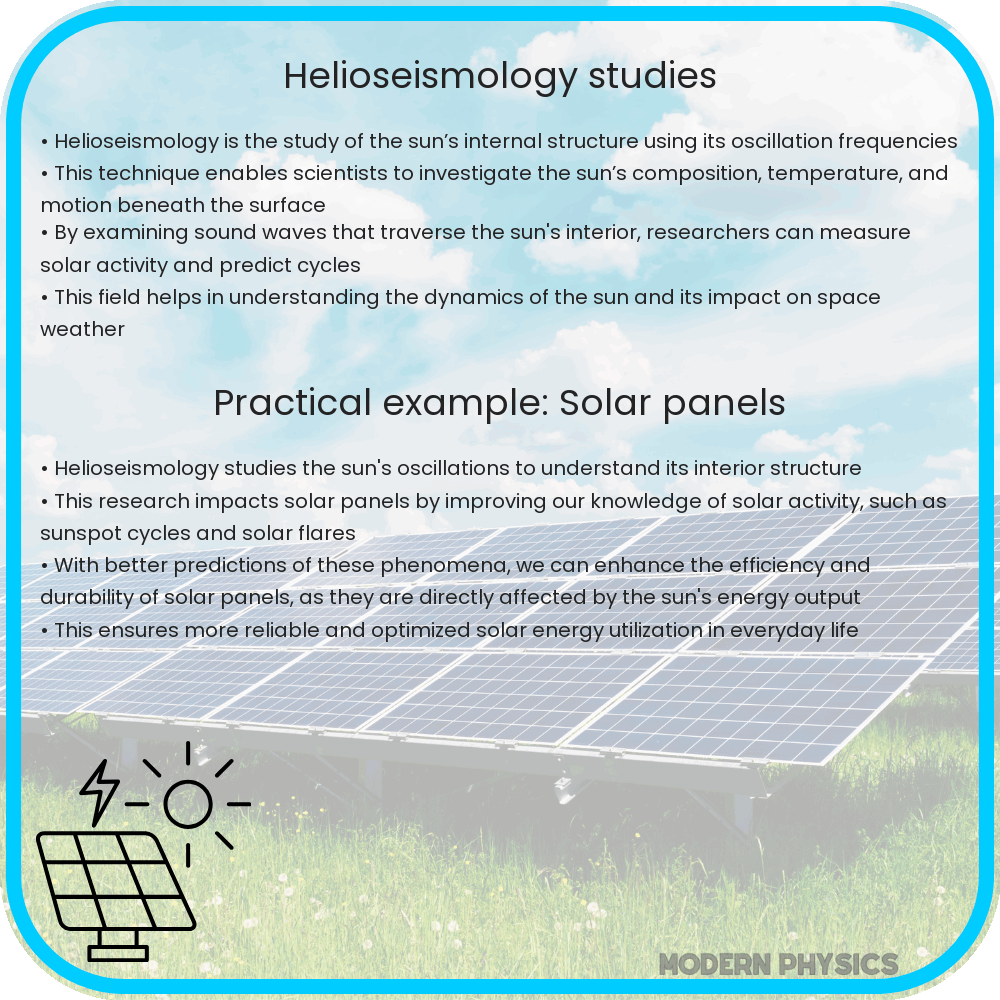
Helioseismology is the study of the interior of the Sun through the interpretation of its oscillation frequencies. This branch of astrophysics allows scientists to probe the Sun’s inner structure and dynamics, much like geologists use seismic waves to study the Earth’s interior. The Sun’s oscillations manifest as sound waves that resonate, providing insights into its internal conditions and processes.
Solar Waves and Dynamics
The Sun is a dynamic and turbulent sphere of plasma, exhibiting various types of waves and oscillations. These solar oscillations are primarily caused by the convective motions occurring beneath the Sun’s surface and the gravitational forces acting within it. The study of these oscillations has revealed that they can be categorized mainly into three types: pressure modes (p-modes), gravity modes (g-modes), and surface gravity waves (f-modes).
- p-modes: These are sound waves that are trapped inside the Sun. They are the most commonly observed and studied, as they travel through the Sun’s interior and are sensitive to changes in temperature, composition, and movement.
- g-modes: These waves are driven by buoyancy and provide valuable information about the Sun’s core. However, g-modes are much harder to detect than p-modes due to their weak surface signatures.
- f-modes: These are surface gravity waves that do not penetrate deeply into the Sun but are useful in studying the Sun’s surface and shallow subsurface layers.
Insights from Helioseismology
Through helioseismology, scientists have gained profound insights into the Sun’s internal workings. Key discoveries include the differential rotation of the Sun, where the equator rotates faster than the poles, and the detailed structure of the solar interior, such as the depth of the convection zone and the temperature gradient. These findings are crucial for understanding solar phenomena like sunspots, solar flares, and the solar cycle.
Moreover, helioseismology has provided evidence supporting the theory of nuclear fusion as the source of the Sun’s energy. By studying sound wave propagation, scientists can infer the temperature and composition at different depths, offering a glimpse into the processes powering the Sun.
Understanding Helioseismology: Unveiling the Sun’s Interior
Helioseismology, a branch of astrophysics, is akin to seismology which studies earthquakes but, instead, focuses on the oscillations and waves within the Sun. This innovative field has revolutionized our understanding of solar dynamics, enabling scientists to probe the internal structure and dynamics of the Sun without direct observation.
The Science Behind Solar Oscillations
At the heart of helioseismology lies the study of pressure waves, or p-modes, which travel throughout the Sun’s interior. These waves are triggered by turbulent convection near the Sun’s surface. As they travel inward, they are refracted and can emerge at different locations, carrying with them information about the internal conditions they encountered.
Waves and Solar Dynamics
- Pressure Waves (P-modes): These are sound waves that travel through the Sun’s interior, providing insights into the density and temperature at various depths.
- Gravity Waves (G-modes): Though more theoretical and difficult to detect, these waves can offer information on the Sun’s core dynamics.
- Surface Gravity Waves (F-modes): These waves are observed on the Sun’s surface and can help understand the solar atmosphere’s dynamics.
The analysis of these waves through helioseismology allows scientists to create detailed models of the Sun’s interior. This includes the core, radiative zone, and the convective zone, each playing a crucial role in solar phenomena like sunspots, solar flares, and the solar cycle.
Insights into Solar Dynamics
Helioseismology has provided profound insights into the internal rotation and magnetic field structures of the Sun. By examining the frequency shifts and time variations of solar oscillations, scientists can infer the Sun’s inner rotational dynamics and the distribution of magnetic fields, which are crucial for understanding solar activities and their effects on space weather.
Conclusion
The study of helioseismology offers a window into the complex internal workings of the Sun, advancing our understanding of stellar processes and the mechanisms driving solar phenomena. Through the analysis of solar waves, this field continues to uncover the mysteries hidden beneath the Sun’s surface, contributing significantly to our knowledge of the star that sustains life on Earth. As technology and methods improve, helioseismology promises to bring even deeper insights into the Sun’s life cycle and its impacts on the solar system.