
Explore the intriguing world of astrobiology, from the origins of life on Earth to the search for extraterrestrial existence and the role of astrochemistry in the cosmos.
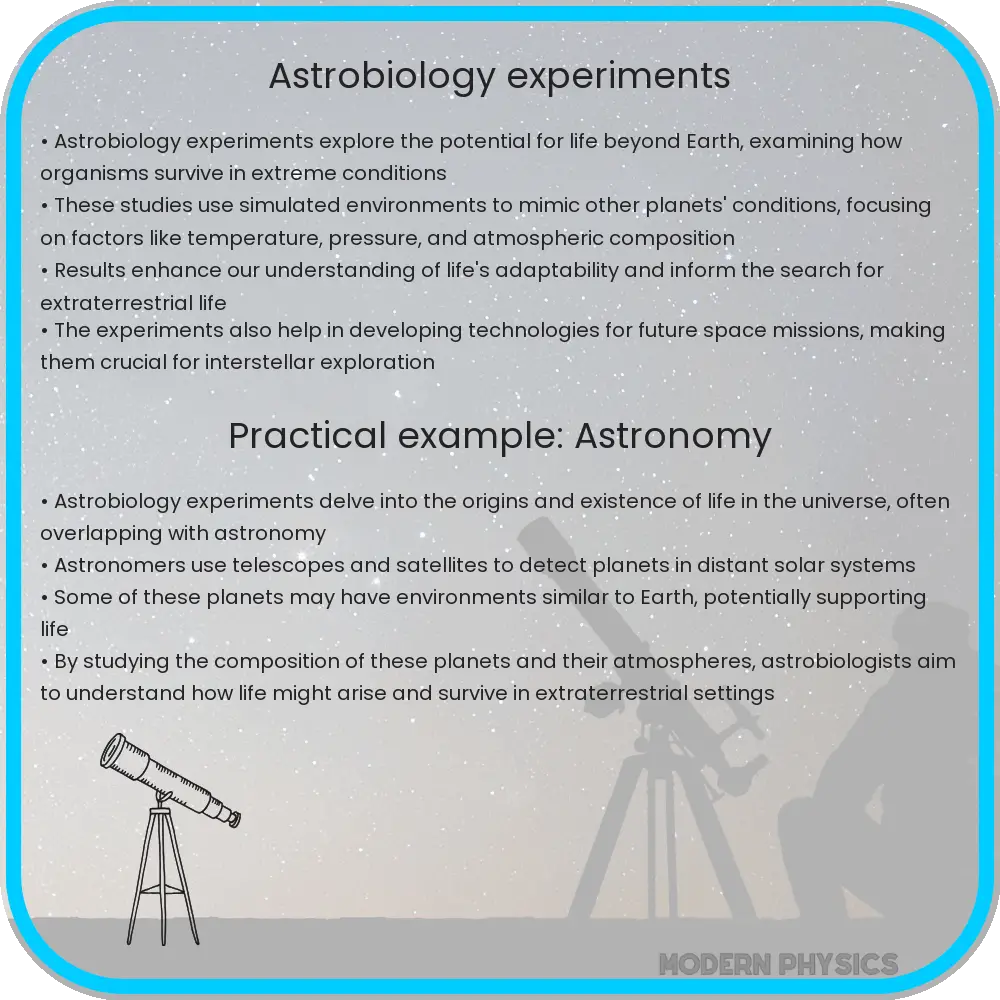
Astrobiology: Unraveling the Mysteries of Life in the Cosmos
Astrobiology, a multidisciplinary field, delves into the origins, evolution, distribution, and future of life in the universe. This fascinating science employs experiments from various domains, including biology, chemistry, geology, and astrophysics, to understand life’s potential beyond Earth. Through these studies, astrobiology aims to answer profound questions about life’s nature and its existence elsewhere in the cosmos.
Experiments in Astrobiology: Understanding Life’s Building Blocks
One of the core areas of astrobiology research involves simulating extraterrestrial environments. Scientists create laboratory conditions that mimic those on other planets and moons. For example, experiments simulating the Martian surface or the icy crusts of Jupiter’s moon Europa, help researchers understand how life might survive in harsh environments. These studies often focus on extremophiles, organisms that thrive in extreme conditions on Earth, as models for potential life forms elsewhere.
Seeking the Origins of Life
Understanding the origins of life on Earth is crucial for identifying life’s universal principles. Experiments in this area often involve recreating the conditions of early Earth in the lab. Scientists mix chemicals thought to have been present on the prebiotic Earth and simulate energy sources such as lightning or ultraviolet light. The famous Miller-Urey experiment, conducted in the 1950s, was a pioneering study in this field, demonstrating that organic compounds essential for life, such as amino acids, could form under prebiotic conditions.
The Role of Astrochemistry
Astrochemistry plays a vital role in astrobiology by studying the chemical compositions, interactions, and processes in space that could lead to the formation of life-sustaining molecules. Through spectroscopy, scientists analyze the light from stars and planets to identify the elements and compounds they contain. Discoveries of complex organic molecules and potential biomarkers in the interstellar medium or on comets and asteroids fuel the possibility that the building blocks of life are not unique to Earth.
This exploration extends beyond our solar system to exoplanets, where the search for biosignatures—indicators of life—continues to evolve with advancing telescope technology and space missions. By comparing the atmospheres of these distant worlds to our own, astrobiologists aim to find signs of life, such as specific gas combinations that could indicate biological activity.
Exploring the Habitable Zones and Exoplanets
Another critical area of astrobiology research is the study of habitable zones around stars, where conditions may be right for liquid water to exist—a key ingredient for life as we know it. Astronomers use telescopes and space observatories to detect exoplanets within these zones and assess their potential habitability. By analyzing factors such as size, composition, and atmospheric conditions, scientists can prioritize these worlds for further study in the quest to find extraterrestrial life.
Future Missions and Technologies
The future of astrobiology is tied to the development of new technologies and space missions. Next-generation telescopes, both ground-based and in space, will provide deeper insights into the cosmos, allowing for more detailed observations of distant planets and their atmospheres. Additionally, upcoming missions to Mars, Europa, and Enceladus aim to search directly for signs of life, collecting samples that could reveal the presence of living organisms or fossilized life forms.
The Interdisciplinary Nature of Astrobiology
Astrobiology’s strength lies in its interdisciplinary approach, combining insights from various scientific fields to build a comprehensive understanding of life’s potential in the universe. By integrating data from astronomy, geology, biology, and chemistry, astrobiologists can construct more accurate models of habitable environments and the potential for life beyond Earth. This collaborative effort not only advances our knowledge of the cosmos but also deepens our understanding of life’s resilience and adaptability.
Conclusion
The quest to understand life in the universe is one of humanity’s most profound challenges. Astrobiology, through its innovative experiments and interdisciplinary research, continues to uncover the secrets of life’s origins, evolution, and distribution in the cosmos. As we stand on the brink of new discoveries, the field of astrobiology inspires us to ponder our place in the universe and to continue our search for answers among the stars. The future of this exciting field promises to not only expand our knowledge of biology and astronomy but also to possibly redefine life as we know it.