
Explore the mysteries of cosmic rays with our in-depth article on spectrometry, covering analysis, origins, applications, and the latest advancements.
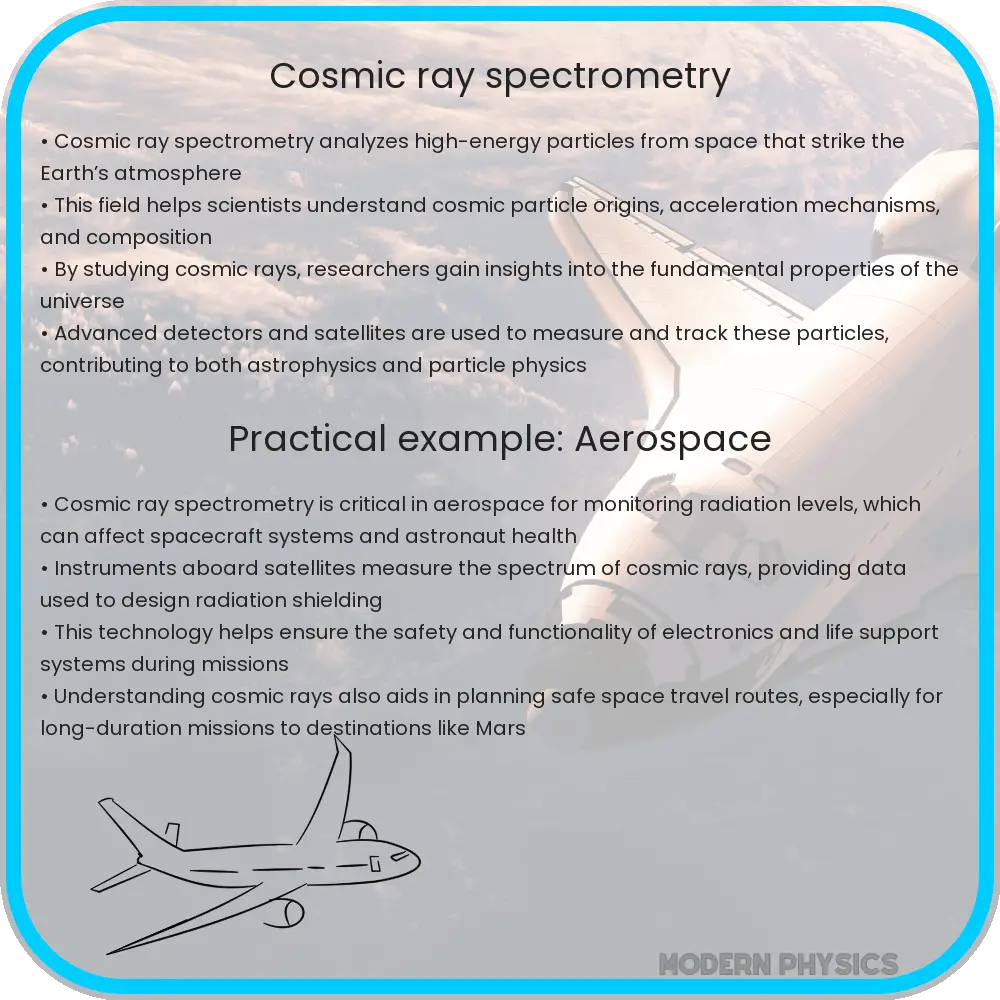
Cosmic Ray Spectrometry: Unveiling the Mysteries of the Universe
Cosmic ray spectrometry, a pivotal tool in astrophysics, is employed to study and analyze cosmic rays – high-energy particles originating beyond the Earth’s atmosphere. This field intertwines fundamental physics with astrophysical phenomena, offering insights into the composition, origin, and energy distribution of cosmic rays, which predominantly consist of protons, helium nuclei (alpha particles), and a smaller fraction of heavier nuclei and electrons.
Analysis of Cosmic Rays
The core of cosmic ray spectrometry lies in detecting and analyzing the energy and mass of these particles. Instruments such as ground-based telescopes, balloon-borne detectors, and satellite sensors are used to capture cosmic rays. These detectors measure various properties, including the particles’ energy, charge, and mass. The data collected facilitates a detailed spectrum analysis, helping scientists understand the energy distribution and composition of cosmic rays.
Origins of Cosmic Rays
Understanding the origins of cosmic rays is a central quest in astrophysics. These energetic particles are believed to be produced by a variety of cosmic phenomena. Supernova remnants, pulsars, and active galactic nuclei are among the most cited sources. Through spectrometric analysis, scientists can trace back the cosmic rays’ origins by examining their energy levels and nuclear composition. For instance, cosmic rays with energies up to about 1015 electron volts (eV) are typically thought to originate within our Milky Way galaxy, while those with higher energies are considered to be of extragalactic origin.
Applications of Cosmic Ray Spectrometry
Cosmic ray spectrometry extends beyond astrophysical research, impacting various scientific fields and practical applications. In climate science, the study of cosmic rays contributes to understanding the Earth’s cloud cover and climate change, as the interaction between cosmic rays and the Earth’s atmosphere may influence cloud formation. Additionally, cosmic ray detection is utilized in space exploration to assess radiation hazards for astronauts and electronic equipment. Furthermore, techniques developed in cosmic ray spectrometry have been applied in homeland security for cargo scanning and in material science for non-destructive testing.
Advancements and Challenges in Cosmic Ray Spectrometry
Recent advancements in cosmic ray spectrometry have significantly enhanced our understanding of cosmic radiation. Innovations in detector technology and data analysis methods have led to more precise measurements of cosmic rays at higher energies. For example, the use of Cherenkov radiation detectors has improved the accuracy in determining the direction and energy of incoming cosmic rays. Additionally, collaborations like the Pierre Auger Observatory and the High Energy Stereoscopic System (HESS) have allowed scientists to study cosmic rays with unprecedented detail, contributing to major breakthroughs in astrophysics and particle physics.
Despite these advancements, cosmic ray spectrometry faces several challenges. One of the main difficulties is the accurate measurement of ultra-high-energy cosmic rays, which are extremely rare and possess energies beyond the reach of current detectors. Moreover, interpreting the data requires complex models and simulations of cosmic ray propagation and interaction, which involve numerous uncertainties. Another challenge is the cosmic ray background noise in other astronomical observations, which can obscure signals from distant cosmic phenomena.
Future Prospects and Interdisciplinary Impacts
The future of cosmic ray spectrometry holds promising prospects, with upcoming missions and technological innovations aimed at overcoming existing challenges. Projects like the Cherenkov Telescope Array (CTA) and the continued expansion of the Pierre Auger Observatory are expected to provide deeper insights into cosmic ray origins and properties. Moreover, interdisciplinary collaborations between astrophysicists, particle physicists, and engineers are fostering the development of new detection techniques and analytical methods.
The interdisciplinary nature of cosmic ray spectrometry has led to its application in fields as diverse as archaeology, where it is used in radiocarbon dating, and geology, where muon tomography helps in exploring volcanic activity and geological structures. This cross-disciplinary approach not only enhances our understanding of cosmic rays but also contributes to advancements in other scientific and practical fields.
Conclusion
Cosmic ray spectrometry is a vital tool in unraveling the mysteries of the universe. It bridges the gap between fundamental physics and astrophysical phenomena, offering insights into the origins and composition of cosmic rays. Despite facing significant challenges, advancements in technology and interdisciplinary collaborations continue to push the boundaries of what we know. As we stand on the cusp of new discoveries, cosmic ray spectrometry remains a beacon of exploration, shedding light on the darkest corners of the cosmos and influencing a multitude of scientific disciplines.